RGo Robotics
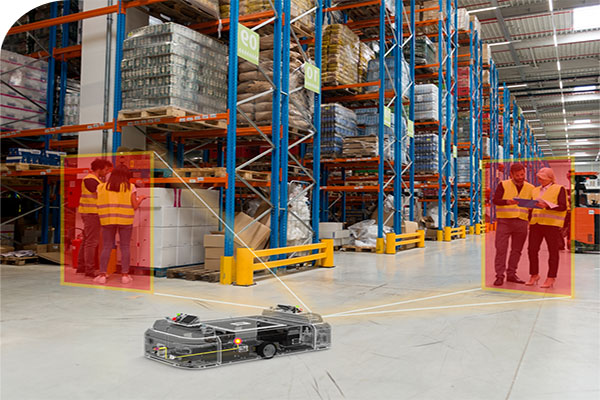
AMRs with RGo Robotics Perception Engine can detect elements to navigate around in warehouses thanks to its powerful AI computer vision.
Get news, papers, media and research delivered. Sign up for our free newsletters.
Stay up-to-date with news and resources you need to do your job. Research industry trends, compare companies and get weekly market intelligence with Robotics 24/7.
RGo Robotics
AMRs with RGo Robotics Perception Engine can detect elements to navigate around in warehouses thanks to its powerful AI computer vision.
Autonomous mobile robots (AMRs) have been heralded as a transformative force poised to supercharge productivity and efficiency across industrial automation. However, as adoption accelerates, there is a growing recognition that many deployments are failing to live up to their full potential.
The dynamic, unpredictable nature of real-world warehouse, distribution and fulfilment environments is exposing critical limitations in traditional localization technologies. Overcoming this gap between an AMR's theoretical capabilities and its practical performance hinges on implementing a new class of robust, adaptable localization solutions.
The constraints of legacy 2D laser scanners have become increasingly apparent, spurring the industrial automation sector's pivot towards vision-based localization driven by the surging performance, cost-effectiveness and ubiquity of camera technology.
However, integrating an industrial-grade 3D vision localization system into an AMR platform is a formidable technical and operational challenge. Companies find themselves grappling with a critical strategic decision - should they marshal resources for an in-house development effort or seek out a specialized partner, such as RGo Robotics.
When paradigm-shifting technologies emerge that are core to their business, industry leaders instinctively gravitate toward building proprietary solutions internally. However, history has repeatedly demonstrated that these in-house initiatives seldom reach full productization.
Juggernauts across diverse sectors such as operating systems, navigation software, design tools and CRM platforms initially invested immense resources to craft their own solutions before ultimately embracing market leaders like Windows, Google Maps, AutoCAD and Salesforce.
Complex software systems like 3D vision localization are particularly prone to organizations underestimating the schedule and budget associated with this project, along with the staff expertise and experience needed to design a solution for scale.
While there are some examples of companies that managed to productize a vision-based localization solution after massive investment, most failed to reach the finish line and often spent four times more than planned.
The allure of open-source and free libraries often tempts teams to quickly build a prototype and then extrapolate the full product development plan based on the time and effort required to reach that initial milestone. However, this approach fails to account for the extensive effort and time needed to elevate a prototype to an industrially hardened, production-grade offering. The resulting miscalculation leads to a significant underestimation of the project’s overall scope.
When organizations start analyzing options for adding next-gen visual perception to their AMR, whether its in-house or partnering with a vendor, some key factors to consider include:
In navigating the complexities of industrial-grade 3D vision localization, collaborating with a seasoned industry veteran offers compelling advantages. By leveraging pre-built components, proven expertise and hard-earned insights from real-world deployments, companies can dramatically accelerate development timelines, mitigate risks and expedite time-to-market
One pioneer leading in this space is RGo Robotics, whose Perception Engine was purpose-built by a team steeped in the nuances of creating reliable, scalable and affordable vision-based perception systems.
The RGo offering has been battle-hardened through deployments across unforgiving environments, distilling learnings from bringing this complex technology to market. Integration is architected for rapid deployment.
At the core of the RGo Perception Engine are proprietary computer vision and AI algorithms engineered to enable continuous learning and human-like consistent accuracy even amidst the most dynamic conditions.
RGo has embraced a multi-modality architecture intelligently fusing inputs from various sensors across different algorithms to enhance robustness through protective redundancy. Notably, the solution has been optimized to deliver high performance on low-cost hardware - ensuring affordability without compromising capabilities.
Through close collaboration with RGo, AMR providers maintain strategic influence over the evolution of their technology stack as well as capitalize on RGo’s continuous enhancement pipeline as the cutting-edge solution for artificial perception.
By leveraging RGo’s solution, AMR providers can quickly bring to market offerings that can perceive, localize and operate robustly in unstructured and complex environments without taking technology and financial risks while focusing on the part of the solution that give them competitive advantage.
As the industry embraces AI-powered perception engines like RGo’s, mobile robots are poised to navigate uncharted territories and achieve much broader adoption.

Ultrasonic sensing enhances robotics perception
Cybernetix Ventures’ event kicks off Robotics Tech Week 2026 slate of events
Preview the manufacturing and warehouse components that will be on the…
Preview the manufacturing and warehouse robots and software that will be on…