By
Bridget McCrea
December 2, 2024
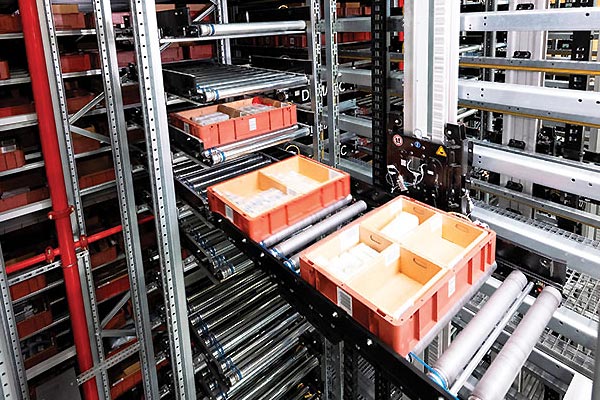
Dematic
New releases in automated storage include performance, reliability and serviceability enhancements like increased payloads and system heights.
Get news, papers, media and research delivered. Sign up for our free newsletters.
Stay up-to-date with news and resources you need to do your job. Research industry trends, compare companies and get weekly market intelligence with Robotics 24/7.
Dematic
New releases in automated storage include performance, reliability and serviceability enhancements like increased payloads and system heights.
Automated storage systems automate the process of storing and retrieving pallets, use rotating shelves to deliver products to an operator to reduce walking around times, and provide high-density storage for everything from small parts to large components. These systems also transport products throughout the warehouse or DC—from receiving to shipping—using conveyor systems, autonomous mobile robots (AMRs) and other equipment.
And, these are just some ways automated storage systems are being deployed in modern warehousing environments, where advancements in technology, labor constraints and changing customer demands are converging to create the right environment for these innovations. The benefits include, but aren’t limited to, improved operational efficiencies, reduced labor costs, higher throughput and fewer errors.
The companies behind the automated storage movement are staying pretty busy these days. According to Ben Yeater, national account manager for Nucor Warehouse Systems, companies are particularly interested in rack-supported automated storage and retrieval systems (AS/RS). With these solutions, robotic cranes are used to store and receive pallets or cases from high-bay storage racks.
The high level of interest in rack-supported AS/RS is often budgetary, according to Yeater, who says the cost savings may exceed 25% (total construction budget) for rack-supported structures that “already have the steel going vertical, so it’s a matter of the structure going another few feet versus two independent systems.”
At Kardex Remstar, Douglas Card, director of system and integrator sales, says he’s seeing a “huge influx” of robotic technologies in the warehousing and fulfillment space, where complex systems are used to achieve greater scalability and enhance throughput. They’re also using devices like Kardex Remstar’s new Wearable Task Assistant (WTA). In lieu of pick-to-light, the smartwatch-esque WTA is worn on the wrist and allows operators to receive picking information, direction to location, order information and more.''

Card says that as robotics availability and reliability both improve, more companies are gravitating toward using them in their warehouses.
“The major advantage with robotic systems is that as you require more performance or capacity, you can simply add more robots,” says Card. “Also, robots are getting more intelligent by the day, with pick-and-place robots now being built with more artificial intelligence [AI] and other advanced features.”
The AI-enabled robots that Card is referring to are also self-learning. Meaning, they use AI to autonomously learn and adapt to new tasks and environments, which helps the robots perform complex operations with minimal human intervention. “The robots maintain a large library of tasks they already know how to handle and can even do end-of-arm tool changes dynamically and on the fly,” he says. “They can do it themselves and actually learn through trial and error.”
Robot uptime has also improved over the last couple of years. For example, now if a single robot goes offline, it may impact overall performance, but it won’t necessarily bring the entire system down. Companies like this level of assurance, which helps make the business case for a warehouse robotics investment.
“As soon as that robot is fixed or replaced, the company is back up and running at 100% capacity,” Card points out. “That’s probably the biggest change that I’ve seen in the last couple of years.”
This year, Card is also seeing an uptick in demand for automated storage equipment from cold storage facilities. Retailers and grocers are leading the charge on this front as they work to shrink their store footprints, get more product into smaller spaces and get those spaces closer to their end consumers.
“Cold space is expensive, and of course companies are looking for ways to optimize that,” says Card. “They’re trying to maximize their available vertical space as much possible, which is especially critical in cold environments.”
The automated storage space seems to understand these challenges and is responding with new solutions specifically targeting retailers, grocers, third-party logistics (3PL) providers and other companies that use cold and frozen storage. For example, Card says AutoStore recently introduced a product that supports three temperature zones in a single machine: ambient, refrigerated and freezer.
Card is also seeing more demand for vertical lift modules (VLMs) from pharmaceutical, grocery and retail sectors, which use freezers that reach up to 15 feet in height. “They want to be able to make use of a more ceiling height and shrink that footprint,” says Card. “Vertical lift modules work really well in that environment.”
Yeater says the racking itself doesn’t really differ as it relates to ambient temperatures or cold storage from a customer standpoint, but many cold storage companies are experiencing high personnel turnover and downtime with lifts.
“The automated storage removes the human element from the equation,” Yeater explains. “This makes the pace at which they can put away and pick both faster and safer.”
For example, employees standing at ground level no longer have to load and/or unload systems that may be anywhere from 50 to 100 feet tall. Also, a piece of machinery that’s operating properly doesn’t have a “bad day,” Yeater points out, which positively impacts throughput and performance in even the harshest of work environments.
If you’ve been to any warehouse automation trade show over the past couple of years, you’ve probably experienced the “AMR boom” firsthand.
Dan Howarth, senior product manager at Dematic, says that boom is being driven by organizations that want flexible and scalable solutions to offset the initial capital expenditures (capex) associated with large, fixed automation systems.
“They desire solution versatility so that they can expand, contract or pivot as their business needs change,” Howarth says.
Companies are also looking to upgrade and/or replace their more “mature” IT products, according to Howarth, who says warehouse automation still largely comprises technologies that have been around for decades, like conveyors, cranes and shuttles. “At a bare minimum,” he adds, “these technologies are being upgraded to include cybersecurity essentials, and data analytics for insights into performance and energy efficiency.”
Dematic has responded to these and other automated storage trends by introducing new products and features for its Multishuttle and its palletizing/depalletizing systems. Howarth says new releases include performance, reliability and serviceability enhancements like increased payloads and system heights.
Going forward, Howarth expects to see automated storage systems used for more than just storage and retrieval in the warehouse environment, where the technology will become sophisticated enough to be able to perform multiple different functions.
“With the rise of Big Data and so much attention being paid to omnichannel and retail media,” Howarth adds, “I expect the sophistication of put-away and retrieval strategies to take a massive leap forward.”
Managing the high cost of labor & rising rents
Automated storage solutions are also helping warehouse operators ease two of their biggest headaches right now: rising labor and rent costs.
As the warehouse labor shortage drags on, companies are being forced to up salary levels to compete with the facility next door, which may be able to steal employees away by promising 25 cents more an hour.
At the same time, the price of leasing warehouse space has increased to the point where it’s no longer feasible to commit to a multi-year contract for expansive space with the goal of filling that space out at some point in the future. Instead, companies are taking a more methodical approach to acquiring new or adding more space, and technology has become the ultimate enabler of this new approach.
“If you’re looking to rent warehouse space in a city like Toronto, New York or San Francisco, you’re going to pay upwards of $20 a square foot for it,” says Doug Robertson, vice president and chief operating officer at AS/R Systems.
Even companies that spring for that available space may soon find themselves needing more to accommodate their growing operation. When that tipping point happens, companies start looking at their automated storage options.
“It’s either that or go find a new warehouse and start hiring people to work in it, both of what are huge expenses for companies right now,” says Robertson, who adds that automated storage is particularly suitable for small to mid-sized operations that can’t feasibly go out and construct new buildings every time their companies grow, take on new customers or add new product offerings. In fact, he says it’s fairly common for companies with up to 10 warehouse employees and 50,000 square feet of space to come to AS/R for help optimizing their facilities.
In this example, doubling production the traditional way means the company would have to hire 10 people and add another 50,000 square feet to its physical footprint. With goods-to-person solutions, horizontal carousels and other automated storage equipment, on other hand, the same organization can stay in its current building and keep its existing staff.
“We can help keep customers in the same building,” says Robertson, “and help them avoid spending millions of dollars on more space, staff and materials handling equipment.”

Bridget McCrea is an Editor at Large for Modern Materials Handling and a Contributing Editor for Logistics Management based in Clearwater, Fla. She has covered the transportation and supply chain space since 1996 and has covered all aspects of the industry for Modern Materials Handling, Logistics Management and Supply Chain Management Review. She can be reached at [email protected] , or on Twitter @BridgetMcCrea

Ultrasonic sensing enhances robotics perception
Cybernetix Ventures’ event kicks off Robotics Tech Week 2026 slate of events
Preview the manufacturing and warehouse components that will be on the…
Preview the manufacturing and warehouse robots and software that will be on…