FANUC
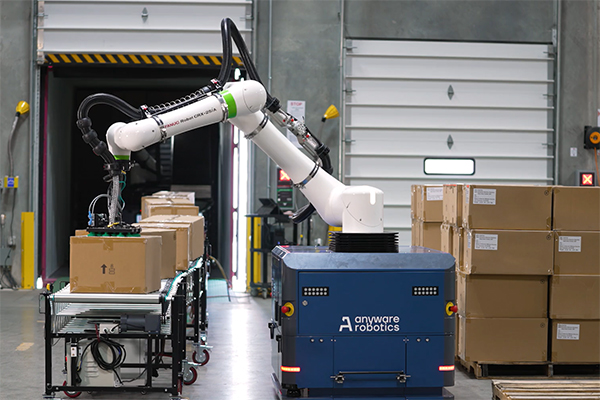
A Pixmo mobile robot from Anyware Robotics, with a FANUC cobot arm, helps Saddle Creek Logistics load and unload truck at its Modesto, Calif. hub.
Get news, papers, media and research delivered. Sign up for our free newsletters.
Stay up-to-date with news and resources you need to do your job. Research industry trends, compare companies and get weekly market intelligence with Robotics 24/7.
FANUC
A Pixmo mobile robot from Anyware Robotics, with a FANUC cobot arm, helps Saddle Creek Logistics load and unload truck at its Modesto, Calif. hub.
In Modesto, Calif., midday temperatures inside a carrier container can soar to a blistering 140 degrees Fahrenheit. For “lumpers” - the workers tasked with unloading, sorting and palletizing hundreds of boxes - this job is not only physically demanding but increasingly untenable as the heat rises. Unsurprisingly, turnover is high.
Yet for Saddle Creek Logistics Services, one of the nation’s largest family-owned logistics providers, Modesto remains a strategic hub. Its proximity to key ports and lower real estate costs compared to Southern California make it a vital node in the company’s network. But the challenge of consistently staffing container unloading operations - especially in extreme heat - required a new approach.
That need led Saddle Creek to partner with automation provider Anyware Robotics, a FANUC Authorized System Integrator and developer of Pixmo, a multi-purpose mobile robot, equipped with physical AI, designed to automate warehouse box handling. Pixmo features a patent-pending conveyor add-on that allows it to move significantly thinner and heavier boxes than similar robot systems can handle.
The companies said the unloading process is simple and takes less than three hours: Pixmo clips into its conveyor accessory, rolls into the carrier container, and begins autonomous operation. Powered by a FANUC CRX-30iA cobot with a 30 kg payload, Pixmo’s vacuum gripper is engineered to pull boxes sideways - rather than lifting and rotating - onto the conveyor. This design reduces movement time by up to 80% versus other solutions.
“We designed Pixmo to solve real operational bottlenecks, not to chase automation for its own sake,” said Torsten Schreiber, vice president of product for Anyware Robotics. “When you can deploy a robot that fits into existing workflows and instantly relieves the toughest jobs, like unloading hot containers, you’re creating meaningful change for both people and performance.”
Since deployment, FANUC said in a case study that Pixmo has handled over 2.6 million pounds of product while eliminating dock-related injuries in unloading operations. Employees have embraced the technology, transitioning into higher-value roles and contributing to a safer, more efficient workplace.
“Any opportunity we have that can reduce a safety risk is a key win,” says Chris Svatek, vice president of operations at Saddle Creek Logistics. “From a performance perspective, reducing the number of associates required to complete a task is also a win. It helps us scale for our clients - going from one container to five in the blink of an eye without being dependent on labor."
The case study - which you can watch and read more about here - highlights how mobile cobot systems, including pre-engineered ones such as Pixmo, can address multiple pain points at once: labor shortages, safety risks and operational bottlenecks.

Ultrasonic sensing enhances robotics perception

Cybernetix Ventures’ event kicks off Robotics Tech Week 2026 slate of events

Preview the manufacturing and warehouse components that will be on the…

Preview the manufacturing and warehouse robots and software that will be on…