Agility Robotics
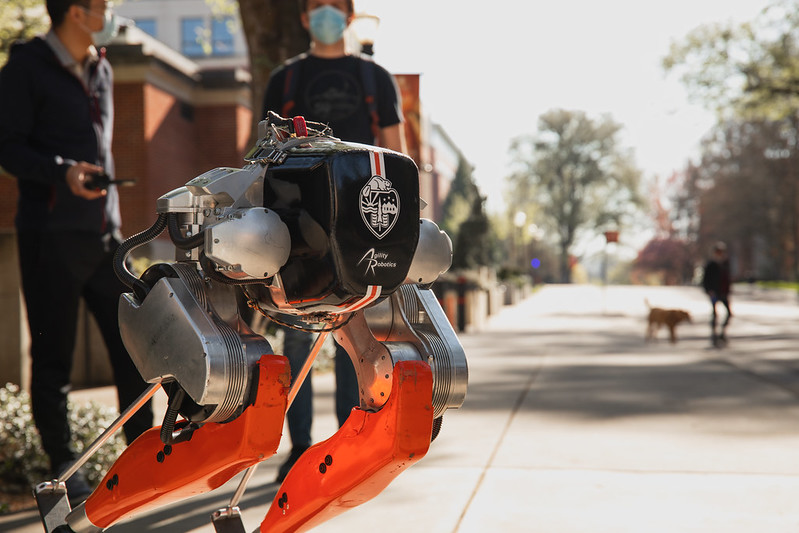
Cassie on the Oregon State University campus.
Get news, papers, media and research delivered. Sign up for our free newsletters.
Stay up-to-date with news and resources you need to do your job. Research industry trends, compare companies and get weekly market intelligence with Robotics 24/7.

Agility Robotics
Cassie on the Oregon State University campus.
Cassie, a bipedal robot invented at Oregon State University and produced by OSU spinout Agility Robotics Inc., has made history by traversing 5 km (3.1 mi.) in just over 53 minutes.
Cassie was developed under the direction of robotics professor Jonathan Hurst with a 16-month, $1 million grant from the Defense Advanced Research Projects Agency (DARPA). OSU students funded by the National Science Foundation have been exploring machine learning options for the robot since 2017.
“The Dynamic Robotics Laboratory students in the OSU College of Engineering combined expertise from biomechanics and existing robot control approaches with new machine learning tools,” said Hurst, who co-founded Agility Robotics. “This type of holistic approach will enable animal-like levels of performance. It’s incredibly exciting.”
Legged robotic locomotion has been limited to date, but Oregon State said its research has enabled multiple breakthroughs. ATRIAS, developed in the Dynamic Robotics Laboratory, was the first robot to reproduce human walking gait dynamics. After that was Cassie, followed by Agility’s Digit humanoid robot.
With knees that bend like an ostrich’s, Cassie taught itself to run using a deep reinforcement learning algorithm. Running requires dynamic balancing – the ability to maintain balance while switching positions or otherwise being in motion – and Cassie has learned to make infinite subtle adjustments to stay upright while moving, said OSU.
“Cassie is a very efficient robot because of how it has been designed and built, and we were really able to reach the limits of the hardware and show what it can do,” said Jeremy Dao, a Ph.D. student in the Dynamic Robotics Laboratory.
“Deep reinforcement learning is a powerful method in AI that opens up skills like running, skipping and walking up and down stairs,” added Yesh Godse, an undergraduate in the lab.
Cassie completed the 5K course untethered and on a single battery charge, said OSU.
During the 5K, Cassie’s total time of 53 minutes, 3 seconds included about 6.5 minutes of resets following two falls. One was because of an overheated computer, and the other was because the robot was asked to execute a turn at too high a speed.
Hurst said walking robots will one day be a common sight – much like the automobile, and with a similar impact. “In the not very distant future, everyone will see and interact with robots in many places in their everyday lives, robots that work alongside us and improve our quality of life,” he said.
In addition to logistics work like package delivery, bipedal robots eventually will have the intelligence and safety capabilities to help people in their own homes, added Hurst.
In a related project, Cassie has become adept at walking up and down stairs without lidar or cameras. Hurst and his colleagues presented a paper on that capability at the Robotics: Science and Systems conference scheduled for July 12 to 16.
OSU researchers have successfully used reinforcement learning to train a recurrent neural network to control bipedal robot Cassie to climb stairs without any perception sensors such as lidar or cameras.

Ultrasonic sensing enhances robotics perception

Cybernetix Ventures’ event kicks off Robotics Tech Week 2026 slate of events

Preview the manufacturing and warehouse components that will be on the…

Preview the manufacturing and warehouse robots and software that will be on…