QNX
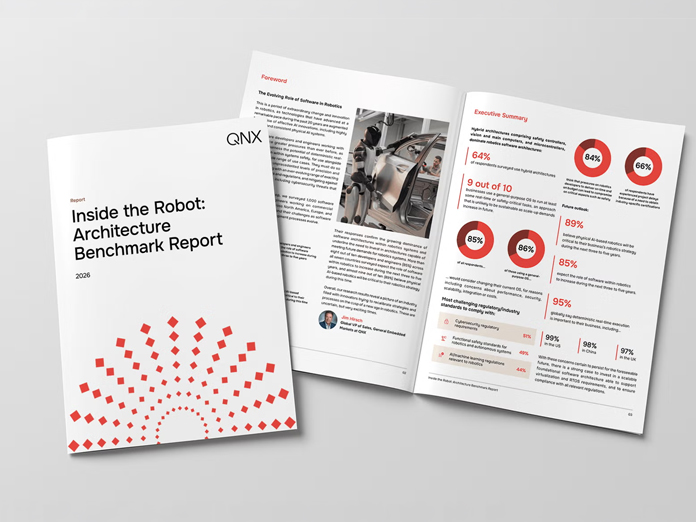
QNX's Inside the Robot: Architecture Benchmark Report, polled over 1,000 robotics developers.
Get news, papers, media and research delivered. Sign up for our free newsletters.
Stay up-to-date with news and resources you need to do your job. Research industry trends, compare companies and get weekly market intelligence with Robotics 24/7.
QNX
QNX's Inside the Robot: Architecture Benchmark Report, polled over 1,000 robotics developers.
QNX, a division of BlackBerry Limited, released a new research study examining how robotics development is changing as systems become more software‑driven, AI‑enabled, and increasingly deployed alongside humans at work and in daily life.
The research report, “Inside the Robot: Architecture Benchmark Report,” is based on a survey of 1,000 developers from around the world.
QNX said that the research reveals the most significant inhibitors to progress, the gap between system ambitions and current capabilities and developers' views on the industry's future.
The report found that almost one in three developers (27%) named software architecture and integration as their biggest performance bottleneck, compared with just 16% who pointed to hardware. QNX said that the research shows that future progress hinges less on new hardware and more on building systems that are predictable, secure and capable of handling mixed levels of criticality.
As robots move more widely from controlled environments into dynamic, real‑world settings such as city streets and factory floors, QNX said that its report found developers are recognizing that software foundations are the deciding factor as to whether innovations succeed or stall.
"Robotics teams are clearly pushing toward more intelligent, autonomous systems, but the data shows they are also running up against the very real limits of architectures that were never designed for this level of complexity or accountability," said Jim Hirsch, global VP of sales, general embedded markets at QNX. "Developers consistently cite four core challenges: integration complexity, certification delays, functional safety risks in human‑machine interaction, and ensuring predictable behavior when it matters most. The good news is that these are all solvable problems and by focusing on stronger software foundations, developers can set the stage for faster innovation and a new generation of safe, reliable, and highly autonomous robots."
Looking ahead, the survey found that 85% of developers also expect software to play an even greater role in robotics over the next three to five years with teams anticipating their biggest investments will be in AI-driven decision making and cybersecurity (both at 51%), followed by operating systems and real-time control software (37%), further reflecting how software foundations are becoming strategic assets as robotics systems grow more complex, interconnected and distributed.
QNX said that more than four in five respondents (83%) say their systems are now deployed alongside humans. Among those not yet deployed alongside humans today, two‑thirds (67%) expect they will be within three to five years. This expanding presence in less controlled environments, from surgical suites to busy shop floors, is driving higher expectations around reliability, safety and predictable behavior, with nearly all respondents (95%) saying deterministic, real‑time execution is important to the systems they develop.
Surprisingly, despite this near‑universal requirement, QNX’s research found that most development teams continue to rely on software not designed for real‑time or safety‑critical use. QNX said that the research revealed 91% of respondents run these workloads, at least in part, on general‑purpose operating systems (GPOS), even though safety‑certified commercial solutions are rated as the best fit for their needs.
As a result, the report found that 86% of these GPOS users say they are open to changing their OS; a contrast that encapsulates the growing tension between flexibility and the need for predictable, guaranteed behavior as robotics deployments scale.
To read the report synopsis, including details related to security demands and physical AI readiness, click here.
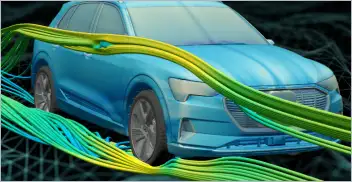
From geometry preparation to AI-assisted analysis, integrated CFD workflows…
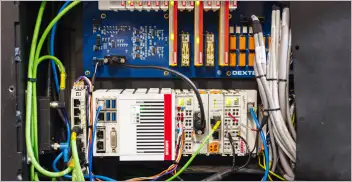
Safety, communication and motion control components enable smooth operation
North America’s largest robotics and automation event winds down

Automate’s largest day ever draws huge crowds to McCormick Place