Get news, papers, media and research delivered. Sign up for our free newsletters.
Stay up-to-date with news and resources you need to do your job. Research industry trends, compare companies and get weekly market intelligence with Robotics 24/7.
Last week, I attended the Automate Forward 2021 virtual conference. Interestingly, many of the recurring themes that were discussed by colleagues in the robotics space were aligned with RIOS’ thesis on manufacturing and automation (i.e., our vision on how the world will evolve). Here are some of the themes that we’ve predicted and are now seeing unfolding:
SMBs have real paint points — they’re being hit from all angles: labor shortage, labor turnover, minimum-wage hikes, and the pandemic. They also have less of a cushion to deal with all the threats to their businesses. They’re realizing that if they don’t act now, their enterprises will slowly fold.
Thus, they’re very gung-ho about automation and they’re moving rapidly to implement solutions. SMBs are becoming the de facto market for robotics companies and automation solution providers.
The labor-intensive tasks in the factory are the ones that require human-level dexterity, involve handling different SKUs (ranging from a handful to millions of objects), and are in unstructured environments (or some permutations of these).
These tasks are hard to automate and can’t be solved using traditional automation or custom engineering. This “last mile” automation in the factory is a multi-billion-dollar market that remains largely untapped. With the advent of cobots, AI, and new computing platforms, the last mile automation challenge has become the core focus of the robotics industry.
Traditional industrial robots are designed to only handle repetitive tasks on the factory floor. “As is” these robots aren’t geared to solve the last mile automation problems. Instead, we need robots with higher cognitive skills, dexterity, and autonomy.
To achieve building these more capable machines requires a confluence of modern technologies like machine vision, AI, cloud computing, edge computing, 5G, new sensors, and new industry 4.0 hardware. There’s a momentum to build infrastructures that integrate those fragmented technologies into one unified robotics platform.
The traditional business model in the robotics space is a purely CapEx play in which the customer needs to pay hundreds of thousands to millions of dollars upfront for robots. New incumbents are departing from this CapEx model and offering a robots-as-a-service (RaaS) business model. It is a pay-as-you-go (OpEx) plan, which allows customers to fund their automation needs with zero upfront capital commitment.
A “$0 down with zero risk” value proposition is extremely attractive, not only for SMBs that are cash strapped but also for larger companies that want to take on more risks. The RaaS model is gaining more momentum and becoming more widespread.
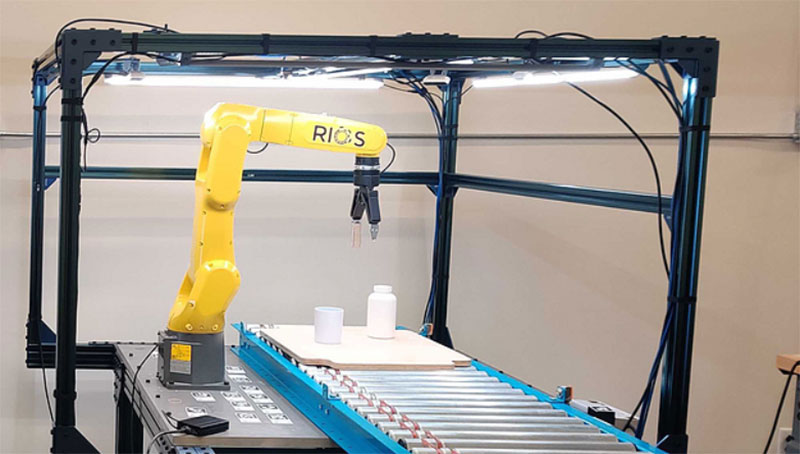
Robots are not “job killers” — certainly, there are dirty, dull, and dangerous roles that are being phased out, but an even higher number of new positions are being created in the process. These new occupational categories are higher-level, better paying (and in some cases will reduce the average hours worked per week) and allow people to enjoy more leisure time. In addition, automation contributes to more cooperation between human and machines. We’re seeing and also helping to upskill workers to interact with these new machines.
These new robotic workcells on the shop floor generate an enormous amount of data while monitoring, maintaining, and managing the production line. Data is being aggregated for inventory tracking, real-time production, predictive analytics, in-line quality testing, real-time adaptation to shifting customer demands, and more. We’re now able to provide significant business intelligence to customers by first synthesizing all this data and helping customers to visualize and understand their own data streams.
It’s not because of any specific use case or task that companies are embracing automation. It’s not because of emerging technologies. It’s primarily because of labor shortage — human capital is scarce in developed nations to fill all the minimum-wage jobs. We could build the perfect robot, but it wouldn’t matter if there was a large pool of human operators lining up to do these jobs. This is compounded by labor turnover (i.e., people leaving these strenuous jobs), people leaving to work for competitors for like 50 cents (per hour) more on their paycheck, and people not showing up for work. Those are the real market pulls besides of course having real business problems that need to be solved.
If you’d like to automate, start small, go for a quick win and start planning for the future. Today, with companies like RIOS, it’s possible to start automating your factory with absolutely zero risks and zero money down.
There has not been any better time in history to reimagine your business processes and thrive into the twenty-first century. SMB customers have seen return on (OpEx) investment on day one — with 40–60% in cost savings and 40% –100% increase in productivity. Pick the lowest hanging fruit to automate first and ramp up complexity comfortably over time. These steps will pay dividends in the future. Talk to an automation expert today.
About the author:
CEO and Founder of RIOS. Dr. Casse is a seasoned leader and entrepreneur, leading a world-class team developing dexterous, AI-powered robots.

Ultrasonic sensing enhances robotics perception

Cybernetix Ventures’ event kicks off Robotics Tech Week 2026 slate of events
Preview the manufacturing and warehouse components that will be on the…
Preview the manufacturing and warehouse robots and software that will be on…