By
Bob Trebilcock
April 11, 2023
Get news, papers, media and research delivered. Sign up for our free newsletters.
Stay up-to-date with news and resources you need to do your job. Research industry trends, compare companies and get weekly market intelligence with Robotics 24/7.

Addison, Ill.
Square Footage: 200,000 square feet plus 50,000 square feet of mezzanine space
Products Handled: Critical and spare OEM MRO parts
SKUS: 165,000 SKUs in stock, plus access to additional SKUs via partners
Throughput: 22,000 lines and 11,000 orders on a typical day
People/Shifts: Two 8-hour shifts per day/5 days per week plus one shift on Saturday
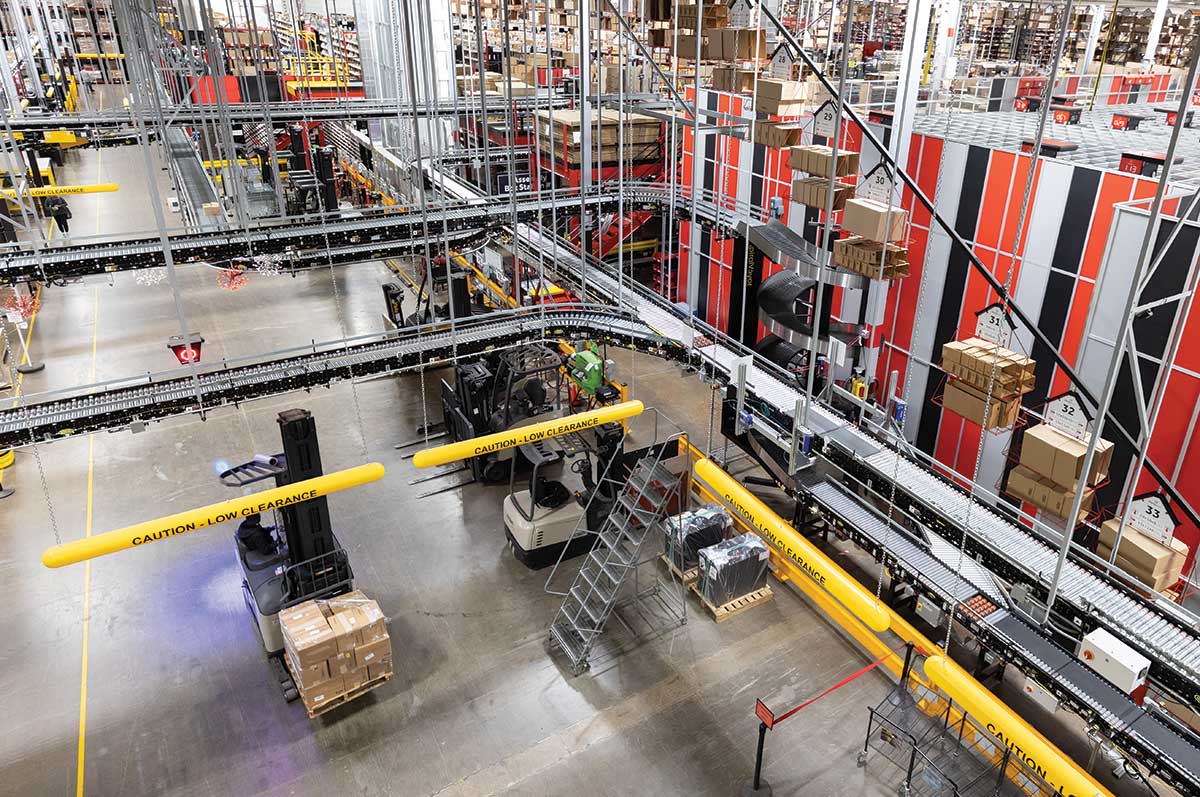
Parts Town’s distribution center was designed from the ground up to speed parts out the door while laying the foundation for growth. Our feature article goes in depth on the redesign.
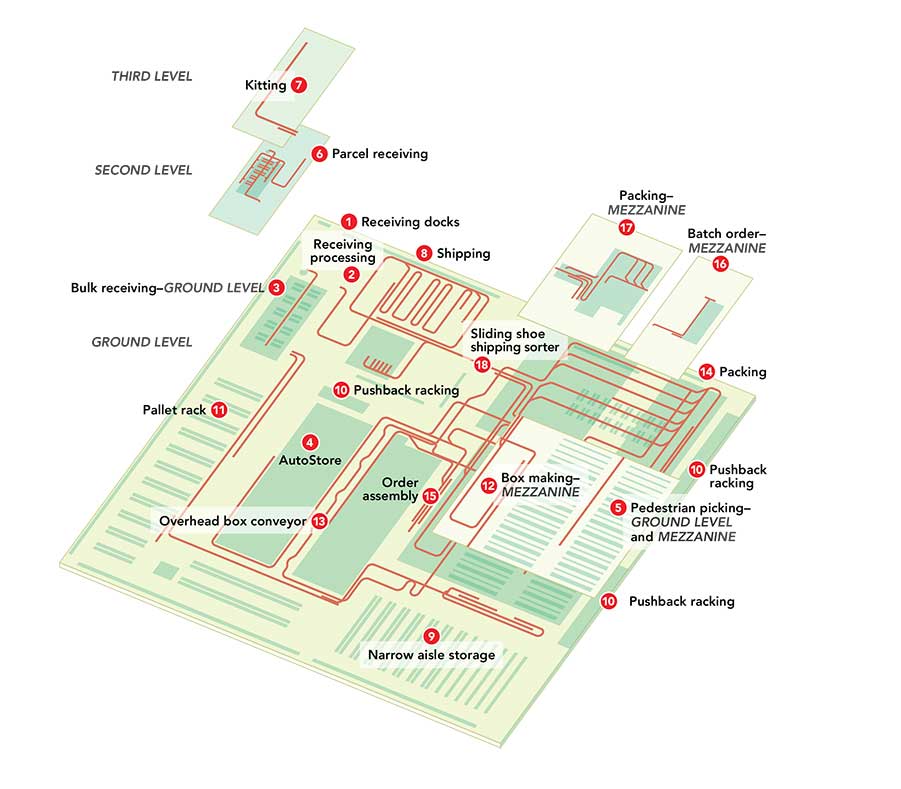
Incoming inventory is unloaded in receiving (1) and then sent to a three-level receiving and processing area (2). The ground level (3) processes palletized inventory. In this area, items are removed from packing, audited and then scanned into totes for storage in the AutoStore goods-to-person picking system (4) or in a pedestrian pick module or into narrow aisle storage for small parts storage (5).
The second level (6) processes parcel receipts. Once again, items are removed from their transport packaging and prepared for storage.
The third level (7) is referred to as a kitting area. There is also a ground level kitting area adjacent to receiving. There, eligible items are prepared for shipping in advance of an order so that they can be conveyed directly to shipping (8) if they are a single line order.
There are several putaway processes, depending on the size of the storage methodology.
Totes with inventory eligible for the AutoStore are conveyed to an induction area where they are inspected, if necessary, audited and then scanned into corrugated cartons that are stored in AutoStore. There are three ports where product is inspected and eight induction ports.
Small parts are delivered to the pedestrian pick module for putaway.
Narrow aisle, pushback rack and pallet racking: Palletized items that can’t be handled by automation are stored in a VNA rack area (9), serviced by wire-guided vehicles for putaway and picking, in pushback racking (10) and in conventional pallet rack (11).
Shipping boxes are assembled on a mezzanine level work area (12). They are then placed in carriers on an overhead conveyor (13) that delivers boxes to the AutoStore pick tunnel. Much like a kanban system, the system is visual: The carriers are individually identified by number along with human readable information about the box sizes in each location on the carrier. Parts Town uses an algorithm to determine the optimal box sizes in the facility and for each order. The carriers continuously circulate at a relatively slow speed, which allows associates to easily remove required boxes, but also work around the overhead conveyor.
Parts Town aggregates its most frequently ordered parts in AutoStore. Associates are directed on the screen at their workstations as to what box size they need and then what items are to be picked to the box. Boxes are then placed on a takeaway conveyor. If no other items are required, the box is conveyed to packing (14).
Multi-line orders picked from varying areas of the facility are delivered to an order assembly area on the ground floor (15). There, the first items for an order are scanned into a temporary storage location. Other items are then added to the order as they arrive. A complete order is then conveyed to packing.
Items that are picked in batch are conveyed to a batch order level (16) in the packing mezzanine. From there, they are sorted to the appropriate packing station.
Items that require documentation are conveyed to a packing mezzanine (17) where they are sorted to a pack station. There, orders are finalized, labeled and inducted onto the shipping sorter (18).
To make the best use of space, the sliding shoe shipping sorter is located on a mezzanine level. Packages are sorted to a shipping lane based by carrier and delivery method.

Bob Trebilcock was the executive editor for Modern Materials Handling and an editorial advisor to Supply Chain Management Review. He has covered materials handling, technology, logistics, and supply chain topics for nearly 30 years. He is a graduate of Bowling Green State University. He retired in 202 but serves as a consultant to Modern and Peerless Media.
Enjoyed this article? Add Robotics 24/7 as a preferred source in Google Search.
Edge computing gives AI agents the processing power to turn instructions into…
Daimon-TWM world model debuts for the public

Platform helps robots adapt to complex tasks

Look beyond the headlines for the latest in humanoid robots