Sponsored
Aetina
By
Bridget McCrea
October 15, 2026
Aetina
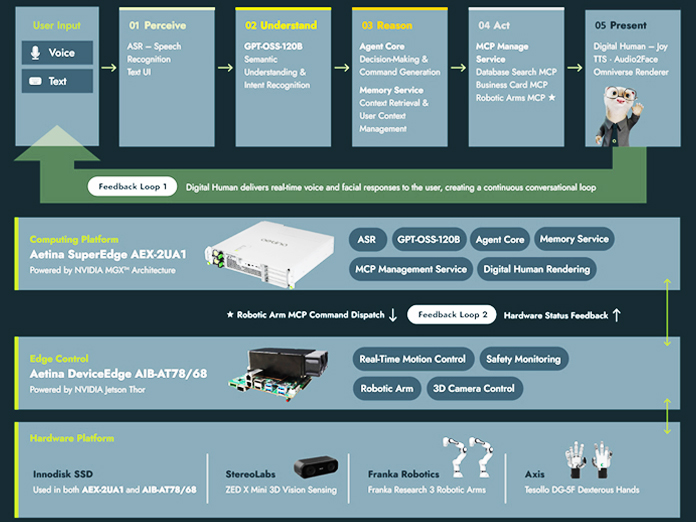
Aetina is building the edge architecture for physical AI by giving AI agents the processing power to turn instructions into robotic actions.
Get news, papers, media and research delivered. Sign up for our free newsletters.
Stay up-to-date with news and resources you need to do your job. Research industry trends, compare companies and get weekly market intelligence with Robotics 24/7.
Aetina
Aetina is building the edge architecture for physical AI by giving AI agents the processing power to turn instructions into robotic actions.
Generative AI has gotten pretty good at answering questions, writing computer code and curating a lot of online information into a single box at the top of Google's search results. Now, the technology is making its way into the physical world, where robots can use AI to interpret instructions, make decisions and carry out tasks.
This is all taking place right on the plant and warehouse floor, where AI agents connect to robotic systems and help them understand instructions, identify objects, handle materials and respond to changing conditions. The wave is gathering steam: according to Capgemini, 79% of organizations are exploring, piloting or deploying physical AI, with 27% already using or scaling these solutions.
The idea of AI controlling machinery is a novel concept for many. “Most people understand Generative AI as 'text-in, text-out' or content generation confined to the digital screen,” says Tim Lin, AI application senior engineer at Aetina, which makes industrial computers, graphics processing modules and hardware that enables AI processing at the edge for robotics applications. “Physical AI bridges high-level reasoning with real-world physical task execution.”
Of course, there’s a lot involved in making all of this work in a real-world industrial setting. For example, robots have to process information from their surroundings, interpret instructions and execute physical tasks in real time. They also have to operate within established safety limits, because one wrong decision could damage equipment, shut down a production line or create a safety hazard.
None of this is easy, but companies like Aetina are addressing the challenges by breaking robotic tasks down into individual functions (e.g., grasping an object, positioning it or moving a robotic arm along a specific path). Then, an AI agent interprets the operator's instructions and leverages the Model Context Protocol (MCP) as a standardized abstraction layer to access those functions.
By treating robotic capabilities (like gripping or trajectory planning) as interoperable MCP tool calls, this approach eliminates the need for proprietary, vendor-locked middleware. The robot's control system executes the commands and sends deterministic feedback back to the AI agent, forming an autonomous, closed-loop decision loop.
Imagine being able to give a robot verbal instructions to pick an item from a bin and then stepping back as it completes the task. That's the type of interaction Aetina demonstrated at COMPUTEX 2026. The company combined an AI agent with a digital human that visitors could speak to and a robotic arm equipped with a dexterous hand.
Booth visitors interacted with the digital human through speech, which the AI agent interpreted and converted into commands for the robot. In a demonstration, the robotic hand grasped a soda can using a series of predefined, verified movements. This could make it easier for operators to change the tasks robots perform as production requirements change.
“Traditional robotic reconfiguration requires automation engineers to rewrite PLC logic or reprogram teach pendants,” says Lin, referring to the handheld devices used to program robots. “With Physical AI, atomic motions are pre-certified as modular building blocks. Operators can use natural language to command new assembly sequences, substantially reducing changeover time without requiring specialized onsite robotics engineers.”
The technology also offers a way for robots to recover from common errors, like an object that's incorrectly positioned for picking. In that situation, a robot could adjust the object's position before attempting to pick it up again, potentially avoiding a halt in operations.
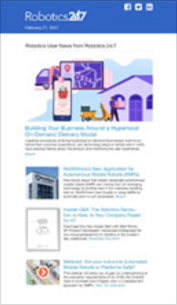
Aetina's technology runs on two edge computing platforms that handle different parts of the process: a SuperEdge AEX-2UA1 server (an NVIDIA MGX-based edge server)that handles the AI agent's reasoning, speech processing and digital human interactions, and the DeviceEdge AIB-AT78/68 platform (powered by NVIDIA® Jetson Thor™), which handles the robotic side.
The two platforms communicate through MCP, which connects the AI agent to the robotic control system. Once the agent interprets an instruction, it sends a command to the robot, which executes the requested action and reports the results.
“We use a dedicated Cognitive Brain vs. Motor Brain architecture to isolate workloads,” Lin says. “This separation keeps the robot’s control system operating within strict time limits, even when the MGX server experiences a spike in computing demand or memory use, reducing the risk of erratic movements and collisions.”
Aetina's five-step system takes instructions from the digital human to the robotic arm and back again by:
Because this entire process runs at the edge, robots can process information locally and maintain control of their movements without depending on a constant connection to the cloud. This is a big win for factories and warehouses, where network interruptions or delayed responses can disrupt operations and create safety hazards.
Local edge processing fundamentally transforms the total cost of ownership (TCO) for automated facilities. Continuous vision-language-action (VLA) models streaming 4K sensor data to the cloud incur prohibitive recurring token and bandwidth costs, alongside unacceptable network latencies. And, running high-frequency inference entirely on-premise guarantees sub-millisecond response times, zero exposure to external network dropouts, and predictable, capital-based ROI. “With continuous high-frequency inference, edge platforms offer fixed-cost predictability,” Lin says, “effectively eliminating recurrent cloud token fees over years of operation.”
As physical AI continues to evolve, robotics developers and systems integrators will have to decide where to start and how much autonomy to give their robots. These decisions are important because even small changes in an object's dimensions or the lighting in a production facility can require adjustments to existing AI applications.
Lin recommends a phased approach that starts with choosing predefined robotic movements that meet established safety requirements. Next, introduce AI agents to manage task sequences and expand their capabilities as the technology advances. Focus on three key areas: how the system operates without continuous cloud connectivity, its support for open standards like MCP and ROS 2, and the separation of AI reasoning from time-sensitive robotic controls.
Companies should also involve experienced edge hardware partners early in the evaluation process. “Engage early and evaluate deeply to avoid paying unnecessary premiums caused by information asymmetry,” Lin says, “and don’t base your decision solely on polished marketing videos.”
As more organizations adopt physical AI, developers will have to turn increasingly sophisticated technology into reliable robotic actions. The hardware will have to keep pace with those advances while giving robots the control they need to operate safely. Aetina's edge computing technology supports that transition, helping robots handle more complex tasks with even greater autonomy.

Bridget McCrea is an Editor at Large for Modern Materials Handling and a Contributing Editor for Logistics Management based in Clearwater, Fla. She has covered the transportation and supply chain space since 1996 and has covered all aspects of the industry for Modern Materials Handling, Logistics Management and Supply Chain Management Review. She can be reached at [email protected] , or on Twitter @BridgetMcCrea
Enjoyed this article? Add Robotics 24/7 as a preferred source in Google Search.
Edge computing gives AI agents the processing power to turn instructions into…
Daimon-TWM world model debuts for the public
Platform helps robots adapt to complex tasks
Look beyond the headlines for the latest in humanoid robots