Get news, papers, media and research delivered. Sign up for our free newsletters.
Stay up-to-date with news and resources you need to do your job. Research industry trends, compare companies and get weekly market intelligence with Robotics 24/7.

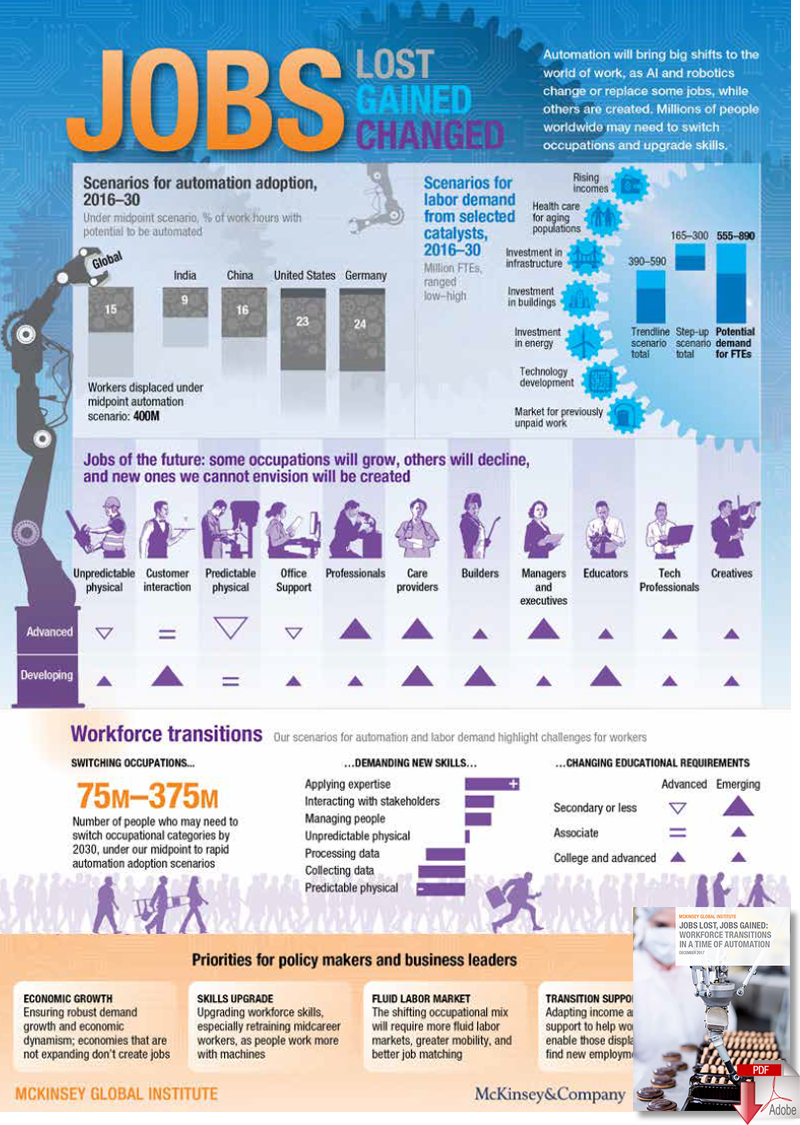
A new study by the McKinsey Global Institute estimates that between 400 million and 800 million of today’s jobs will be automated by 2030.
The research adds a fresh perspective to what is becoming an increasingly concerning picture of the future employment landscape.
“We’re all going to have to change and learn how to do new things over time,” institute partner Michael Chui told Bloomberg.
In the United States, it appears it’s the middle class that has the most to fear, with office administrators and construction equipment operators among those who may lose their jobs to technology or see their wages depressed to keep them competitive with robots and automated systems.
As many as 375 million workers around the world may need to switch occupational categories and learn new skills.
The technology-driven world in which we live in is a world filled with promise but also challenges.
Cars that drive themselves, machines that read X-rays, and algorithms that respond to customer-service inquiries are all manifestations of powerful new forms of automation.
Yet even as these technologies increase productivity and improve our lives, their use will substitute for some work activities humans currently perform - a development that has sparked much public concern.
Building on their January 2017 report on automation, McKinsey Global Institute’s latest report, Jobs lost, jobs gained: Workforce transitions in a time of automation, assesses the number and types of jobs that might be created under different scenarios through 2030 and compares that to the jobs that could be lost to automation.
The results reveal a rich mosaic of potential shifts in occupations in the years ahead, with important implications for workforce skills and wages.
The key finding is that while there may be enough work to maintain full employment to 2030 under most scenarios, the transitions will be very challenging - matching or even exceeding the scale of shifts out of agriculture and manufacturing we have seen in the past.
Related Resources
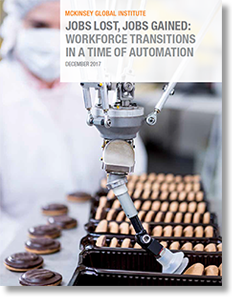
Jobs Lost, Jobs Gained: Workforce Transitions in a Time of Automation
This report examines questions surrounding automation - will there be enough work in the future to maintain full employment, and if so what will that work be? which occupations will thrive, and which ones will wither? Download Now!
A Future That Works: Automation, Employment, and Productivity
This detailed report contributes to McKinsey Global Institute’s mission to help business and policy leaders understand the forces transforming the global economy, identify strategic locations, and prepare for the next wave of growth. Download Now!
More Resources on Automation

From geometry preparation to AI-assisted analysis, integrated CFD workflows…

North America’s largest robotics and automation event winds down

Automate’s largest day ever draws huge crowds to McCormick Place

North America’s largest robotics and automation event kicks off