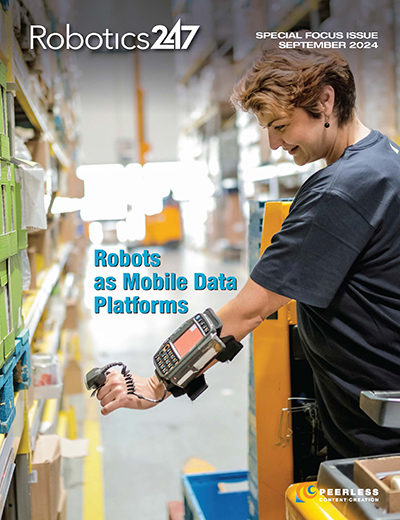
Most autonomous robots require an array of cameras and sensors to operate independently. Beyond navigation, those sensors already capture a huge amount of data about environmental conditions and the robots themselves.
Some robots are designed specifically to collect information, such as inventory location, cycle-counting or structural defects. Wearable robotic equipment collects data on human movement to improve ergonomics.
Technological advancements in data collection, analysis and connectivity allow organizations to harness the information already at their fingertips better than ever before. With robotics and automation generating mountains of valuable data for humans and neural networks to sift through, organizations can accurately monitor and track their inventory and workflows.
When combined with generative AI analytics, robots can serve as mobile data platforms, informing decision-making and improving operational efficiency for commercial and industrial end users.
Edge computing gives AI agents the processing power to turn instructions into…
Daimon-TWM world model debuts for the public
Platform helps robots adapt to complex tasks
Look beyond the headlines for the latest in humanoid robots