Found in
The Internet of Things (IoT) and edge computing have triggered the proliferation of connected devices, products that perform a rich assortment of functions and sport expanded capabilities. This, in turn, has increased the level of product design complexity engineers must tackle. The complexity becomes particularly evident when selecting processing resources for one of these devices. The problem is that engineers…
Found in
The emergence of ubiquitous sensing and the Internet of Things (IoT) has sparked a migration of advanced processing, memory and communication resources to the network’s edge. In the process, these trends have caused a shift away from simple sensors to smart sensors, a move toward deploying greater intelligence at the data source. Yet the chain reaction does not stop there.…
Found in
Printed electronics developers have started launching the technology into the third dimension, throwing off the constraints of flat, 2D architectures to integrate electronics directly into a product’s geometry. Until recently, electronics companies designed and manufactured components, systems and layers in 2D. Then they finished off the lengthy process by performing steps like drilling, pressing and plating to connect the separate…
Found in
Deep learning (DL)—one of the newest trends in artificial intelligence—has driven remarkable progress in the development of autonomous driving systems, but the driverless car has a long way to go before it crosses the finish line. One factor holding the technology back is its need for massive amounts of data for training, testing and validation. The growing fleet of driverless…
Found in
The internet of things (IoT) has several faces. Some have become familiar to almost all segments of society, like wearables, while others claim notoriety only in specific markets, such as industrial IoT systems. But there is more to the IoT than these two sectors. Another face that is gaining attention is the commercial IoT. Related Coverage Connecting the Thread: 5G…
Found in
In recent years, design engineers have expended considerable time and resources to impart human-like senses into new products, with some notable successes. Natural language processing has helped develop intelligent virtual assistants that enable increasingly rich interaction between humans and machines. At the same time, computer vision has played an important role in bringing amazing applications to life, such as the…
Found in
Researchers at Vanderbilt University have developed a non-destructive evaluation process that promises to enhance manufacturers’ ability to assess the structural integrity of 3D-printed products. The new testing technique chips away at one of the chief obstacles keeping additive manufacturing (AM) from taking on more demanding applications in the automotive, aerospace and medical equipment industries. An interdisciplinary team of researchers at…
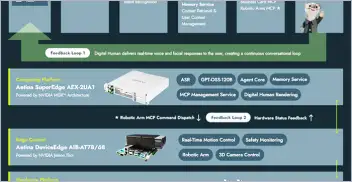
Edge computing gives AI agents the processing power to turn instructions into…
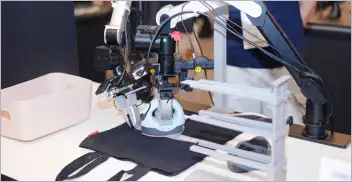
Daimon-TWM world model debuts for the public
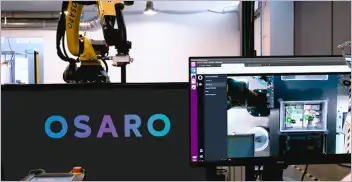
Platform helps robots adapt to complex tasks
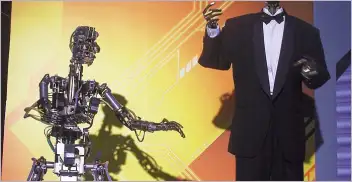
Look beyond the headlines for the latest in humanoid robots