Mobile Industrial Robots
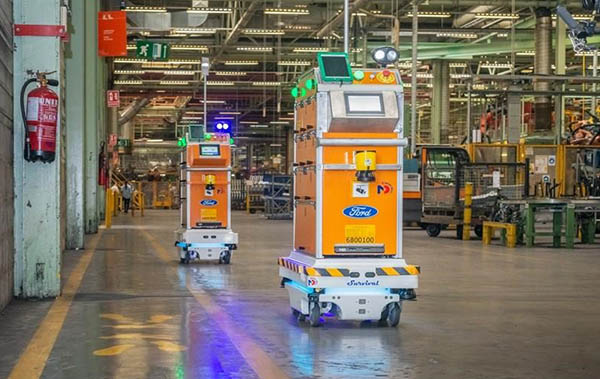
MiR AMRs use ML at Ford Motor.
Get news, papers, media and research delivered. Sign up for our free newsletters.
Stay up-to-date with news and resources you need to do your job. Research industry trends, compare companies and get weekly market intelligence with Robotics 24/7.
Mobile Industrial Robots
MiR AMRs use ML at Ford Motor.
Artificial intelligence, robotics, and related technologies have found a place in online retail. In fact, e-commerce providers such as Amazon.com, Asos, and Zalando have found AI and deep learning departments essential.
Why do they invest in machine learning (ML)? It can helps them better understand their clients, customize offers for particular buyers, and automate manual tasks.
Machine learning allows online stores to be upgraded with smart on-site search, personalized ads, and intelligent chatbots. That’s why you should integrate it into your website, the Magento "headless commerce" architecture or a headless platform on another content management system (CMS), or even in brick-and-mortar store.
Here are three ways to use machine learning and robotics to assist e-commerce.
Vision systems and robotics have come together for industrial applications. Regular robots that aren’t equipped with an advanced perception system require certain conditions. For example, the work environment must be fixed, and the robot should always proceed to a predetermined position.
How can a robot move to where it’s needed? Picking systems require high-precision sensing to locate objects to manipulate.
Today, vision-guided robots (VGR) are rising in popularity. They include the following capabilities:
A seemingly simple task requires complex AI and ML technologies. VGRs are commonly used to locate objects on a conveyor belt. How does this help e-commerce companies? Most vision-guided picking occurs in warehouses.
For example, the RightPick system from RightHand Robotics uses AI to autonomously handle thousands of SKUs from totes, bins, boxes, and cases. The hardware consists of an intelligent gripper, a high-performance industrial PC, and a robot arm.
Advanced automation systems can help online stores keep up with product flow and ensure customer satisfaction. For example, Paltac Corp., a major wholesaler of consumer packaged goods in Japan, has streamlined its picking processes with the help of RightHand Robotics.
As manufacturers and supply chains adopt automation, they need to control and manage their growing fleets of autonomous mobile robots (AMRs). Fleet management systems (FMS) from the robot vendors or third-party software providers can help.
An FMS allows users or operators to centrally supervise numerous mobile robots from multiple devices via standard communication protocols. They can use devices incuding laptops, tablets, or smartphones to access the robots from anywhere, not just the shop floor.
What benefits can an FMS provide? First, it helps avoid bottlenecks and downtime, ensuring 24/7 AMR operation throughout a facility.
For instance, Mobile Industrial Robots' MiR Fleet software offers an intuitive Web interface for programming and monitoring. How does it work?
MiR Fleet is equipped with cameras to control robot traffic patterns. Coupled with advanced learning algorithms, the system analyzes anonymized data to determine the objects in the area, such as people, forklifts, or other mobile equipment.
MiR's AMRs receive this information from the cameras, which improves their awareness of their surroundings and allows them to change their behavior even before entering an area. Thus, the robots use AI and ML to avoid high-traffic areas, such as where goods are regularly transported and transferred by fork truck or where large groups of workers are present.
MiR robots are already at work at Toyota, Ford, and other companies in over 60 countries.
How can e-commerce businesses handle the ever-growing number of orders? Recruitment and retention of workers for repetitive tasks has become more difficult during the COVID-19 pandemic.
As online shopping doesn’t show any sign of slowing down, more merchants are applying robots to order picking. At the same time, people are still needed for upstream and downstream processes. That’s where collaborative robots, or cobots, come into play.
Collaborative robot arms and AMRs are different from industrial robots because they include sensors and programming to avoid dangerous interactions with humans. They are also potentially easier to operate, reducing the need for technical experts in production. Cobots include the following features, depending on the application:
Unlike other autonomous systems, cobots and collaborative AMRs are designed for constant work alongside human workers. One example is DHL, which keeps pace with e-commerce demands by using collaborative picking technology from Locus Robotics.
The global logistics provider uses more than 500 assisted picking robots in its warehouses in the U.S., Europe, and the U.K., and it plans to increase that number this year.
AI, ML, and robotics are already helping the e-commerce industry meet customer expectations for rapid and accurate order fulfillment. Vision-guided picking, fleet-management systems, and collaborative robot arms and AMRs have matured and are helping businesses be competitive.
This is only the tip of the iceberg, and we'll see how online retailers realize these technologies' full potential.

Alex Husar, is chief technology officer at Onilab, with more than eight years of experience in developing progressive Web apps, Magento migration, and Salesforce development. He graduated from the Czech Technical University and obtained a bachelor’s degree in computer software engineering. Husar’s expertise includes both full-stack development skills and the ability to provide guidance to an entire project team.
“The ability of the Locus solution to scale up and down depending on the needs of the business and the volume has been paramount for us,” said Kimberly Potts, director of operations at DHL Supply Chain.

Ultrasonic sensing enhances robotics perception

Cybernetix Ventures’ event kicks off Robotics Tech Week 2026 slate of events
Preview the manufacturing and warehouse components that will be on the…
Preview the manufacturing and warehouse robots and software that will be on…