By
DE Editors
December 16, 2020
Get news, papers, media and research delivered. Sign up for our free newsletters.
Stay up-to-date with news and resources you need to do your job. Research industry trends, compare companies and get weekly market intelligence with Robotics 24/7.
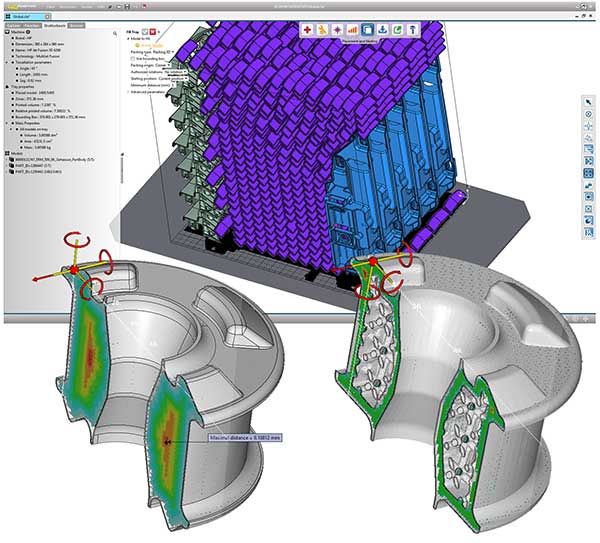
The new version of the 3D printing Software 4D_Additive uses artificial intelligence algorithms to achieve an optimal heat distribution. This new technology is used to ensure an even arrangement of parts in the build space during nesting.
The new nesting function of the renowned 4D_Additive software from CoreTechnologie uses artificial intelligence (AI) for the first time to automate intelligent behavior and machine learning. The new technology simulates certain human decision-making structures based on the programming and by this means the computer independently processes complex tasks in the area of so called nesting.
With its new "pack and optimize" strategy, the nesting module of the latest 4D_Additive software version is able to ensure both maximum filling of the installation space and even distribution of the mass to be printed, thus ensuring the most constant possible slice surfaces. The advanced program uses AI technology and imitates the behavior of an experienced user by automatically filling empty areas in the packaging space after pre-positioning. This has the advantage that even build spaces that are not fully loaded are filled evenly and without so-called heat nests. The printing results are maximally optimized by the even distribution of the components.
In addition to intelligent nesting, further functions are available to optimize heat distribution within the components. An analysis to determine so-called massive zones shows problematic areas with large material volumes and displayes these zones graphically in a highly visible manner. These zones then can be hollowed out with a few mouse clicks using the hollow and lattice functions and, if necessary, reinforced with an internal support structure. To remove powder from the inside of the hollowed parts, holes and the appropriate lids can be created automatically.
For the preparation of 3D printing data, the 4D_Additive tool has CAD data interfaces for all B-Rep native and standard formats as well as the common 3D printing formats such as STL and 3mf.
Further information on the new 4D_Additive software version is available here.

DE's editors contribute news and new product announcements to Digital Engineering 24/7 and the Robotics 24/7 sites. Press releases may be sent to them via [email protected].
Enjoyed this article? Add Robotics 24/7 as a preferred source in Google Search.
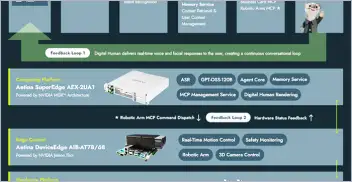
Edge computing gives AI agents the processing power to turn instructions into…
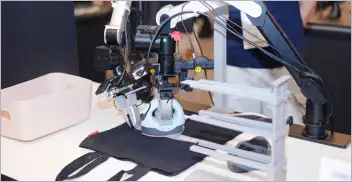
Daimon-TWM world model debuts for the public
Platform helps robots adapt to complex tasks
Look beyond the headlines for the latest in humanoid robots