By
DE Editors
August 23, 2019
Get news, papers, media and research delivered. Sign up for our free newsletters.
Stay up-to-date with news and resources you need to do your job. Research industry trends, compare companies and get weekly market intelligence with Robotics 24/7.
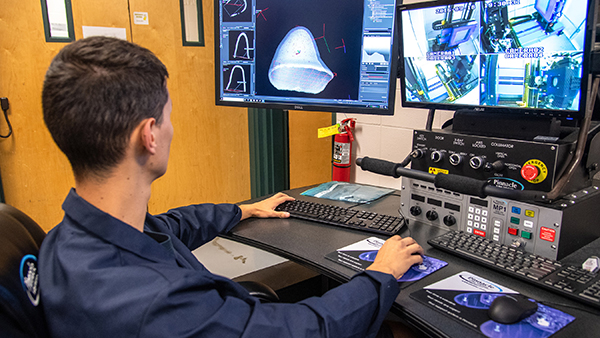
Auburn University's Samuel Ginn College of Engineering has begun in-process inspection of additive manufactured parts using a customized digital radiology vault and specialized additive manufacturing systems designed by Auburn University researchers. The new system was acquired through a $1.5 million grant from the National Institute of Standards and Technology awarded to Auburn's Center for Additive Manufacturing.
Auburn's Center for Additive Manufacturing was formed in 2015 and now includes extensive collaboration between Auburn, NIST, NASA and the global standards organization ASTM International. The nationally recognized organization conducts research, trains and educates graduate and undergraduate students, and develops and promotes technological innovations that advance the pace of the additive manufacturing industry.
The new system is comprised of a customized digital radiology vault from Pinnacle X-Ray Solutions that accommodates additive manufacturing machines designed and built by Auburn researchers to fit within the X-ray vault. Thissolution enables Auburn engineers and their partners to conduct three-dimensional non-destructive interrogation of mission-critical metal parts as well as provide real-time process monitoring of the additive manufacturing process. Researchers are able to confirm internal dimensions of structures and assess the quality of not only the finished part, but the manufacturing process itself.
Bart Prorok, professor of materials engineering and principal investigator on the NIST grant, reported that the new system offers precise design interrogation capabilities previously unattainable using conventional post-production methods.
"It's a real game-changer because while we're building a component with additive, it's difficult to monitor what's happening," Prorok says. "With this new system, we can take two-dimensional X-ray pictures of a metal structure for real-time process monitoring or a series of 2-D images in 360 degrees of rotation that are then reconstructed into a 3-D representation of the build."
Auburn engineering researchers are working with partners at NIST, NASA, the U.S. Army, ASTM International and leaders throughout the aerospace and aviation industries to progress the development of industry standards and processes to bring additive manufacturing of mission-critical into commercial use. NASA recently awarded Auburn $5.2 million to develop additive manufacturing processes and techniques for improving the performance of liquid rocket engines.
Sources: Press materials received from the company and additional information gleaned from the company’s website.

DE's editors contribute news and new product announcements to Digital Engineering 24/7 and the Robotics 24/7 sites. Press releases may be sent to them via [email protected].
Enjoyed this article? Add Robotics 24/7 as a preferred source in Google Search.
Edge computing gives AI agents the processing power to turn instructions into…
Daimon-TWM world model debuts for the public
Platform helps robots adapt to complex tasks
Look beyond the headlines for the latest in humanoid robots