By
Jim Romeo
April 1, 2019
Get news, papers, media and research delivered. Sign up for our free newsletters.
Stay up-to-date with news and resources you need to do your job. Research industry trends, compare companies and get weekly market intelligence with Robotics 24/7.
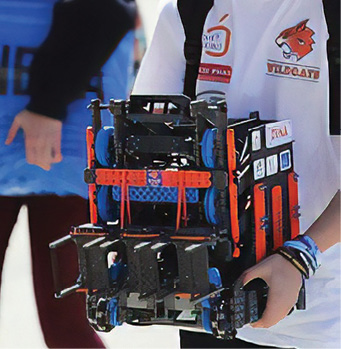
The Robotics Education and Competition (REC) Foundation hosts the VEX IQ Challenge Next Level and VEX Robotics Competition Turning Point to involve students who are in middle school through college in hands-on robotics and science, technology, engineering and mathematics (STEM).
The VEX IQ Challenge Next Level and VEX Robotics Competition Turning Point are this season’s series of game challenges supported by the REC Foundation. VEX IQ Challenge Next Level brings elementary and middle school students together to compete in teamwork challenges with custom-built robots using VEX IQ.
To learn more about the competition, we spoke to Vicki Grisanti, senior director of Marketing and Communications, REC Foundation and Eleanor Honious, a past VEX Robotics Competition participant.
Digital Engineering: Can you provide an overview of the REC Foundation’s VEX Robotics competition?
Vicki Grisanti: VEX Robotics Competition Turning Point brings middle school, high school and college students together with guidance from their teachers and mentors to compete against each other with robots they designed, built and programmed using VEX EDR. Two alliances—one “red” and one “blue”—are formed and consist of two teams each, where they compete in 15-second autonomous matches followed by 1 minute and 45 seconds of driver-controlled play. The object of the game is to attain a higher score than the opposing alliance by high-scoring or low-scoring caps, toggling flags and by alliance parking or center parking robots on the platforms.
Eleanor Honious: VEX Robotics competitions inspired me to pursue STEM by establishing some of my first formal, hands-on engineering experience. With VEX, I learned different design techniques and approaches. I learned about mechanisms [and] I learned how to solder and about gear ratios. I even learned how to keep a well-organized engineering notebook that was filled with design drawings, and math and physics equations for their implementations. While I was learning all of these different things, I was having the time of my life, and I was fortunate enough to realize at such a young age that this was the kind of work I wanted to pursue.
DE: What drove the REC Foundation then to coordinate the event?
Grisanti: In 2008, the VEX Robotics Competition was established [to] get students excited about STEM as they designed, built and programmed robots for competition events. The early partners changed direction, but Innovation First International remained committed to the effort and renamed it the VEX Robotics Competition. In 2010, as its popularity grew, the REC Foundation was established to manage the overall team experience, including team registration, training materials and competitions. The REC Foundation helps provide a consistent competition experience and trained event partners around the country to build interest and expand the program.
Today, the REC Foundation serves over 22,000 student-led teams to engage them in educational robotics opportunities throughout the U.S. and across 50 countries. The REC Foundation works in partnership with VEX Robotics Inc., creator of the robotics kits and educational tools used by students, educators and mentors.
Each year, the two organizations unveil new engineering game challenges for the VEX IQ Challenge and the VEX Robotics Competition. Students, led by their teachers and mentors, form teams and design, build and program a robot for competition. The REC Foundation supports the success of students and their teams with a vibrant competition experience that challenges their creativity, encourages teamwork and communication, and values hands-on engineering and programming experience.
Creating a workforce prepared to solve our future problems depends on our ability to harness students’ natural curiosity, engage them in meaningful learning opportunities to incite passion, and expand their interest in a variety of subjects. The VEX Competition experience provides just that type of environment, to ensure we have lifelong learners that are excited to contribute to their future and ours.

Jim Romeo is a freelance writer and contributor to Robotics 24/7 based in Chesapeake, Va.
Enjoyed this article? Add Robotics 24/7 as a preferred source in Google Search.
Edge computing gives AI agents the processing power to turn instructions into…
Daimon-TWM world model debuts for the public
Platform helps robots adapt to complex tasks

Look beyond the headlines for the latest in humanoid robots