By
Patrick Burnson
March 22, 2016
Get news, papers, media and research delivered. Sign up for our free newsletters.
Stay up-to-date with news and resources you need to do your job. Research industry trends, compare companies and get weekly market intelligence with Robotics 24/7.
“Robots work in many industries but haven’t made an impact on logistics yet because of the complexity of the work – handling a wide array of different things in an infinite number of combinations, close to people and in confined spaces,” says Matthias Heutger, Senior Vice President Strategy for the Group.
“Current research shows that 80 percent of logistics facilities today are still manual. Recently, however, technology is just starting to catch up to meet demands for flexible and low-cost robots that could collaboratively work in logistics.”
The report highlights that the development of the next generation of robots that can see, move, react to their environment and work at precision tasks alongside people, is on a fast track powered by the explosion in labor-intensive e-commerce and diminishing and ageing workforces.
As a result, investment from government, venture capitalists and large retailers in several countries is driving a new wave of research that is having significant impact on creating robots with logistics affinity. In addition to the US, China, Russia and Japan, Europe is firmly in the robotics race.
“Just like our children can’t picture a world without computers, it is likely that their children will feel the same way about robots,” says Clemens Beckmann, Executive Vice President Innovation, Post - eCommerce - Parcel, Deutsche Post DHL Group. “Developing the next generation of robots that can work around and among people will take a substantial investment to advance the technology but at DPDHL Group we believe that soon supply chains will see humans and robots working side by side to handle goods faster and more economically.”
DPDHL Group has already started testing how robotics could further play a role in logistics. The Group trials collaborative robots in selected warehouse sites to find solutions for transforming supply chains. The speed of technological progress is increasing rapidly with new advancements and breakthroughs occurring almost daily, add spokesmen.
Download the Report from: Collaborative Robots to Transform Logistics Industry

Mr. Burnson is a widely-published writer and editor specializing in international trade, global logistics, and supply chain management. He is based in San Francisco, where he provides a Pacific Rim perspective on industry trends and forecasts.
Enjoyed this article? Add Robotics 24/7 as a preferred source in Google Search.
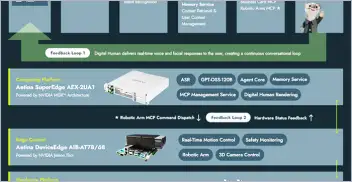
Edge computing gives AI agents the processing power to turn instructions into…

Daimon-TWM world model debuts for the public
Platform helps robots adapt to complex tasks

Look beyond the headlines for the latest in humanoid robots