By
Bob Trebilcock
September 1, 2019
Get news, papers, media and research delivered. Sign up for our free newsletters.
Stay up-to-date with news and resources you need to do your job. Research industry trends, compare companies and get weekly market intelligence with Robotics 24/7.
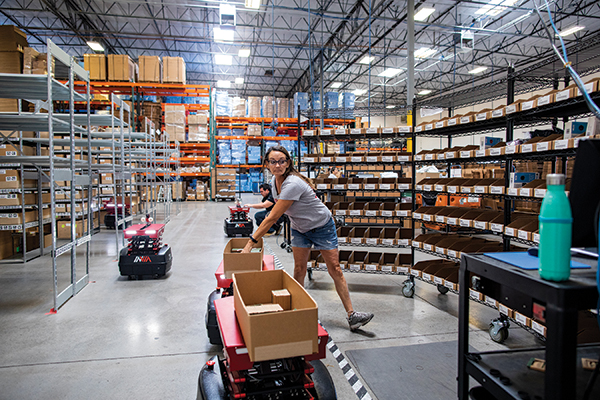
RSL is in the process of building out a different kind of network, with a different style of fulfillment center.
Receiving: RSL receives an advanced ship notification (ASN) for all incoming product. When it’s received (1) at the facility, it is counted twice and then scanned into RSL’s proprietary warehouse management system (WMS).
Product is placed into the storage bins used in picking, and storage can be at the single bin level or at the pallet level.
Putaway: Newly received product can be stored in a reserve storage location (2) or a pick location (3).
The lowest storage locations within the pick module are reserved for cartons that will replenish the active pick locations that are serviced by the robots, which have the ability to adjust their height.
The location is determined by the velocity of a product at the time it is received. That can change—an item going into reserve storage this week may go into a pick location the following week if demand for that item changes.
Picking: There are two picking processes. The first is a conventional pickto-cart process for items that can’t be handled by the robots because of their size or weight. Associates are directed by the WMS to a pick location (2), where they scan items to a location on the cart. Once all the items for that cart have been picked, an associate rolls it to a staging location, where another associate moves carts ready for packing to the pack location (4).

The order selectors get an empty cart and repeat the picking process. Second is the robotic picking process. The robot management system receives and analyzes a wave of orders from the WMS to determine the most efficient travel path. The robots travel to storage locations, where theyretrieve bin—each robot carries one bin at a time.
Once a bin has been retrieved, the robot travels to an order selector who is directed by the system to pick items (3) from a bin and put them into bins on a rack. Once all of the items from the first robot have been picked, the next robot moves up and the order selector repeats the process. Once all of the items for the rack have been picked, an associate moves it to packing (4) and gives the order selector an empty rack. The robots, in turn, return the bins to a storage location and are then directed to their next pick.
Packing: In the packing area (4), a packer scans the cart and is system directed on how to pack orders. Once all of the items for an order have been packed, the shipping container is conveyed to the shipping area, where it is labeled (5) according to the carrier selected for that order and then loaded onto a truck for delivery.
SQUARE FOOTAGE: RSL operates a total of 12 e-commerce fulfillment facilities, ranging in size from 50,000 to 75,000 square feet, with up to six more scheduled to go live by the end of the year.
PRODUCTS HANDLED: Varies by facility, but represents the e-commerce marketplace.
THROUGHPUT: Varies by facility and seasonality
SKUs: Varies by facility from as few as 100 to as many as 1,000,000.
PEOPLE/SHIFTS: Operations are 6 days per week and the number of shifts vary by the demands of the season and customer promotions.
ROBOTIC MATERIALS HANDLING: inVia Robotics
SYSTEM DESIGN, INTEGRATION AND WMS: Rakuten Super Logistics
MOBILE COMPUTING AND BAR CODE SCANNING FOR PICK TO CART: Panasonic
LIFT TRUCKS: Toyota Material Handling

Bob Trebilcock was the executive editor for Modern Materials Handling and an editorial advisor to Supply Chain Management Review. He has covered materials handling, technology, logistics, and supply chain topics for nearly 30 years. He is a graduate of Bowling Green State University. He retired in 202 but serves as a consultant to Modern and Peerless Media.
Autonomy Lift Trucks News Automation inVia Robotics Manufacturing Packaging Technology
Enjoyed this article? Add Robotics 24/7 as a preferred source in Google Search.
Edge computing gives AI agents the processing power to turn instructions into…
Daimon-TWM world model debuts for the public
Platform helps robots adapt to complex tasks

Look beyond the headlines for the latest in humanoid robots