Flexiv
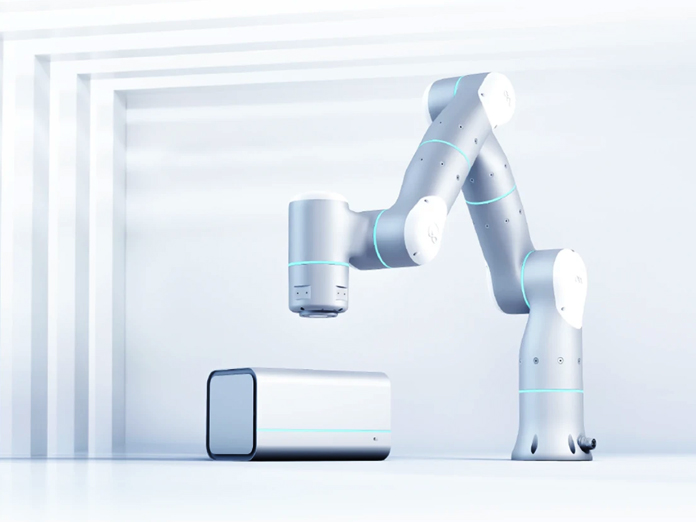
Flexiv's Rizon 4 series of adaptive robots are now supported by NVIDIA Isaac.
Get news, papers, media and research delivered. Sign up for our free newsletters.
Stay up-to-date with news and resources you need to do your job. Research industry trends, compare companies and get weekly market intelligence with Robotics 24/7.
Flexiv
Flexiv's Rizon 4 series of adaptive robots are now supported by NVIDIA Isaac.
Flexiv announced that its flagship Rizon 4 adaptive robot is now supported in NVIDIA Isaac. Flexiv said that this support includes a new contact-rich insertion reference workflow from NVIDIA built on NVIDIA Isaac Lab, Isaac ROS and Rizon 4.
The company said that the milestone brings Flexiv’s force-controlled technology into one of the most widely used robotics software platforms, giving developers a powerful new tool to build intelligent, adaptable systems - and makes the Rizon 4 one of the first seven-axis force-controlled robots supported in the Isaac ecosystem.
By integrating the Rizon 4 with NVIDIA’s high-performance software stack, Flexiv said that roboticists gain native access to hardware-accelerated packages optimized for NVIDIA GPUs.
”Support in NVIDIA Isaac demonstrates the utility of our force control technology,” said Shiquan Wang, Flexiv CEO. “As one of the first adaptive robots supported in this ecosystem, the Rizon 4 bridges the gap between high-level AI perception and physical adaptability. We’re enabling solutions that can respond dynamically with controllable contact to real-world conditions."
The company said that this support significantly reduces the computational overhead of AI, motion planning and real-time environment processing, allowing teams to focus on high-level application logic instead of low-level system optimization.
Flexiv said that insertion is one of the hardest problems in electronics assembly. Connector sockets shift by fractions of a millimeter between fixtures and cycles, tolerances are tight and a replayed trajectory cannot reliably absorb that variation. The company said that traditional position-controlled automation either over-constrains the part or damages it.
Flexiv said that NVIDIA’s new contact-rich insertion reference workflow addresses this with a reinforcement learning policy trained in simulation and transferred to real hardware. The company said that the first instance of the workflow is DisplayPort cable insertion, running on a Rizon 4 series arm with a Flexiv Grav gripper:
Flexiv said that the workflow and its simulation assets are being released so developers can reproduce the DisplayPort reference workflow and adapt the same recipe to their own connectors, sockets and fixtures.
Flexiv said that force-sensitive applications such as assembly, insertion and polishing have long fallen between two worlds: research platforms that are open but not production-ready, and industrial arms that are robust but closed.
The company said that Rizon 4 bridges that gap, which is what made it a fit for this workflow:
Flexiv added that those same properties are already being used in production settings: electronics manufacturers apply the Rizon platform’s force capabilities to tasks such as high-precision, contact-rich assembly, while physical AI developers build on the open SDK and integrated sensing for similar workflows.
Unlike traditional position-controlled robots that rely on rigid, pre-programmed trajectories, Flexiv said that the Rizon 4 can sense and adjust to contact forces in real time. The company said that this enables it to compensate for variability in object position, surface properties and material compliance, making it ideal for tasks that use AI-driven perception to make intelligent decisions about how to act.
Flexiv said that developers working with Rizon 4 can now use modular Isaac ROS GEMs - ready-to-use GPU-accelerated software modules that provide optimized building blocks for perception, navigation and manipulation - without writing custom low-level wrapper code.
The company said that these modules deliver high-performance capabilities out of the box, lowering technical barriers and shortening prototyping cycles. Flexiv added that the integration also provides a clear, production-ready path from NVIDIA Isaac Sim virtual testing to physical deployment, allowing teams to validate complex behaviors in simulation before transferring them to the real robot.
Artificial Intelligence Machine Learning Industrial Automation Robot Arm Components Controllers Grippers Motion Control Software Robot Operating System Simulation News Press Release Assembly Flexiv Force Sensing Mobile Manipulation NVIDIA Perception Physical AI Reinforcement learning Training
Enjoyed this article? Add Robotics 24/7 as a preferred source in Google Search.
Edge computing gives AI agents the processing power to turn instructions into…
Daimon-TWM world model debuts for the public
Platform helps robots adapt to complex tasks
Look beyond the headlines for the latest in humanoid robots