By
Bridget McCrea
June 11, 2019
Get news, papers, media and research delivered. Sign up for our free newsletters.
Stay up-to-date with news and resources you need to do your job. Research industry trends, compare companies and get weekly market intelligence with Robotics 24/7.
As a private-label cheese manufacturer, Masters Gallery Foods’ facilities are regularly inspected by current and potential partners as well as numerous third-party auditors. The company processes, ages and distributes a variety of cheese products for its customers. Major regional and national brand retailers and restaurants can get 8-ounce and 2-pound shredded cheese packages; industrial companies can order 640-pound blocks of aged Monterey Jack; and food service industry customers can specify 5- to 10-pound units in shredded, diced and cubed variations.
After doubling in size in 2000 and then doing the same in 2009, the Plymouth, Wisc.-based manufacturer needed a new facility to accommodate its steady, organic growth. That meant adding 240,000 square feet to its Plymouth facility and also building a new plant and warehouse in Oostburg, Wisc.
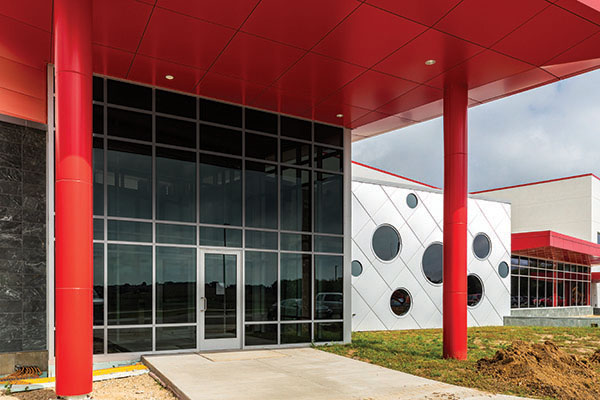
Open since June 2018, the latter is a 175,000-square-foot, state-of-the-art facility that incorporates a range of worker safety and ergonomic elements (Rite-Hite). “If I can keep our employees happy, that’s a big deal,” says Mark Wirtz, engineering manager. “Safety is a crucial part of that and an important ingredient to our success.”
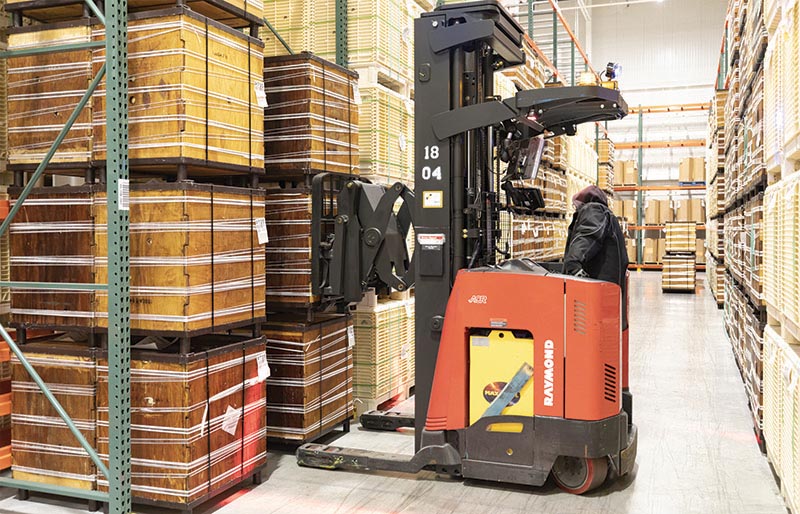
Masters Gallery Foods processes blocks of cheese weighing up to 640 pounds.
When plans for Masters Gallery’s new Oostburg plant were being developed, the company had to pick what types of high-speed doors it would use to separate manufacturing areas from production and finishing areas. Already using a few different types of doors in its Plymouth facility, the company decided that high-speed doors provided the right balance of safety and efficiency.
When a door malfunctioned in Masters Gallery’s Plymouth plant, for example, a specially trained technician had to work on the junction box (which could potentially produce arc flash). Working with the supplier, the manufacturer installed touchscreen control panels for the doors that employees can operate and program, thus eliminating the arc flash danger.
“Workers don’t have to wear gloves or other personal protective equipment when using the 7-inch LCD graphic user interface control screen,” Wirtz explains, noting that the new controls help improve plant productivity by providing real-time data on door usage.
The controls also incorporate a light-emitting diode (LED) timer screen. This lets employees know when the door is about to close. Working in conjunction with the door’s internal timers, the LED countdown display uses white numbers when the count is “3” or larger and the numbers turn to yellow for “2” and “1.” A red arrow appears when the door is about to close.
Additionally, the two FasTrax doors that connect the packaging area to a storage area use LED Virtual Vision devices. Although the doors don’t have vision panels (since condensation caused by temperature differences between the two areas would render the panels useless), the new technology allows workers to effectively “see” through the door.
“As a food plant, we can’t have any condensate, which is a warning sign for potential listeria problems,” says Wirtz, who needed a viable way to improve visibility for employees without installing windows in the company’s coolers (so pedestrians can see whether there’s a forklift on the other side of the door). “The problem is that any time you put a window in a cooler, you’re going to get condensation. I wanted to eliminate the windows.”
Wirtz got his wish. Now, when traffic is approaching the door from one side, the other side alerts workers with flashing red LEDs, minimizing the opportunity for dangerous collisions in the doorway area. “Forklifts in the packaging area can get moving pretty fast,” Wirtz says. “The LED Virtual Vision was a conscious decision we made to create a safer work environment for our employees.”
Being in the food production business, Masters Gallery needed warehouse doors that could not only move quickly, but also withstand some additional abuse. For example, they had to be able to stand up to everyday washdowns, which are required by Food and Drug Administration (FDA) and United States Department of Agriculture (USDA) regulations.
“There’s consistent traffic between the cooler storage areas and the warmer packaging areas, so we were more concerned with fast-acting doors with tight seals than slower-moving ones with high R-values,” Wirtz explains. “The extra speed of the doors we selected reduces the opportunity for air to move from one room to another and minimizes the chance someone hits them.”
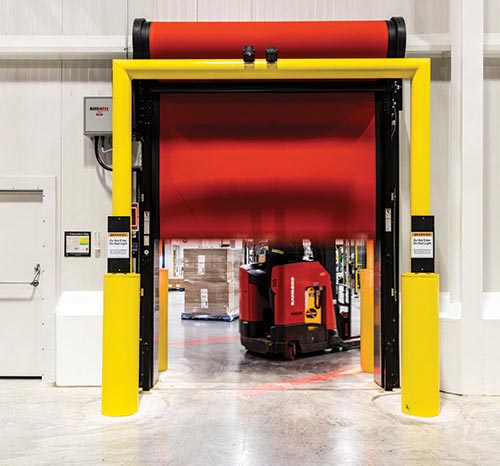 The Oostburg plant was outfitted with 11 high-speed FasTrax doors that operate at speeds of up to 100 inches per second. Of those, eight are FasTrax Clean doors, which are designed for cleaning and processing rooms due to their ability to withstand daily cleanings and washdowns. The doors’ one-piece radial header—which is machined from a single block of UHMW plastic—meets the USDA and FDA clean-up standards.
Three other FasTrax doors are used in the plant’s packaging and finishing environments—areas that don’t require washdown capabilities. “These doors do an excellent job of separating the cold environments of the storage and shipping areas from the warmer environments related to packaging and processing.
To keep everything clean in a plant where everybody must remove their shoes before entering, Masters Gallery uses a “drive-through” design to ensure the highest degree of temperature and environmental control in its Oostburg plant. Drive-through docks feature a vertical-storing leveler and a recessed pit, for example, allowing trailers to back all the way to the loading dock with their doors closed and security seal intact. The dock doors don’t open until they’re secured by the structure’s vehicle restraint.
At that point, the trailer’s security seal is broken and its doors are opened into the building—eliminating the cargo’s exposure to outside elements or contaminants (and minimizing the chance for tampering, pest intrusion or cargo theft). This dock setup also reduces energy loss due to outside air intrusion and enables easier cleaning and wash-down.
“To keep the shipping and receiving areas clean and secure, our good manufacturing practice and standard operating procedure policies don’t allow workers to go outside and come right back in without going through numerous procedures.” Wirtz said. “This setup allows us to do that, while simultaneously improving the cold chain.”
All of the Oostburg plant’s docks are equipped with vertical storing levelers and dock shelters. Specifically designed for drive-through applications, they provide an environmental seal between the back end of the semi-trailer and the inside of the loading dock. To help minimize the amount of warm outdoor air flowing into the building, the company also installed small vestibules that include air curtains around each dock position.
Using “shadow hook” technology, the Dok-Lok vehicle restraint secures all types of trailers, including ones with damaged or obstructed rear-impact guards (RIGs). Because it locks all types of trucks and trailers to the dock position, the vehicle restraint eliminates trailer-separating accidents.
“It gives our lift drivers peace of mind to know that the trailer isn’t going anywhere when they’re loading and unloading,” Wirtz says. “No one wants to be in a situation where they fall while carrying thousands of pounds of equipment and cheese.”
Wirtz says Masters Gallery’s new plant setup and traffic flow also reduced congestion that the company was grappling with in its flagship location. “We had a lot of people working in a tight area at our Plymouth plant, where having fast-moving doors required a lot of sensors to keep everyone safe,” he explains. “All of our safety systems worked perfectly, but reaction time was slow due to the high amount of congestion that we were dealing with.”
This situation presented some interesting challenges for a company that was clearly on a growth track. “Our company went from small to big over a pretty short period of time, and we suddenly found ourselves working with more levels of management and oversight,” says Wirtz. “With our new facility—and all of the safety and cleaning features we incorporated into it—our safety department can rest easy knowing that the congestion and other issues have been addressed. We hardly see those guys anymore.”
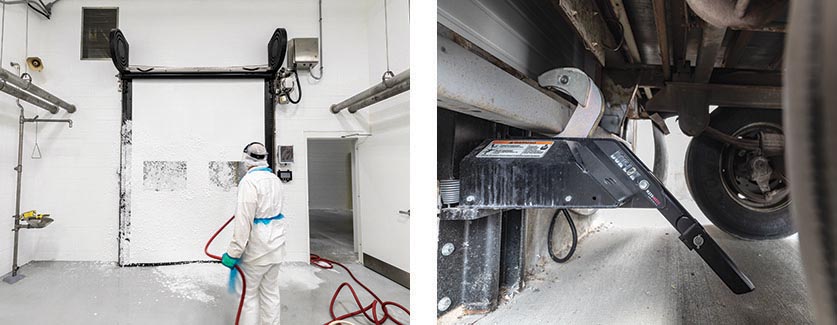
Left: FasTrax Clean doors are designed for cleaning and processing rooms due to their ability to withstand daily cleanings and washdowns. Right: The dock doors don’t open until they’re secured by the structure’s vehicle restraint.
To companies that are planning out their own facilities, Wirtz advises putting some extra energy into the planning process. “We spent a lot of time working with Rite-Hite to get heights of the parking lot correct so that all of its equipment worked seamlessly,” says Wirtz, who adds that facilities with positive or negative grades may need extra planning to work out correctly. “We spent a lot of time making sure we had that part right.”
According to Wirtz, Masters Gallery designed its new Oostburg facility with future expansion in mind, and that growth is already taking place. “All of the infrastructure is in place for the next addition,” he says. “Based on the good results we’ve had so far, we’ll just duplicate everything we’ve already done here.”

Bridget McCrea is an Editor at Large for Modern Materials Handling and a Contributing Editor for Logistics Management based in Clearwater, Fla. She has covered the transportation and supply chain space since 1996 and has covered all aspects of the industry for Modern Materials Handling, Logistics Management and Supply Chain Management Review. She can be reached at [email protected] , or on Twitter @BridgetMcCrea
Enjoyed this article? Add Robotics 24/7 as a preferred source in Google Search.
Edge computing gives AI agents the processing power to turn instructions into…
Daimon-TWM world model debuts for the public
Platform helps robots adapt to complex tasks

Look beyond the headlines for the latest in humanoid robots