By
Eugene Demaitre
June 7, 2022
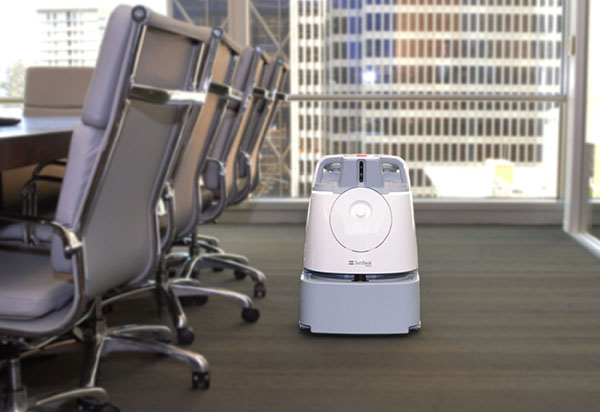
SoftBank Robotics
SBRA is branching out from its Whiz indoor cleaning robot to yard automation with ASI.
Get news, papers, media and research delivered. Sign up for our free newsletters.
Stay up-to-date with news and resources you need to do your job. Research industry trends, compare companies and get weekly market intelligence with Robotics 24/7.
SoftBank Robotics
SBRA is branching out from its Whiz indoor cleaning robot to yard automation with ASI.
SoftBank Group has been a significant investor in collaborative and service robotics. Its SoftBank Robotics America Inc. unit today announced a strategic development and equity partnership with Autonomous Solutions Inc., expanding its interest from indoor robots to automated ground vehicles.
As part of the agreement, San Francisco-based SoftBank Robotics America (SBRA) has acquired a minority stake in Petersboro, Utah-based Autonomous Solutions Inc. (ASI). The companies said their partnership "will expedite the development and deployment of a wide range of autonomous commercial service vehicles."
“We are very excited to work with ASI," stated Brady Watkins, general manager of SoftBank Robotics America. "With decades of cross-industry data and customer interaction and feedback, their Mobius technology platform is uniquely positioned for immediate scalable commercialization."
"This partnership enables SBRA to expand our focus on automation by addressing the same labor concerns for outdoor work that we have answered with our indoor solutions,” he added.
Tokyo-based SoftBank Robotics has offices in 12 cities worldwide, and its robots are used in more than 70 countries. The company has commercialized systems for cleaning, warehouse, retail, and other applications. It is known for its Whiz indoor cleaning robot, but how did it come to partner with ASI?
"Our focus is on creating value with automation in general," Watkins told Robotics 24/7. "We're evolving to cooperative robotics because we're seeing real labor shortages across multiple industries. There's a need to automate single-unit tasks. We have business units in different regions, and all of these problems are global."
The most immediate opportunities for SBRA and ASI to combine their technologies are in logistics and landscaping, he noted.
Autonomous Solutions Inc. said it has used more than 21 years of data and customer feedback from deployed systems to provide scalable hardware and software to help companies optimize their production. The company claimed that its technologies allow new and existing vehicle fleets to be quickly refitted and controlled from anywhere in the world.
Its Mobius platform uses artificial intelligence and machine learning to enable multi-vehicle coordination of remote-controlled, semi-autonomous, and fully autonomous vehicles to safely cooperate with human-driven equipment. ASI supports robotic applications in mining, agriculture, construction, security, defense, material handling, and autonomous car testing and validation.
“SoftBank Robotics America is leading the way in the scaling of robot commercialization, and we are thrilled with the complementary strengths we are now fusing together to solve the crippling labor and efficiency challenges facing industry,” said Mel Torrie, CEO of Autonomous Solutions Inc.
Are there similarities in technologies such as SBRA's Whiz and ASI's automated yard vehicles?
"We solved indoor automation with Whiz, and we saw similar challenges in terms of technologies and driving sustainable scale," said Watkins. "Indoor and outdoor systems are very different, but they both work around people, require orchestration, and have willing marketplaces."
"We like [ASI's] industry-agnostic approach -- it's not focused on a single vertical but is instead building on years of experience accelerating automation in an outdoor format," he said. "We're constantly searching for products and partners that do those things."
However, while the cost of cameras and lidar sensors has dropped thanks to smartphone and autonomous vehicle development, scaling depends as much on understanding applications as as it does on enabling components, Watkins said.
"ASI has implemented its stack in real-world environments, and it leverages different navigation equipment within its machines," he said. "This will bring commercial success faster, rather than just technology looking for a problem."
"The Fourth Industrial Revolution is all about change management and workforce transformation," said Watkins. "By integrating technology with labor, companies can provide more predictable, efficient service. Our focus is on evolution -- it's not either people or robots."
"There are plenty of tasks people don't want to do, but robots offer alternatives," he said. "We want to involve people -- whether its a janitor or a dock worker -- they can become robot managers."
"We're focusing all around the building, whether it's a warehouse, a corporate office, or residential," Watkins said. "You want persistent performance for mining, cleaning, or movement. We're creating scenarios for robots in landscaping and logistics."
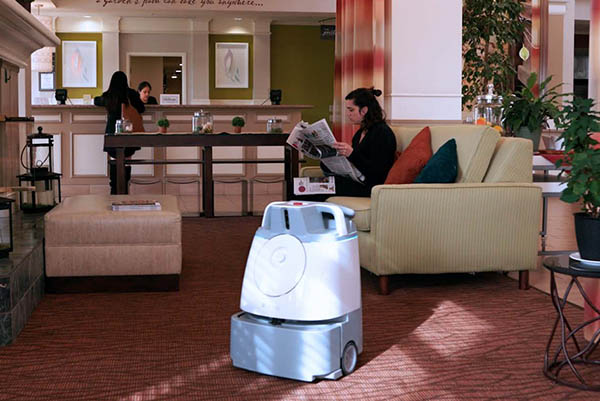
Watkins said he can envision orchestration and interoperabilty between systems such as autonomous lift trucks and dock vehicles.
"You can imagine a scenario where we could drive service value," said Watkins. "With a centralized way to understand data and drive, and multiple points indoors and outdoors, you could create more efficiencies. It's a matter of understanding the value proposition and then having the technology and data flow for specific action."
"With our Whiz Connect software and Mobius, we can see a future where that's possible," he said. "Within the next 12 months, we expect to be on the market with a joint solution."
"It's a testament to the readiness of Mobius and the time to market ASI has had over more than 20 years," Watkins concluded. "Only a company like SoftBank can go from assessment to scalability. We want to help companies go to market with technical due diligence and our enterprise experience."
Whiz Connect is a software-as-a-service application that helps users track cleaning metrics and measure their return on investment. It works in partnership with Whiz, SoftBank Robotics' automatic sweeper robot.

Eugene Demaitre was editorial director of Robotics 24/7. Prior to joining Peerless Media, he was a senior editor at Robotics Business Review and The Robot Report. Demaitre has also worked for BNA (now part of Bloomberg), Computerworld, and TechTarget. He has participated in numerous robotics-related webinars, podcasts, and events worldwide.

Ultrasonic sensing enhances robotics perception
Cybernetix Ventures’ event kicks off Robotics Tech Week 2026 slate of events
Preview the manufacturing and warehouse components that will be on the…
Preview the manufacturing and warehouse robots and software that will be on…