By
Donald Halsing
May 20, 2025

Texas Instruments
Texas Instruments latest analog-to-digital converters equipped with isolated modulators can help improve robot dexterity for precision applications through feedback loops.
Get news, papers, media and research delivered. Sign up for our free newsletters.
Stay up-to-date with news and resources you need to do your job. Research industry trends, compare companies and get weekly market intelligence with Robotics 24/7.

Texas Instruments
Texas Instruments latest analog-to-digital converters equipped with isolated modulators can help improve robot dexterity for precision applications through feedback loops.
Ensuring electrical isolation at key points is an essential step when designing robot components.

“There are different types of isolation: there's inductive, there's capacitive, and there's optical.” said Kia Rahbar, Texas Instruments product marketing manager for isolated converters. “Isolation is used for preventing unwanted high-voltage DC and AC currents from transferring to the low voltage domain.”
Isolation can be used for ground loop breaking, surge protection, and can even help reduce digital noise. It is also critical for maintaining functional safety.
“If it's somewhere a human could touch the low voltage side, if there's not that isolation barrier between the high and low voltage, it could lead to harm for a human who interacts with it,” Rahbar said.
TI’s latest functionally isolated modulators, installed in its analog-to-digital converters (ADCs), use galvanic isolation that can help improve fine motor control in robots using feedback loop sensing.
Modulators work by measuring current across a shunt with an analog input, usually the power being fed to a motor. Measuring motor current to enable control of that motor requires a sensing device and a resistance.

"You want to select a resistance so that it matches the input range of our current sensing device,” Rahbar said.
TI’s newest current sensing modulators can handle different voltage input ranges. The AMC0106M05 can accept +/- 50 millivolts (mV) while the AMC0106M25 can handle +/- 250mV.
“If you use the 50mV input, you can use a smaller shunt resistor, enabling lower power consumption within the system,” Rahbar said. “But if you want greater resolution - you want a larger-scale measurement of the current - then you could use a larger resistor and then do a 250mV input device.”
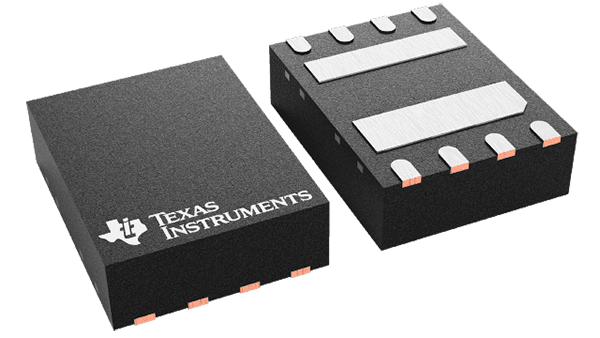
The AMC0136 for voltage sensing can accept +/- 1V input, which can be achieved by using a resistor ladder to step down from higher voltages. Because it can receive bidirectional inputs, this modulator can be used for either DC or AC measurement.
Each ADC contains a delta sigma modulator, which converts the analog resistance measurement into a digital signal.
“That digital signal is then sent across the isolation barrier and outputted from our device,” Rahbar said. “Inside of the microcontroller, you will have digital filtering, which we call SDFM capabilities - sigma delta filter module. That's where you will interface our product to the microcontroller.”
Digital feedback from TI’s ADCs can be used by microcontrollers to adjust the power supply to a motor through a real-time control loop.
Power entering multi-phase electrical motors is controlled by field-effect transistors (FET) and gate drivers. TI’s ADCs measure the current for each phase of the motor and send that measurement to the microcontroller.
“The microcontroller will then send out a pulse width modulation (PWM) signal to the gate driver to tell you the rate at which the gate driver should switch the FETs,” Rahbar said. “And this rate on which you're switching the FETs will affect how much current is going to be driven to the motor.”
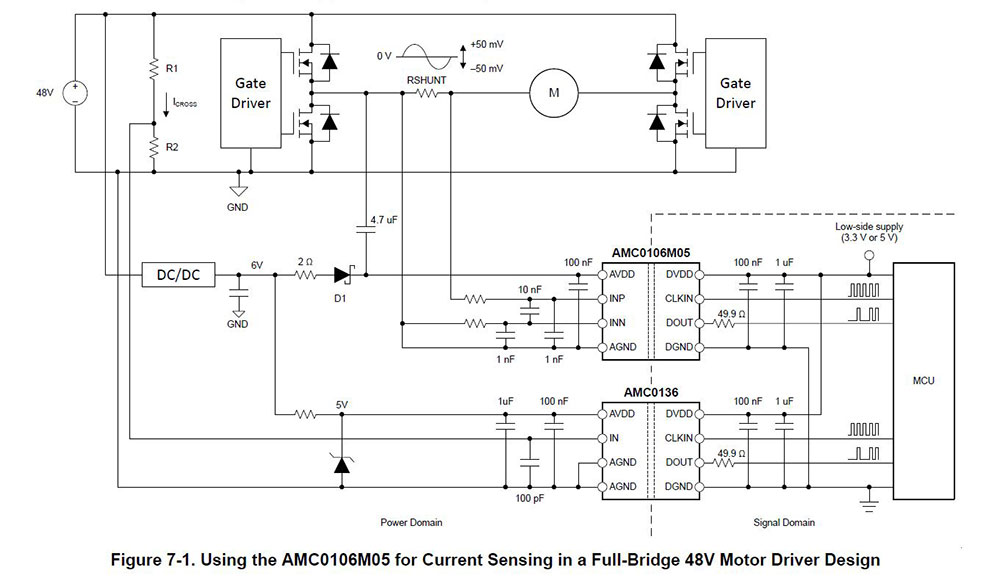
A microcontroller on its own can send power to a motor, but it cannot tell if the right amount of power is being sent. TI’s ADCs tell the microcontroller how much current is actually being sent.
“With precise current measurements, you can optimize the rate at which the gate drivers switch the FETs to drive the motor.”
Processors sample data at a specific rate known as an oversampling rate (OSR).
“And as you sample it to a greater OSR, you'll get a higher effective number of bits (ENOB) for the measurement,” Rahbar said.
He added ENOB is a measure of converter performance as compared to the theoretical ideal signal-to-noise ratio (SNR) limit based on quantization noise.
For applications such as electric vehicle chargers or solar inverters, Rahbar said analog isolated amplifiers are sufficient. These voltage sampling applications do not require frequent, high-resolution data.
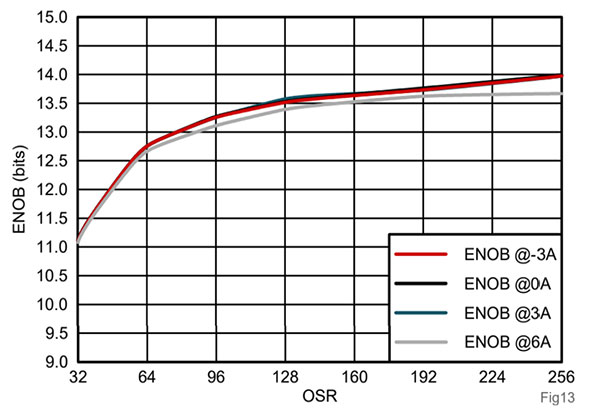
“One of the key values of the modulator is the resolution,” he added. “When you're doing motor control, precision is everything, and that is where you need the modulator functionality - that higher resolution functionality.”
TI’s ADCs can achieve 12-14 ENOB. This resolution permits more accurate current measurements, which in turn allows for more precise motion control.
“For example, if you think of a humanoid robot, where they have so many joints in there because they're replicating the motions of a human - you have your elbows, you have your shoulders - you need good precision for the motors to be able to do the same functionality that a human would be doing,” Rahbar said. “So by having a higher resolution sensing solution with these isolated modulators, you can enable the capability to do those precise actions.”
Control subsystems for robot motor and servo drives need to fit a lot of computing chips in small spaces, oftentimes on printed circuit boards (PCBs) only an inch or two in diameter.
“A lot of the products that exist for motor control are more for those industrial DC servos, industrial AC inverters, where size isn’t as important,” Rahbar said. “The big thing we see today is a request for the smaller-size solution, and that's part of the reason we also invested in these functional isolation products to help with that size reduction.”
TI’s latest functional isolators measure only 0.14 by 0.11 inches (3.5 by 2.7 millimeters).
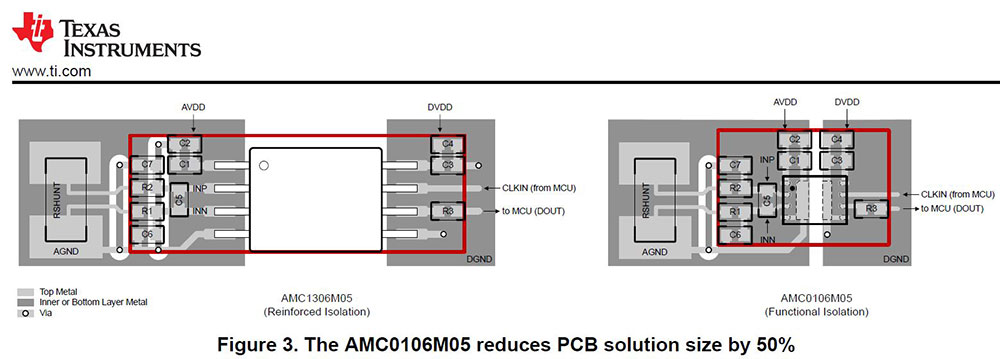
“The functional isolation solution gives you a smaller isolated sensing device in comparison to what previously existed with the reinforced type of isolation,” Rahbar said. “We wanted to create a product that is not only providing that capability of a modulator output, but also doing it in that smaller solution size, and with the functional isolation packaging.”
Because of their small size, TI’s new ADCs are suitable for compact robot designs, such as on small circular band PCBs in the joints of surgical robot arms and humanoids, where precision is an absolute necessity for dexterity. But Rahbar said they can also be used in any other type of industrial robot that operates in a manufacturing facility today.
“Factories do benefit from using modulators,” he added. “They may be using reinforced isolation, since the voltages are going to be higher in those cases, but there is still a value proposition for isolated modulators.”

Donald Halsing is Associate editor of Robotics247.com. As an editor and journalist with a Bachelor of Arts in English from Framingham State University, he has a strong background in developing engaging and impactful stories for print and digital media. In addition to serving as Editor-in-Chief of Framingham State’s award-winning independent student newspaper, “The Gatepost,” Don spent over four years in operations at Mattress Firm, with his primary responsibilities including inventory control and inventory management. Don is currently pursuing his Master of Arts at FSU and is a professional photographer for Ashley Wall Photography
Enjoyed this article? Add Robotics 24/7 as a preferred source in Google Search.

Edge computing gives AI agents the processing power to turn instructions into…
Daimon-TWM world model debuts for the public

Platform helps robots adapt to complex tasks

Look beyond the headlines for the latest in humanoid robots