Get news, papers, media and research delivered. Sign up for our free newsletters.
Stay up-to-date with news and resources you need to do your job. Research industry trends, compare companies and get weekly market intelligence with Robotics 24/7.
To increase throughput and order fulfillment speed in a challenging labor market, Evergreen Enterprises implemented a fleet of autonomous mobile robots (AMRs) at their Richmond, Virginia warehouse. The wholesale home and garden décor retailer, headquartered at the same location, had relied on 90 associates to push picking carts through static storage racks to manually pick orders across two shifts. But the operation found it difficult to scale up during seasonal peak periods and maintain order accuracy and inventory control.
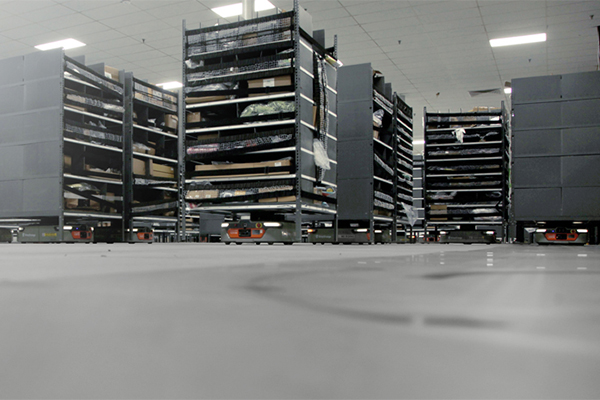
Evergreen selected GreyOrange’s Ranger RTP M 3.0 goods-to-person AMRs powered by GreyMatter warehouse orchestration software. Driven by artificial intelligence (AI), the new system supports Evergreen’s desire to scale up throughput on demand. GreyMatter directs the fleet of 100 AMRs - deployed in two phases - to retrieve inventory stored on 450 multi-level mobile storage racks and present it to 21 associates working across 14 pick/put stations. Integrated screens direct picks, while scanning processes increase accuracy. Once the required items are picked, AMRs return the mobile racks back to their storage area.
Roughly 80,000 square feet of Evergreen’s facility is dedicated to warehousing and order fulfillment activities. When the company initially undertook the project, the operation was only using two-thirds of that space. Leadership decided to pilot the automated solution in the empty 20,000 square feet first, to verify proof of concept.
Evergreen moved all its inventory and fulfillment processes into the 20,000-square-foot space and began using their new automated solution. But the existing flooring proved to be problematic almost immediately.
Lee Crowe, Director of Visual Brand Management at Evergreen:
“This warehouse facility was previously a grocery store built around 1970. The floor was covered in multiple materials, including vinyl tile adhered to concrete. It simply couldn’t stand up to the AMR traffic.”
With each AMR transporting loaded racks weighing up to 1,320 pounds apiece, the facility’s existing floor surface quickly showed signs of wear.
&ldldquo;The AMRs travel on a combination of two drive wheels and several polyurethane casters. When the AMR turns, the casters snap either 90- or 180-degrees to make a precise change in direction,” explained Bower. “However, that creates a lot of wear on the floor.”
Not only do worn, damaged floors prevent AMRs from traveling smoothly and predictably along their workflow paths, but they also generate dust and debris. Through GreyMatter, Evergreen reset the AMRs’ travel paths to avoid areas with wear as a short-term workaround. However, Bower and Crowe realized they needed to find a new flooring solution that would provide long-term durability and wear resistance.

In researching alternative options, Evergreen ruled out removing the existing flooring surface or pouring a new concrete floor. “Both processes would have been costly and exceptionally disruptive to the operation - which continued to fill orders during the project. To do either would require the building to be completely emptied. Neither option was feasible,” said Bower.
While searching for a different alternative, Evergreen’s operations team discovered ResinDek® mobile robot flooring panels from Cornerstone Specialty Wood Products.
Dave Paquin, Director of Robotic Sales for Cornerstone:
“AMRs use sensors and machine vision technologies to read fiducial markers - similar to QR codes - affixed to the floor as they navigate through an operation. The sensors’ function can be adversely affected by surface gloss".
Paquin continued:
“Additionally, to operate as expected, AMRs require floor surfaces to have a very specific coefficient of friction, surface roughness, levelness, and durability. For that reason, every floor we design is custom manufactured to meet the operation’s specified load capacities and traffic volumes. Further, all ResinDek robotic floor panels have a customized finish to ensure the operation attains the optimal AMR performance and throughput."

In discussing Evergreen’s specific situation, Paquin recommended installing ResinDek with TriGard® ESD Ultra Coating. The finish provides exceptional wear resistance, making it ideal for ultra-high repetitive robotic traffic traveling repeatedly over defined paths. Additionally, to shield the AMRs’ sensitive electronic equipment from static electricity damage, TriGard ESD Ultra incorporates electrostatic dissipative (ESD) protection that complies with ANSI/ESD Association specifications.
“We had some concerns about how the AMRs would react to the seams where the ResinDek flooring panels meet,” recalled Bower. “To prove the robotic sensors would track to the QR codes and not to the seams, the Cornerstone team flew out to help us test the AMRs’ performance on the floors. We were really happy with that level of customer service.”

For assistance in specifying and installing the ResinDek panels, Evergreen engaged Legacy Platform. Working with Legacy Vice President John Sloan, Bower and Crowe decided the least disruptive course of action would be to lay the floor over the empty side of the building.
The vinyl flooring in this area had several areas that were visibly out of level. Due to the quirks of an older building, the flooring in this side of the operation was also 3/8-inch lower than the area in which the AMRs had initially been deployed.
Legacy Vice President John Sloan:
“While it is possible to install the ResinDek panels directly over an existing floor surface, we needed to remediate any significant slopes or swale areas first. That ensures that the finished floor is perfectly level and suitable for AMR navigation.”
Legacy brought in a firm to conduct a floor survey and generate a 3-dimensional map of its elevation variances. Sloan and his team applied an epoxy compound to level the areas with the most extreme inconsistencies. Additionally, shims placed under the floor panels during their installation addressed smaller areas of concern. Sloan also shared the floor survey map with Cornerstone’s engineers to help inform their recommendation of the optimal ResinDek robotic floor panel to install.
Sloan continues:
“For the 3/8-inch lower side of the building, Cornerstone recommended their ResinDek Xspan flooring material, which measures 1-1/8-inch thick. For the other side, which was 3/8-inch higher, Cornerstone recommended their 3/4-inch-thick ResinDek HD flooring.”
Dave Paquin:
“The difference in the thickness of the two panels compensated for the height variance in the building’s floor surface, creating a perfectly flat floor where they met in the middle. Using the same ResinDek panel on both halves of the facility would have created a gap or elevation change at that point, which was problematic for the AMRs to negotiate.”
Both thicknesses of ResinDek panels were installed directly over the existing floor. Capable of handling dynamic robot loads up to 5,000 pounds, the ResinDek flooring’s capacity is nearly four times the total weight of each fully loaded AMR, significantly reducing the risk of wear.
As soon as the ResinDek Xspan panels arrived, Legacy’s installation team got to work. In September 2023, they installed the panels across the empty space in under four weeks. Once that was complete, Evergreen re-located its operations into that side of the building, vacating the other side.
John Sloan:
“We then returned in October 2024 to install the ResinDek HD panels on the original 20,000-square-foot side. This time, ResinDek pre-drilled the floor panels before shipping them to Evergreen. That meant the installers only needed to drill into the concrete through the holes, then secure the panels to the concrete with a fastener. It was also a smaller space. Both factors cut the installation time down to 10 days.”
After a few months of use, Bower and Crowe noted that the ResinDek flooring subjected to the heaviest AMR traffic - at its pick/put stations where operators selected inventory from the mobile storage racks - was showing signs of wear. Cornerstone’s Paquin recommended replacing those specific panels with MetaGard GVT, which features galvanized steel encapsulating the top and sides of a ResinDek panel.
“One of the advantages of the ResinDek floor panels is that it’s really easy, clean, and straightforward to replace a single panel without taking up the entire floor,” said Bower. “That meant replacing certain panels with the MetaGard panels was easy. It’s comforting to know that if a panel develops wear, it’s not a big deal to replace it.”

“Today, Evergreen has 100 AMRs deployed in a 60,000-square-foot robotic field. With the new ResinDek floors, Evergreen has been able to speed up the AMRs’ travel rates. They’ve also been able to use the entire area, as they no longer have to set robot paths to avoid areas with high wear spots,” added Crowe.
“We’ve also gone from two shifts to one and are filling our peak order volumes with just 28 people instead of the 90 we needed pre-robots,” he said. That allowed Evergreen to make use of their entire facility in time for the peak holiday shipping period.
“In our experience, Cornerstone was really good to work with. The whole team was great, responsive, and we never had any major challenges,” concluded Bower.

Ultrasonic sensing enhances robotics perception

World's first omni-modal evaluation including tactile sensing for…

Cybernetix Ventures’ event kicks off Robotics Tech Week 2026 slate of events

Preview the manufacturing and warehouse components that will be on the…