By
Patrick Burnson
July 10, 2020

Get news, papers, media and research delivered. Sign up for our free newsletters.
Stay up-to-date with news and resources you need to do your job. Research industry trends, compare companies and get weekly market intelligence with Robotics 24/7.

For many industry thought leaders, analysts and educators, the impact made by the COVID-19 pandemic has yet to realign the current third-party logistics (3PL) marketplace. But when it does, shippers may expect far greater reliance on innovative technologies requiring substantial capital investment.
“Given the massive coronavirus windfall for omni-channel and e-commerce companies, some might think that 3PLs have a tremendous opportunity,” says Michael Gravier, associate professor of marketing and supply chain management at Bryant University. “Even before this disruption, the world was a volatile place with tariffs and raw material costs fluctuating as quickly in response to Twitter blasts. And it was pushing companies to focus more on innovation based on core competences and allowing 3PL’s to take more charge of supply chains.”
These trends before the virus struck indicated that 3PLs were increasing their strategic importance greatly, adds Gravier, with the focus on the “fourth industrial revolution” providing a tantalizing opportunity for them if only they could capitalize on their roles as integrators and supply chain matchmakers.
“But the virus has also polarized the 3PL world,” he observes. “At one end of the spectrum, the great wall of doubt must be overcome, as there’s a long-standing mistrust between 3PLs and shippers. This is a fundamental disconnect common to any outsourced relationship because the shippers don’t understand the 3PL’s world, yet they must rely on them.”
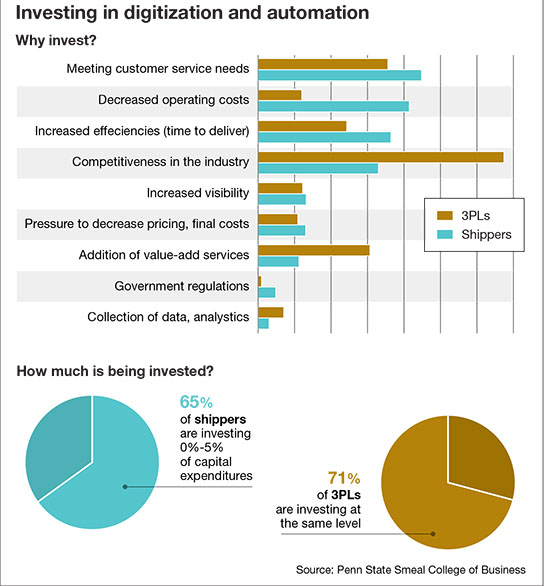 For Gravier, 3PLs that find the successful combination of warehouse robotics, Internet of Things, artificial intelligence, blockchain, and organizational culture are going to see exponential growth—but the time for providers to invest in these technologies is now. “Those 3PLs that adopt the right digital technologies to facilitate strategic competitiveness of their shippers will be among the first to succeed in this new environment,” he adds.
Gravier was intrigued by a recent paper written by Andy Johnston, director of innovation at Geodis, a global 3PL racing to embrace digitization. In “The Rise of Robotics in the 3PL Industry,” he examines how using robotics in the 3PL warehouse enhances—not replaces—the workforce and thus helps to increase overall efficiencies for global shippers.
“Working with robotics can make employees more efficient, and not just by reducing the physical needs on the job,” says Johnson. “Robots with an intuitive user interface that ‘speak’ multiple languages can reduce training times up to 50%. When many operations offer a pay-for-performance incentive, any saved training time can help both the brand and the employee.”
Gartner analyst Courtney Rogerson agrees that 3PLs will rely on robotics and other digitized strategies as part of managing ever-increasing logistics complexity while simultaneously improving visibility. “As demands expand the scope and scale of potential services, 3PLs must weave deeper into the fabric of a shipper’s supply chain,” she concludes.

Mr. Burnson is a widely-published writer and editor specializing in international trade, global logistics, and supply chain management. He is based in San Francisco, where he provides a Pacific Rim perspective on industry trends and forecasts.
Enjoyed this article? Add Robotics 24/7 as a preferred source in Google Search.
Edge computing gives AI agents the processing power to turn instructions into…
Daimon-TWM world model debuts for the public
Platform helps robots adapt to complex tasks

Look beyond the headlines for the latest in humanoid robots