By
Beth Stackpole
February 18, 2021
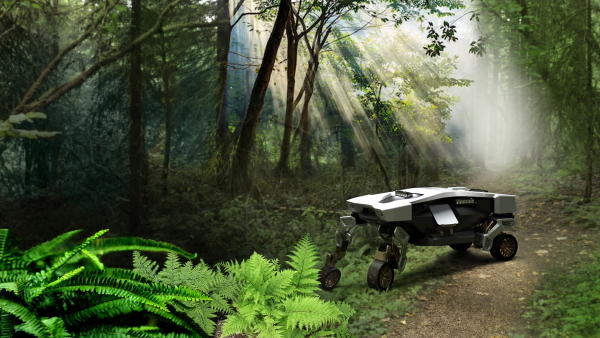
Hyundai Motor Group
The TIGER un-crewed ultimate mobility vehicle (UMV) boasts a variety of parts lightweighted through Autodesk generative design tools and additive manufacturing. Image Courtesy of Hyundai Motor Group.
Get news, papers, media and research delivered. Sign up for our free newsletters.
Stay up-to-date with news and resources you need to do your job. Research industry trends, compare companies and get weekly market intelligence with Robotics 24/7.
Hyundai Motor Group
The TIGER un-crewed ultimate mobility vehicle (UMV) boasts a variety of parts lightweighted through Autodesk generative design tools and additive manufacturing. Image Courtesy of Hyundai Motor Group.
When creating something as unique as the first un-crewed Ultimate Mobility Vehicle (UMV), it makes sense that an R&D team would take a novel approach to design.
Hyundai Motor Group’s New Horizons Studio, established in late 2020 to draw on research from Silicon Valley and other innovation hubs to create a new class of intelligent mobility vehicles, is doing just that with its latest concept models. The studio is leveraging an on-going partnership with Autodesk to wield advanced technologies like generative design (GD) software and additive manufacturing (AM) to deliver TIGER (Transforming Intelligent Ground Excursion Robot), a concept vehicle announced earlier this month.
As a follow-on to Elevate, its first UMV concept with moveable legs, the TIGER X-1 concept vehicle is based on a modular platform architecture that includes a sophisticated leg and wheel locomotion system, 360-degree directional controls, and a range of sensors for remote observation. The UMV can transform from four-wheel drive to four-leg walking and operate without a crew to perform different missions such as delivery in urban settings, transport of critical supplies in remote environments, or carrying sensors and instruments as part of a mobile scientific exploration platform.
TIGER X-1’s modular platform and leg-wheel articulation are what sets it apart from other mobility solutions as it enables the vehicle to handle a range of extreme situations while keeping payloads more level than a typical ground vehicle. “We believe the combination of leg robotics and wheels results in vehicles of unprecedented mobility,” says Dr. John Suh, head of New Horizons Studio.
When its legs are retracted, TIGER performs at its most efficient, driving like an all-wheel drive vehicle. When the vehicle gets stuck or needs to traverse uneven or impassable terrain, it can switch to walking mode. “We use the walking capabilities to keep moving when other vehicles can’t,” Suh says. The unit can also connect to unmanned aerial vehicles (UAVs), for communications during complicated explorations or for charging TIGER’s batteries when in inaccessible locations.
Key to the development effort was Hyundai’s open innovation approach. The New Horizons Studio team worked with Autodesk on lightweighting parts and components, leveraging Autodesk’s 360 Fusion and generative design capabilities to design specifically for additive manufacturing (DfAM). TIGER X-1’s legs, wheels, chassis, and tires were all concepted with generative design capabilities and then produced using carbon fiber composite AM techniques.
The combination of generative design and AM was critical to helping the New Horizons team achieve its strength and durability design objectives using the least amount of material, Suh says. The design approach was also key to eliminating a number of assembly applications, which together with the material choices, helped in the lightweighting strategy.
“AM lets you minimize or eliminate the need for assembly, which gives you a chance to reduce weight,” he explains. “Every ounce of this vehicle counts—there is no room for an extra gram of weight.”
While the team is using AM to produce components for the concept vehicle, it will reevaluate AM and its consolidated design strategy as the Elevate and TIGER get closer to mass production, depending on such factors as design for repairability, for example. “Even if we could single print a chassis, the better strategy might be to break it into components for repair,” Suh explains. “It is still an evolving discipline and needs to be explored.”
For more on TIGER and Hyundai’s development effort, watch this video.

Beth Stackpole is a contributing editor to the Digital Engineering 24/7 and Robotics 24/7 sites.
Enjoyed this article? Add Robotics 24/7 as a preferred source in Google Search.
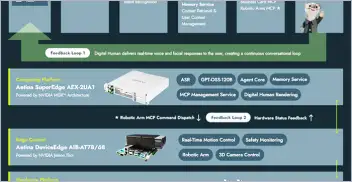
Edge computing gives AI agents the processing power to turn instructions into…
Daimon-TWM world model debuts for the public
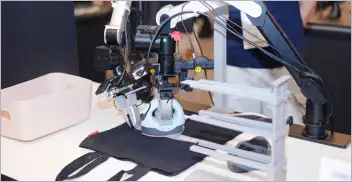
Platform helps robots adapt to complex tasks
Look beyond the headlines for the latest in humanoid robots