AMD
AMD said its expanded Ryzen AI embedded processor portfolio enables next-generation industrial and robotics offerings with up to twice the CPU cores and higher AI throughput in the same compact footprint.
Get news, papers, media and research delivered. Sign up for our free newsletters.
Stay up-to-date with news and resources you need to do your job. Research industry trends, compare companies and get weekly market intelligence with Robotics 24/7.

AMD
AMD said its expanded Ryzen AI embedded processor portfolio enables next-generation industrial and robotics offerings with up to twice the CPU cores and higher AI throughput in the same compact footprint.
Advanced Micro Devices (AMD) said that factory automation, physical AI in mobile robotics and other AI-driven edge applications are rapidly evolving and driving the need for computing platforms that provide real-time AI processing, deterministic performance and long-term reliability in always-on environments.
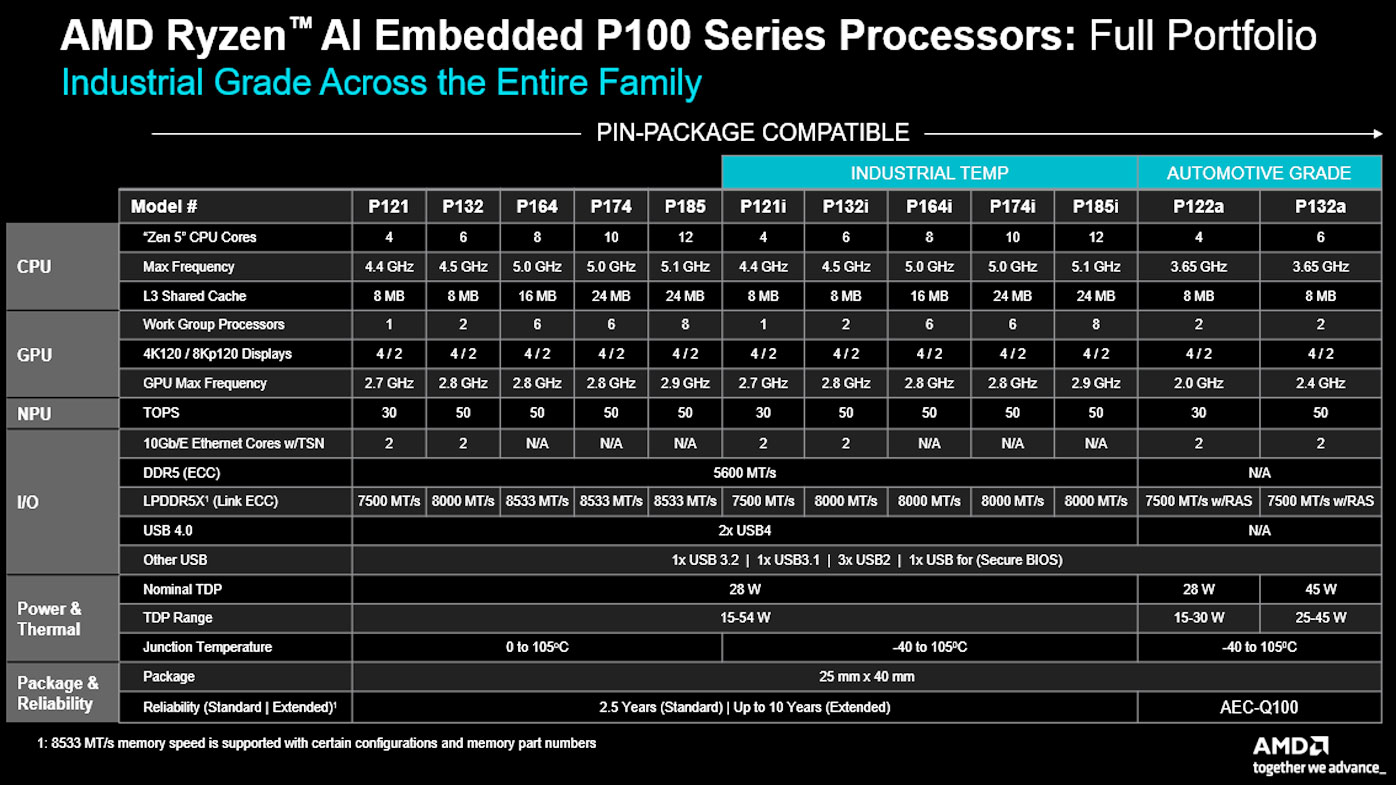
To meet these needs, AMD said it is expanding its AMD Ryzen AI Embedded P100 Series processor portfolio. The company said that its new processors feature up to 2x higher CPU core counts, up to 8x higher graphics processing unit (GPU) compute and an estimated 36% higher system tera operations per second (TOPS) of performance compared with the previously announced P100 Series processors in the same compact ball grid array (BGA) package1.
The company stated that its new P100 Series processors offer AMD ROCm software support, providing developers and system designers with an expanded and scalable portfolio of power-efficient edge computing offerings. The processors support real-time AI, from vision to control and reasoning, and offer advanced graphics capabilities. They also support industrial temperature ranges (- 40 °C to 105°C), continuous 24/7 operations, and 10-year life cycles.
AMD said that the processors feature eight to 12 “Zen 5” cores, up to 80 system TOPS for physical AI acceleration, AMD RDNA™ 3.5 graphics for real-time visualization and a neural processing unit (NPU) based on the AMD XDNA 2 architecture for low-latency, power-efficient AI inference - all on a single chip.
"The AMD Ryzen AI Embedded platform is a game changer for industrial and AI-driven applications at the edge,” said Thomas Stanik, senior sales & business development manager, Kontron. “Our P100-based K4131-Px mITX will be equipped with four-core to 12-core APUs, allowing us to offer customers an array of solutions that deliver high compute performance and AI acceleration in the same compact footprint."
From industrial PCs for the intelligent factory to autonomous robots and medical imaging devices, AMD said that the new x86 embedded processors are optimized for next-generation industrial and broader edge AI use cases, including:
Compared with the prior generation AMD Ryzen Embedded 8000 Series, the company said its P100 Series is expected to provide up to 39% higher multithreaded performance and up to 2.1x higher total system TOPS2. AMD said that the new processors deliver exceptional AI performance-per-watt and support almost twice the number of virtual machines and bigger large language models, like Llama3.2-Vision 11B, than the existing P100 Series to enable more advanced AI and mixed workloads.
"With the launch of the AMD Ryzen AI Embedded P100 Series, congatec is able to expand its computer-on-module portfolio for embedded computing and edge applications with a highly versatile platform,” said Florian Drittenthaler, product line manager, congatec. “It enables customers to precisely tailor performance, power and cost to their specific application needs by offering four to 12 CPU cores and highly scalable GPU performance. This extraordinary level of flexibility is essential as edge workloads become more diverse, from industrial automation to AI-accelerated systems.”
ROCm software support and virtualized reference stack
AMD said that support for its ROCm open software ecosystem brings a proven, open-source AI software stack to embedded applications. Developers can run standard AI frameworks while relying on open-source compilers, runtimes and libraries - all while having immediate access to embedded-ready models without rewriting code. At the programming level, ROCm software uses the open-source Heterogeneous Computing Interface for Portability (HIP), decoupling GPU programming from the hardware and eliminating vendor lock-in between the software stack and the hardware.
AMD said that the tightly integrated CPU, GPU and NPU architecture enables efficient workload partitioning and predictable latency under mixed workloads, while the use of familiar frameworks and software stacks helps simplify and streamline development and deployment across broad use cases. The company said that this level of integration enables advanced compute and graphics capabilities without the need for additional external components, making it easier for OEMs and system integrators to design scalable platforms.
AMD said its “Zen 5” CPU cores provide the isolation and performance headroom to consolidate multiple critical workloads on a single platform with deterministic, multitasking behavior. Additionally, AMD said that it delivers a packaged and vertically integrated virtualized reference stack for industrial mixed-criticality applications. Built on the Xen hypervisor, it runs Linux, Windows, Ubuntu and RTOS environments in isolated domains to deliver safety, real-time performance and flexibility. The result is a scalable, open architecture that simplifies design and accelerates development for next-generation embedded systems.
GENISOM AI makes ICRA debut at conference in Vienna

World's first omni-modal evaluation including tactile sensing for…

North America’s largest robotics and automation event winds down

Automate’s largest day ever draws huge crowds to McCormick Place