GENISOM AI
The GENISOM L1 EDU is designed as a research and secondary-development platform for SLAM, autonomous navigation, and embodied AI applications.
Get news, papers, media and research delivered. Sign up for our free newsletters.
Stay up-to-date with news and resources you need to do your job. Research industry trends, compare companies and get weekly market intelligence with Robotics 24/7.
GENISOM AI
The GENISOM L1 EDU is designed as a research and secondary-development platform for SLAM, autonomous navigation, and embodied AI applications.
GENISOM AI made its International Conference on Robotics and Automation (ICRA) debut at ICRA 2026 in Vienna, where the company presented a full-stack embodied intelligence system spanning robot hardware, simulation infrastructure, autonomous navigation, and agent-based task execution.
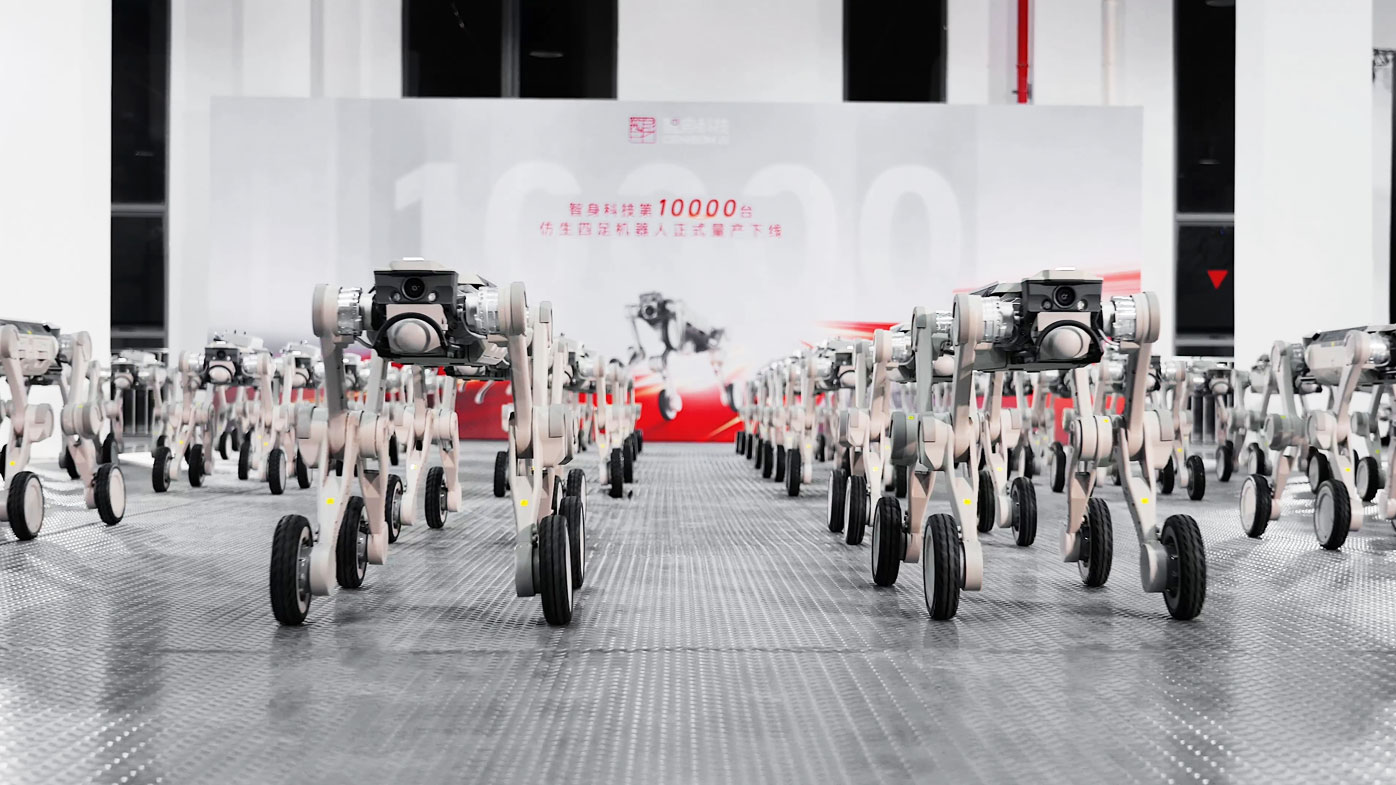
Founded in 2023 and headquartered in Beijing, GENISOM AI says it has already surpassed 10,000 units in cumulative production and delivery, placing it among a small group of robotics companies that have industrialized embodied AI platforms at scale.
The company brought live demonstrations of its M1 and L1/L1-W robotic platforms to the conference floor, supported by its in-house joint actuator modules, simulation infrastructure, and software toolchains that connect component-level engineering to real-world autonomous deployment.
The GENISOM M1 is the centerpiece of the company’s robotics platform. Positioned as the industry's first lightweight, high-payload, fully protected quadruped robot, it has already been mass-produced and deployed across inspection, security, industrial, and research environments.
This quadruped robot is designed for high-load autonomous operation in complex outdoor environments. With a continuous walking payload of 30 kg and a near 1:1 payload-to-body-weight ratio, the platform can carry inspection sensors, communication equipment, emergency supplies, or additional mission payloads while remaining fully mobile during operation.
To support demanding terrain and heavy-load movement, the GENISOM M1 uses GENISOM AI’s in-house joint actuator modules, including the P85MAX-S actuator with peak torque reaching 180 N·m. The system enables stable locomotion across slopes, stairs, rubble, and uneven terrain, while allowing the robot to clear obstacles up to 80 cm and continuously climb 25 cm stair steps.
IP67 protection and an operating temperature range from -20°C to 55°C allow the GENISOM M1 to function in rain, dust, humidity, energy infrastructure sites, and emergency response conditions where conventional robotic systems are difficult to maintain reliably.
GENISOM AI also demonstrated the GENISOM M1 Ultra configuration at ICRA 2026, which adds an advanced perception layer using BEV-based temporal fusion and occupancy-network methods to support its Omni-Panorama system for 720° 3D spatial awareness. The system improves spatial understanding in low-clearance environments, blind corners, and obstacle-dense areas, making it suitable for inspection, security patrol, and emergency-response scenarios that require continuous environmental awareness and navigation reliability.
Alongside the GENISOM M1, the company presented the smaller GENISOM L1 and L1-W platforms. The GENISOM L1 is optimized for lightweight deployment scenarios while retaining sufficient payload and mobility for inspection and mobile sensing tasks. The wheeled-leg GENISOM L1-W combines wheeled efficiency with legged obstacle-crossing capability, allowing operation across mixed indoor-outdoor terrain.
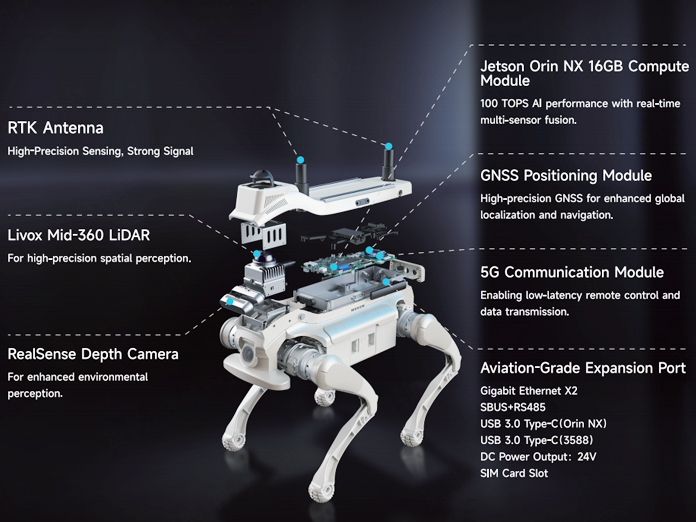
The GENISOM L1 EDU extends the same platform architecture into a dedicated research and secondary-development system. Equipped with an NVIDIA Jetson Orin NX module delivering 100 TOPS, together with lidar, RealSense depth sensing, GNSS, and 5G connectivity, the platform supports a wide range of applications, including SLAM research, autonomous navigation development, reinforcement learning, and embodied AI experimentation.
Behind the M1 and L1-series platforms is a deployment-oriented software stack designed to support robot development, validation, navigation, motion control, and field operation.
At the foundation is the open-source MATRiX simulation platform, which combines physics simulation, high-fidelity rendering, and sensor simulation to help train and validate robot behaviors before deployment on real hardware. The platform supports reinforcement learning workflows and allows developers to test robot performance across different environments with lower development costs.
The Real2Sim2Real Data Flywheel further connects real-world deployment with simulation-based development. By converting captured field environments into reusable simulation assets and feeding operational data back into validation and optimization workflows, the system helps accelerate adaptation to industry-specific deployment scenarios.
For physical deployment, RoamerX provides the navigation layer, supporting mapping, localization, path planning, obstacle avoidance, and cross-floor navigation across indoor and outdoor environments. These capabilities are designed to support inspection, patrol, emergency response, and research applications where robots must operate beyond controlled laboratory settings.
Whole-body control enables coordinated movement across the robot’s legs, body, and optional robotic arm, supporting more advanced mobility and manipulation tasks on quadruped platforms. SomaMind, GENISOM AI’s physical AI agent system, connects task understanding with physical execution, reducing the need to manually configure every intermediate step in multi-stage robotic workflows.
Together, these technologies form an integrated deployment framework that connects simulation, data, navigation, control, and task-level intelligence, supporting GENISOM AI’s mass-produced robot platforms in real-world applications.
At IROS 2025, a team from the University of Manchester used GENISOM AI hardware to take first place in the Quadruped Robot Challenge. The result provides independent evidence that the platform's locomotion, balance, control, and navigation stack hold up under standardized competitive evaluation, not just in controlled demonstration conditions.
GENISOM AI said that its ICRA 2026 appearance makes a coherent case for vertical integration as a development strategy. The path from proprietary joint actuators and in-house manufacturing through robot platforms, open-source simulation, and layered software toolchains to agent-level reasoning is now visible as a single connected system.
With more than 10,000 cumulative units already produced and delivered, GENISOM AI has moved beyond prototype-stage validation into scaled deployment across industrial, inspection, security, research, and field-operation scenarios.
Enjoyed this article? Add Robotics 24/7 as a preferred source in Google Search.
Edge computing gives AI agents the processing power to turn instructions into…
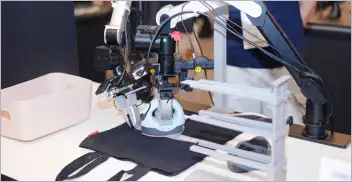
Daimon-TWM world model debuts for the public
Platform helps robots adapt to complex tasks

Look beyond the headlines for the latest in humanoid robots