ASPINA
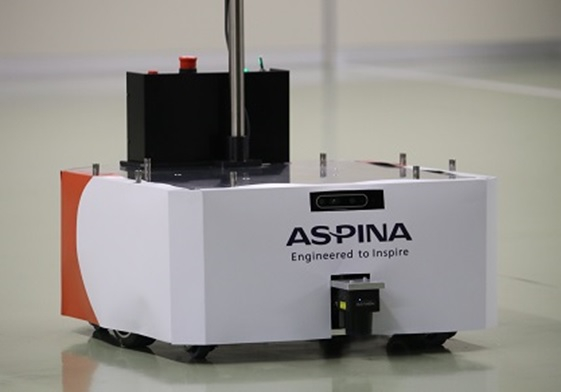
ASPINA's autonomous mobile robot is designed to serve manufacturing needs.
Get news, papers, media and research delivered. Sign up for our free newsletters.
Stay up-to-date with news and resources you need to do your job. Research industry trends, compare companies and get weekly market intelligence with Robotics 24/7.
ASPINA
ASPINA's autonomous mobile robot is designed to serve manufacturing needs.
Numerous vendors have designed and offered mobile robots for warehouse use, but several are starting to offer them to factories. ASPINA Inc. last week announced that it has developed an autonomous mobile robot, or AMR, to save labor transporting materials in manufacturing plants.
Founded in 1918, Shinano Kenshi Co. rebranded itself as ASPINA in 2019. The Nagano, Japan-based company develops and produces motors and modules for industries such as industrial equipment, home appliances, housing, automobiles, and healthcare. It said it is constantly refining its products to be more compact, lightweight, and quiet.
ASPINA, whose U.S. headquarters are in Culver City, Calif., added that it works closely with customers to solve problems. Its slogan is "Engineered to inspire."
While many companies are considering adding or expanding automation for intralogistics and to reduce costs, there are differences between automated guided vehicles (AGVs) and AMRs, noted ASPINA. AGVs are often cheaper, but they can take too much time for trials and setup, it said.
In addition, AGVs require more infrastructure for navigation, and they may not be nimble enough for site requirements, ASPINA said. While warehouses can support fully automated processes, factories often change their layouts, it said.
Workers and transport equipment may coexist in a limited space, and "safety is of utmost importance," said ASPINA. The company said its AMR hardware is designed for manufacturing sites, and its user interface is designed for usability.
Drawing from its own manufacturing experiences of the past 100 years, ASPINA said it has developed its AMR to be easily integrated for use on the plant floor. The robot includes automatic mapping for fast implementation, autonomous driving features, and safe maneuvering around human workers and other equipment, claimed the company.
ASPINA said its AMR uses simultaneous localization and mapping (SLAM) and can automatically map a factory, providing "seamless integration for first-time use." It can quickly and easily enter narrow passageways and can operate in existing facilities, the company said.
In addition, ASPINA said its new robot can be easily synched with other equipment in a facility, such as automatic doors.
In the manufacturing industry, operations such as the delivery of parts to the production line and the transport of finished products always occur. However, in many cases, they are recorded as indirect expenses and are not included in product estimates, said ASPINA. By automating transportation, the company said it can save labor, reduce costs, and improve productivity and profits.
AMRs allow manufacturers to introduce complex and non-static stations to existing production lines. ASPINA said its AMR can easily maneuver among changing environments without the need for reprogramming or mapping new paths.
ASPINA plans to promote its new robot on a trial basis with a limited number of units starting this month. The company said it will work with customers to understand their needs, plan for how AMRs will be used in a facility, and build its products to order.
ASPINA works with motors for robotics and automation.

Ultrasonic sensing enhances robotics perception
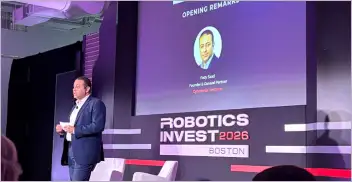
Cybernetix Ventures’ event kicks off Robotics Tech Week 2026 slate of events
Preview the manufacturing and warehouse components that will be on the…
Preview the manufacturing and warehouse robots and software that will be on…