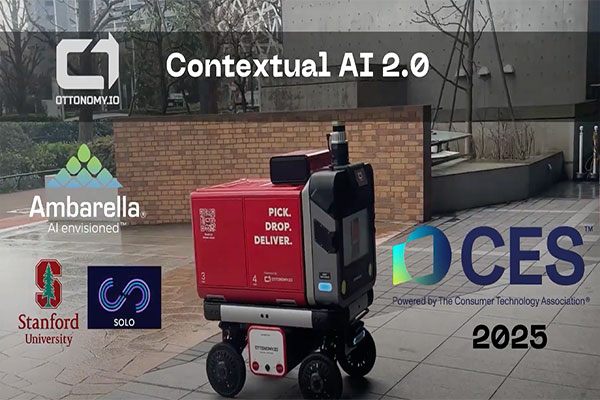
Ottonomy
Ottonomy’s Ottobot AMRs serve customers in healthcare, last mile delivery, and intralogistics at large manufacturing campuses in both indoor and outdoor environments.
Get news, papers, media and research delivered. Sign up for our free newsletters.
Stay up-to-date with news and resources you need to do your job. Research industry trends, compare companies and get weekly market intelligence with Robotics 24/7.
Ottonomy
Ottonomy’s Ottobot AMRs serve customers in healthcare, last mile delivery, and intralogistics at large manufacturing campuses in both indoor and outdoor environments.
Autonomous delivery robot provider Ottonomy recently unveiled its Contextual AI 2.0 at CES 2025. This software leverages vision language models (VLMs) on Ambarella's edge hardware.
The company’s Ottobot autonomous mobile robots (AMRs) can now make more contextually aware decisions and exhibit intelligent behaviors, which Ottonomy said marks a significant step towards artificial general intelligence (AGI).
“LLMs on edge hardware is a game-changer for moving closer to general intelligence and that's where we plug in our behavior modules to use the deep context and add to our Contextual AI engine,” said Ritukar Vijay, Ottonomy CEO.
Contextual AI 2.0 empowers AMRs with the understanding of real-world complexities, allowing Ottobots to not only detect objects but also decipher and “understand” additional “context.” Ottonomy said this ability can provide situational awareness, enabling AMRs to adapt to environments, operational domains, or even weather and lighting conditions.
Ottonomy said AI-enabled robots with contextually aware behaviors is a big leap towards general intelligence for robotics over robots purpose-built with traditional behaviors.
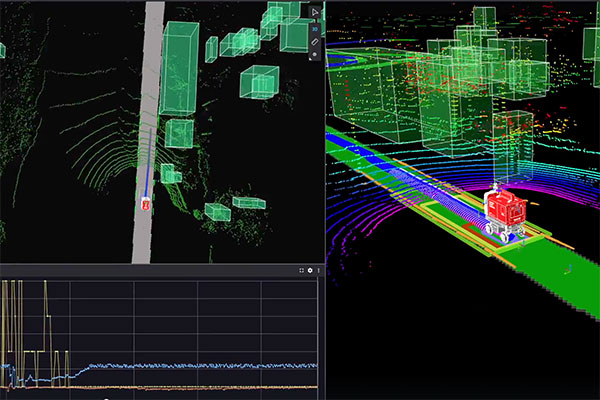
“The integration of Ottonomy’s Contextual AI 2.0 with Ambarella’s advanced N1 family of SoCs marks a pivotal moment in the evolution of autonomous robotics,” said Amit Badlani, Ambarella director of generative AI and robotics. “By combining edge AI performance with the transformative potential of vision language models (VLMs), we’re enabling robots to process and act on complex real-world data in real time.”
Contextual AI and modularity has been the core fabric of Ottonomy. Ottobots deployed for end users operate in both indoor and outdoor environments:
Ambarella’s single SoC supports up to 34 B-Parameters multi-modal LLMs with low power consumption.
Solo Server was used by Stanford students from EE205 to deliver fast, reliable, and fine-tuned AI directly on the edge, which helped to deploy VLMs and depth models for environment processing.
Enjoyed this article? Add Robotics 24/7 as a preferred source in Google Search.
Edge computing gives AI agents the processing power to turn instructions into…
Daimon-TWM world model debuts for the public
Platform helps robots adapt to complex tasks
Look beyond the headlines for the latest in humanoid robots