By
George Kokoris
September 12, 2019
Get news, papers, media and research delivered. Sign up for our free newsletters.
Stay up-to-date with news and resources you need to do your job. Research industry trends, compare companies and get weekly market intelligence with Robotics 24/7.

FATHOM's Application & Engineering Team created this design guideline for 3D printing and additive manufacturing technologies—get answers for commonly asked questions specific to designing for Fused Deposition Modeling (FDM), Selective Laser Sintering (SLS), Multi Jet Fusion (MJF), Stereolithography (SLA), and PolyJet (PJ).
The easy-to-use chart includes wall thickness, hole diameter, clearance for assemblies, escape holes, minimum detail, pin diameter, Z & XY accuracy, and standard layer thickness. FATHOM’s Application & Engineering Team is always adding to this chart, so check back often for any updates.
Fused Deposition Modeling (FDM) is ideal when you need to build concept models, functional prototypes, and end-use parts using standard, engineering-grade and high-performance thermoplastics. As you consider the many material options available for FDM versus other additive manufacturing technologies, remember that this process uses the same types of raw materials used in the injection molding process.
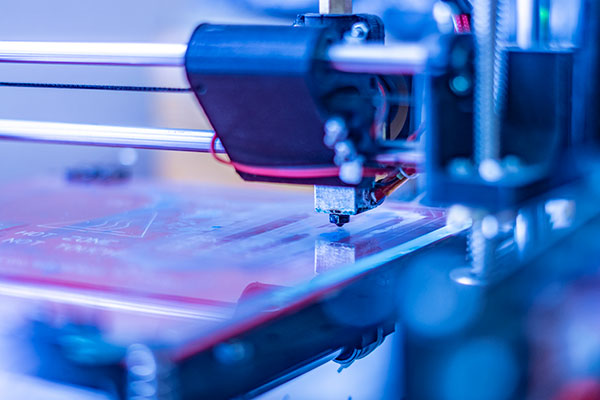
How does the FDM technology work? FDM is a filament-based additive technology distributed by a moving print head that extrudes a heated thermoplastic material in a pattern layer by layer onto a build platform. This technology includes use of a support material to create supportive structures that are removed by force or solution.
Selective laser sintering (SLS) is a commonly used powder-based additive technology to create models, prototypes, and end-use parts in durable, engineering-grade thermoplastics. Consider SLS technology for applications that involve high-complexity and organic geometries, as well as parts requiring durability. SLS nests in the z direction which allows for short-run production and efficient builds. The technology is also capable of producing parts with finer details than most processes that use high-strength plastics. The composition is one of the more isotropic available from additive manufacturing.
How does the technology work? SLS uses a blade to spread a thin layer of powder over the build volume. A laser sinters the cross-section of the part, fusing the powder together. The z stage then drops one layer, and the process begins again until the build is finished. Parts are then excavated from the build powder-cake and bead blasted. The un-used powder in the build envelope acts as the support structures, so no support removal is necessary.
Multi-jet fusion (MJF) is quickly becoming a popular choice for 3D printing prototypes and production parts. Ideal uses for MJF are enclosures, electronics housings, complex ducts, lattice structures, and functional assemblies. The technology is capable of 3D printing parts with high detail, as well as suitable for applications that require durability (e.g. snap fits). It is common for designers and engineers to choose this material for short production runs because the MJF process allows for nesting in the z direction. Offering this technology further expands FATHOM’s all-ready comprehensive 3D printing and additive manufacturing services. To learn more about MJF, read a featured FAQ blog post by a FATHOM Applications Engineer.
How does it work? MJF technology builds parts by laying down a thin layer of powder on a print bed over and over. The inkjet array in the print carriage sweeps over the print bed, jetting two agents downward—a fusing agent, printed where the powder will fuse together, and a detailing agent that is used to reduce fusing at the part boundary to achieve greater detail.
This technology is ideal for high-resolution finishes regarding medium- to large-sized parts—it is an extremely cost-effective solution for creating durable, aesthetically pleasing parts of considerable size on a tight deadline. SLA resins with extremely high heat deflection are available and are great candidates for molds or inserts.
How does the stereolithography technology work? SLA cures photopolymer resin with an ultraviolet laser. The laser traces a shape dictated by the original file across the surface of the resin bath. The resin touched by the laser hardens, then the build platform descends in the resin bath, and the process is repeated until the entire part is complete.
PolyJet technology is capable of creating smooth surfaces, thin walls, and complex geometries with accuracy as high as 0.1 mm—the one and only technology that supports a wide selection of materials with properties that range from rubber to rigid and transparent to opaque. It is also possible to 3D print with multiple materials in a single build to achieve combinations of colors and characteristics (e.g. parts made of rigid and flexible materials).
How does the technology work? PolyJet is photopolymer-based jetting process that distributes material droplets layer by layer onto a build platform (immediately cured by a flash of UV light). At the end of the build process, the object is fully cured and can be handled immediately without post-curing. This technology includes use of a gel-like support material, designed to enable complicated geometries (removed by soaking and/or water jetting).
Click thru to read more about this design guideline on 3D printing and manufacturing technologies!
Enjoyed this article? Add Robotics 24/7 as a preferred source in Google Search.

Edge computing gives AI agents the processing power to turn instructions into…
Daimon-TWM world model debuts for the public
Platform helps robots adapt to complex tasks

Look beyond the headlines for the latest in humanoid robots