By
Roberto Michel
February 7, 2022
Zebra Technologies
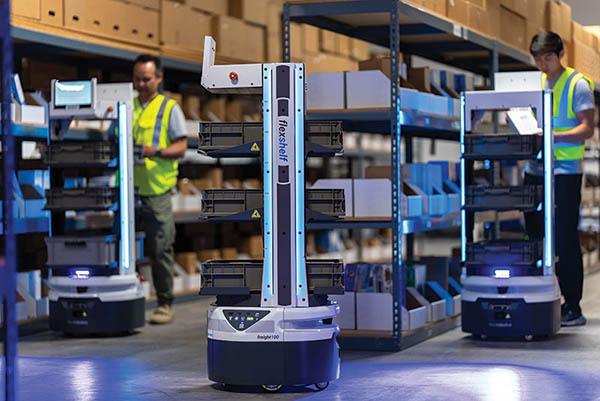
Fetch Robotics' new fulfillment system combines mobile robot fleet management and optimization of human associates to reduce wait times and increase picking efficiency.
Get news, papers, media and research delivered. Sign up for our free newsletters.
Stay up-to-date with news and resources you need to do your job. Research industry trends, compare companies and get weekly market intelligence with Robotics 24/7.
Zebra Technologies
Fetch Robotics' new fulfillment system combines mobile robot fleet management and optimization of human associates to reduce wait times and increase picking efficiency.
In warehousing and other sectors, tasks such as moving carts through a pick area or sending completed orders and totes downstream to packing or a conveyor system are increasingly carried out by mobile robots, not people pushing carts. Better coordination of people and robots can lead to even greater efficiencies, according to Zebra Technologies Corp.
Autonomous mobile robots (AMRs) can reduce much of the travel involved in conventional pick-to-cart operations, and they often work closely with warehouse associates as part of the actual pick task. The optimization of workflows to account for the activities of both humans and robots can reduce wait times and provide even greater benefits, said James Lawton, vice president and general manager of robotics automation at Zebra Technologies.
The Linconshire, Ill.-based company is known for its rugged mobile devices, wearables like ring scanners, and other data-collection and real-time location tracking technologies. Last year, Zebra acquired Fetch Robotics Inc., a leading provider of AMRs and related software, for $290 million.
“We’ve seen through our market research and by going into facilities that are utilizing robots that you would sometimes see the robots waiting around because there is no worker ready nearby to get started on a joint task," Lawton said. "You can find the flip side of that, too -- people waiting for a mobile robot to show up in one of these robot-assisted, zone-based picking solutions. So all that waiting adds up to waste, which could be eliminated.”
To address this need, Fetch and Zebra in October announced three new AMR models—FlexShelf, FlexShelf Guide, and RollerTop Guide—and a new FetchCore fulfillment software package for order or batch picking.
The software uses a combination of software Fetch had developed for AMR fleet management and drag-and-drop configuration of AMR processes, according to Lawton.
In addition, its optimization layer for managing both people and robots draws on capabilities from Zebra’s Fulfillment Edge software package.
The Fetch Fulfillment Solution can better manage and coordinate human and robot resources to reduce wait times, allowing robots to do what they do best: direct workers through accurate picking and fulfillment activities in a relatively compact area of the warehouse. This eliminates much of the walking and all of the cart pushing typically involved in conventional pick-to-cart methods, said Lawton.
Zebra describes Fulfillment Edge as a “WMS accelerator” because it ties into different warehouse management systems (WMS) to provide a user-friendly application for tasks like order picking, as well as business intelligence tools to gauge productivity. This capability allows an operation to scale up by adding more connected workers and conventional carts to meet demand during peak periods, said the company.
The optimization layer is used to simultaneously direct and optimize the tasks of robots and workers outfitted with rugged mobile devices or wearables.
“With this solution, a connected worker, or what some call an ‘instrumented’ worker, along with the robots, can be better coordinated, and in some scenarios, can both be redirected to the next best activity that achieves an optimized workflow overall,” Lawton said. “When you can manage and redirect both human and AMR resources together, rather than separately, we believe it results in greater productivity and throughput.”
Fetch claimed that its Fulfillment Solution offers up to a three-fold increase in productivity in comparison with a traditional pick-to-cart scenario based on human labor and mobile device inputs. It does this instead of keeping workers in a tighter zone and having mobile robots come to them to guide them through a set of picks.
Fetch continues to offer stand-alone AMR systems and has partnered with other vendors involved in warehouse optimization, including Lucas Systems.
Other vendors are also addressing the optimization of processes involving both robots and people. Rather than focus on automation hardware, several suppliers are promoting software that extends beyond task assignment and routes for robots.
For example, inVia Robotics pointed out that in some cases, customers have deployed its software to gain efficiencies in human-centered processes even before deploying robots.
In addition, major providers of WMS and warehouse execution systems (WES) are addressing workflows that combine human and robot resources.
inVia Logic is a warehouse fulfillment software suite that inVia Robotics said can speed up order processing and increase order accuracy. The inVia PickMate tool is designed to enable people to use the intelligence that the inVia Logic creates.

Roberto Michel, senior editor for Modern, has covered manufacturing and supply chain management trends since 1996, mainly as a former staff editor and former contributor at Manufacturing Business Technology. He has been a contributor to Modern since 2004. He has worked on numerous show dailies, including at ProMat, the North American Material Handling Logistics show, and National Manufacturing Week. You can reach him at: [email protected].
Enjoyed this article? Add Robotics 24/7 as a preferred source in Google Search.
Edge computing gives AI agents the processing power to turn instructions into…
Daimon-TWM world model debuts for the public
Platform helps robots adapt to complex tasks
Look beyond the headlines for the latest in humanoid robots