By
Tim Culverhouse
June 16, 2025
Photoneo
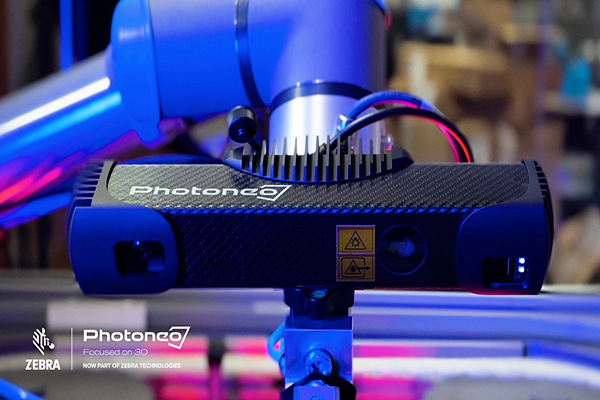
The new addition to the Photoneo MotionCam-3D family is the MotionCam-3D (Blue) with blue laser technology.
Get news, papers, media and research delivered. Sign up for our free newsletters.
Stay up-to-date with news and resources you need to do your job. Research industry trends, compare companies and get weekly market intelligence with Robotics 24/7.
Photoneo
The new addition to the Photoneo MotionCam-3D family is the MotionCam-3D (Blue) with blue laser technology.
There’s a hand-in-hand approach to technological development at Photoneo, the automation software and 3D sensor manufacturer headquartered in Slovakia.
Now part of the Zebra Technologies family, Photoneo recently released the third generation of its 3D camera technology, with a powerful ‘colorful’ change.
It’s blue, baby.
Think back to your middle school science classes. Remember the spectrum of light? It organizes light into different colors, wavelengths and frequencies. On the left-hand side of the spectrum, you have your violets and blues with smaller wavelengths and higher frequencies. On the right-hand side of the spectrum, you see your oranges and your reds.
Now think about lasers. In movies or reality, the red laser tends to show up as a dangerous weapon.

Photoneo utilizes red lasers on its MotionCam-3D, capable of handling scanning in motion. These scanners give robots “sight” and enable fast, accurate inspection, picking, and more.
But at Automate 2025 in Detroit, Photoneo turned blue.

“Blue lasers interact better with multiple complex materials,” said Jakub Bohus, application engineering manager at Photoneo. “We first experienced the performance advantages of developing scanning for transparent objects. We saw that the reflection of transparent or semi-transparent materials is much better with the blue laser compared to the red laser.”
With MotionCam-3D Color (Blue), dark colors and plastic materials - both common in the automotive industry - yield better visual results with the blue laser. Not only can blue reconstruct these items better, but it can also measure the distance between objects with higher degrees of accuracy. The result is a higher picking success rate.
“Due to different wavelengths of the blue and red laser, the blue light has advantages in these materials,” Bohus said. “For example, we can see the signal from the top layer of a transparent object much more clearly. Therefore, we are able to distinguish between the front of the object and the background. And then, we can calculate the distance of the first response of this reflection. Also, the blue laser is better in terms of scanning black and dark materials. These black materials are very often used in automotive for most of the metallic, rubber, and plastic components.”
In conjunction with the new laser hardware, the software side of Photoneo’s operation has to keep up. As with all innovations at the company, the physical and the digital components are tied together.
Photoneo’s software team developed coding strategies to decipher the projected patterns from its blue laser and generate clear scans in motion of a plethora of items and colors.
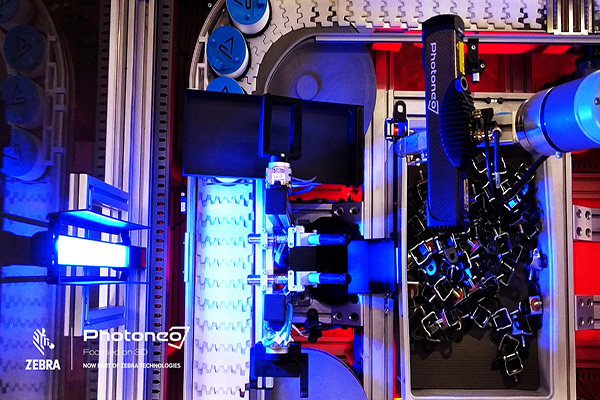
“We were able to determine the optimal coding strategies for several different materials,” said Patrik Daniel, software development manager at Photoneo. “Those black or shiny materials, and then things with many interreflections, or also the transparent or semi-transparent materials, we developed different coding strategies, which turned out to work even better after using the blue laser.”
Bohus’ and Daniel’s teams worked closely to ensure these developments worked hand-in-hand.
“Our Parallel Structured Light technology in conjunction with the proprietary COMPIS sensor, allowed us to get rid of sequential projections of the structured light patterns into the scene, and instead, we are doing just one laser sweep,” Daniel said. “And from that, we are able to basically freeze time and scan the objects, even in motion, without any motion artifacts or any motion blur. And, we are able to achieve sub-millimeter accuracy, with the frame rate almost reaching up to 20 frames per second.”
Following Automate, Photoneo hosted a launch event for MotionCam-3D Color (Blue) and made an eye-opening proclamation. The company said that all its new devices would be maintenance-free.
“Maintenance-free is definitely a bold statement,” Daniel said. “In our launch event, we presented the autonomous maintenance feature. This new feature is something that we want to become an industry standard. From now on, all the new products, including MotionCam-3D Color (Blue) and the red variant, along with all the future products from Photoneo, will come with the Autonomous Maintenance feature.”
Through Photoneo’s tools for infield maintenance, users can check if their sensors are properly calibrated and running to the required level of precision.
“With Autonomous Maintenance, all you have to do is trigger one extra, special scan of a well-scannable static scene, which will check the health of the device, and maintain the performance within the datasheet specification range,” Daniel said. You don’t have to put any special marker patterns into the scene. It doesn’t require well-trained personnel. You can automate this very easily, just trigger one more scan, and you get the information about the health of your device. The Autonomous Maintenance feature is available for all the new devices through the GUI and API,” he said.
Daniel also touted the retroactive maintenance capabilities of Photoneo’s tools for infield maintenance like Maintenance Tool and Marker Dots Correction, which allows current customers of older products to take advantage of these features.
“We also wanted to take a step for all the devices that are already in the field… I believe this is going to be a game-changer for us and for all the 3D sensor manufacturers,” he said.

Tim is the Editorial Director of Robotics247.com. His mission is to provide valuable information and insights to robotics professionals and decision-makers, and to help them solve business challenges. He is a creative, deadline-driven, and detail-oriented storyteller. In addition, he is a sports broadcaster and public address announcer.
Artificial Intelligence Machine Vision Industrial Automation Collaborative Robots Robot Arm Components Sensors Cameras Software Cloud and Edge Data Management News Features Editors Pick Automate Camera Laser Scanning Maintenance Maintenance Repair and Operations Photoneo Picking Precision Scanning Sensors
GENISOM AI makes ICRA debut at conference in Vienna
World's first omni-modal evaluation including tactile sensing for…
Ultrasonic sensing enhances robotics perception
Cybernetix Ventures’ event kicks off Robotics Tech Week 2026 slate of events