By
DE Editors
February 5, 2021
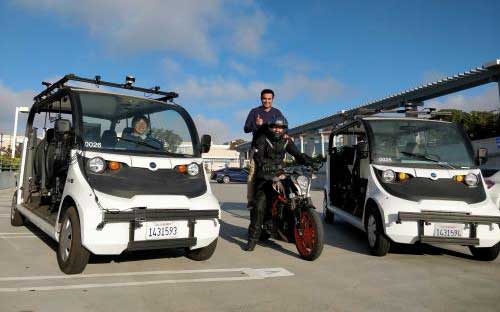
The Qualcomm Innovation Fellowship recognizes creative Ph.D. students, providing them with funding, mentoring and other resources to pursue innovative research. This year, five UC San Diego Jacobs School of Engineering teams were awarded fellowships—four from Computer Science and Engineering and one from Electrical and Computer Engineering.
Get news, papers, media and research delivered. Sign up for our free newsletters.
Stay up-to-date with news and resources you need to do your job. Research industry trends, compare companies and get weekly market intelligence with Robotics 24/7.
The Qualcomm Innovation Fellowship recognizes creative Ph.D. students, providing them with funding, mentoring and other resources to pursue innovative research. This year, five UC San Diego Jacobs School of Engineering teams were awarded fellowships—four from Computer Science and Engineering and one from Electrical and Computer Engineering.
The Qualcomm Innovation Fellowship (QIF) recognizes creative Ph.D. students, providing them with funding, mentoring and other resources to pursue innovative research. This year, five UC San Diego Jacobs School of Engineering teams were awarded fellowships—four from Computer Science and Engineering and one from Electrical and Computer Engineering.
“This is the most QIF awards UC San Diego has ever received in a single year,” says Sorin Lerner, chair of the computer science department. “We are honored by Qualcomm’s commitment to our students and excited to watch them solve important and impactful research problems.”
Each team will receive $100,000 from Qualcomm to pursue cutting-edge research on autonomous vehicles, natural language processing and other areas.
“It is great to see the UC San Diego engineering graduate students thrive as participants in the Qualcomm Innovation Fellowship program,” said John Smee, Qualcomm’s vice president of Engineering. “Congratulations to all of the student finalists and winners this year.”
Advisors: Professor Henrik Christensen, director of the Contextual Robotics Institute; Professor Falko Kuester, Structural Engineering; Professor Todd Hylton, mechanical and aerospace engineering and executive director of the Contextual Robotics Institute
Project: Spatiotemporal Fusion of Radar, Vision and LIDAR Data for Autonomous Driving
Building on work conducted at the Autonomous Vehicle Laboratory and DroneLab, Meyer and Zhang are developing a system that adjusts how sensor data is fused based on driving conditions to create a dynamic sensor fusion algorithm.
“The work on sensor fusion for autonomous driving vehicles the QIF fellows in my group are conducting is a rich data science problem of modeling sensors, fusion of information and generating actionable knowledge to operate in a dynamic and uncertain world,” says Christensen. “Qualcomm’s support for our students is invaluable for their studies, building direct links to real-world problems and helping them establish a broader world view.”
Advisor: CSE Associate Professor Julian McAuley
Project: Toward Personalized and Multimodal Conversational Recommender Systems
Working in the Julian McAuley lab, Li and Majumder have been investigating natural language processing to develop a conversational recommender system. The team was one of 10 finalists in the Amazon Alexa Prize 2019-2020 for their efforts to build dialog systems that conduct engaging conversations with users.
“We believe this approach can be particularly impactful in a variety of user-facing applications, such as recommendation engines in product marketplaces, ad-targeting systems and customer support,” says McAuley. “For these applications, we must provide explanations that are interpretable by laypeople, and those explanations should be personalized to each individual user. Conversational frameworks increase accessibility, facilitate new forms of interaction and make recommender systems more empathetic.”
Advisor: Computer Science Assistant Professor Hao Su
Project: Learning-Based 3D Mesh Reconstruction
The team is developing ways to better handle ambiguous structures, noise and incomplete data to create a system that supports robotics, autonomous driving, augmented reality and other applications.
Advisors: Comptuer Science Assistant Professor Manmohan Chandraker and Professor Ravi Ramamoorthi
Project: Physically Motivated Deep Inverse Rendering from Sparse Inputs
Bi and Li are developing inverse rendering networks that require only light-weight setups to handle complex visual effects, such as spatially varying lighting and global illumination. This work could potentially turn mobile phones into powerful augmented reality and 3D modeling devices.
Advisors: Electrical Engineering Assistant Professor Hanh-Phuc Le and Associate Professor Patrick Mercier
Project: Vertical Hybrid Power Delivery for High-Performance Processors and Digital Systems
Mobile devices must maximize battery life and minimize heat generation, limiting their performance. Autonomous vehicles rely on input/output (I/O) processor pins to handle large amounts of sensor data. However, a large number of pins are needed for power delivery. Power demands can generate data processing bottlenecks. Hardy and Abdulslam are using a novel power converter architecture to operate at optimal efficiency while reducing power losses.
The team’s preliminary analysis shows this architecture can increase power delivery efficiency by up to 12%, as well as reducing heat generation and increasing I/O pin availability for laptops, smart phones and autonomous vehicles.

DE's editors contribute news and new product announcements to Digital Engineering 24/7 and the Robotics 24/7 sites. Press releases may be sent to them via [email protected].
Enjoyed this article? Add Robotics 24/7 as a preferred source in Google Search.
Edge computing gives AI agents the processing power to turn instructions into…
Daimon-TWM world model debuts for the public
Platform helps robots adapt to complex tasks
Look beyond the headlines for the latest in humanoid robots