Daegu Gyeongbuk Institute of Science and Technology
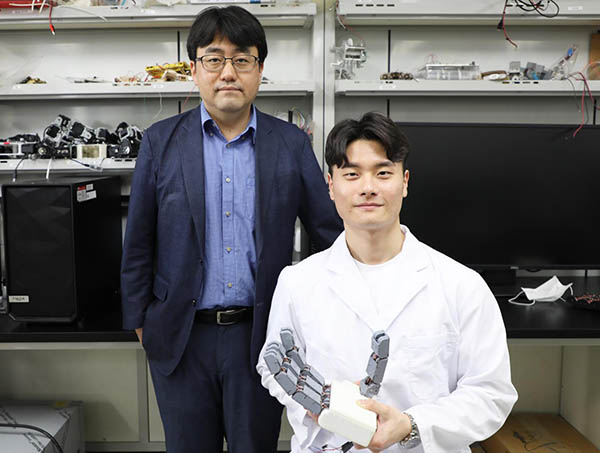
DGIST researchers Prof. Dongwon Yun (left) and integrated M.S. and Ph.D. student Junmo Yang with robotic hand.
Get news, papers, media and research delivered. Sign up for our free newsletters.
Stay up-to-date with news and resources you need to do your job. Research industry trends, compare companies and get weekly market intelligence with Robotics 24/7.
Daegu Gyeongbuk Institute of Science and Technology
DGIST researchers Prof. Dongwon Yun (left) and integrated M.S. and Ph.D. student Junmo Yang with robotic hand.
Until now, competing types of robotic hand designs offered a tradeoff between strength and durability. One commonly used design, employing a rigid pin joint that mimics the mechanism in human finger joints, can lift heavy payloads, but it is easily damaged in collisions, particularly if hit from the side. Meanwhile, fully compliant hands, typically made of molded silicone, are more flexible, harder to break, and better at grasping objects of various shapes, but they fall short on lifting power.
A team of researchers at the Department of Robotics Engineering at Daegu Gyeongbuk Institute of Science and Technology (DGIST) in South Korea investigated a partially compliant robot hand. It uses a rigid link connected to a structure known as a crossed flexural hinge (CFH), which it said could increase the robot's lifting power while minimizing damage in the event of a collision.
Generally, a CFH is made of two strips of metal arranged in an X-shape that can flex or bend in one position while remaining rigid in others, without creating friction.
"Smart industrial robots and cooperative robots that interact with humans need both resilience and strength," said Dongwon Yun, who heads the DGIST BioRobotics and Mechatronics Lab and led the research team. "Our findings show the advantages of both a rigid structure and a compliant structure can be combined, and this will overcome the shortcomings of both."
The team 3D-printed the metal strips that serve as the CFH joints connecting segments in each robotic finger, which allow the robotic fingers to curve and straighten similar to a human hand. The researchers demonstrated the robotic hand's ability to grasp different objects, including a box of tissues, a small fan and a wallet.
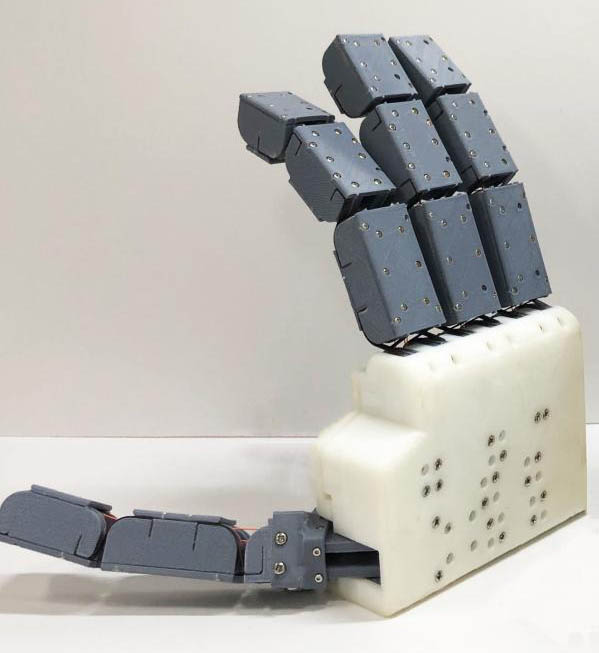
The CFH-jointed robot hand was shown to have 46.7% more shock absorption than a pin joint-oriented robotic gripper, said the researchers. It was also stronger than fully compliant robot hands, with the ability to hold objects weighing up to 4 kg (8.8 lb.).
Further improvements are needed before robots with these partially-compliant hands are able to go to work alongside or directly with humans. The researchers noted that additional analysis of materials is required, as well as field experiments to pinpoint the best practical applications.
"The industrial and healthcare settings where robots are widely used are dynamic and demanding places, so it's important to keep improving robots' performance," said Junmo Yang, a DGIST engineering Ph.D. student and the first paper author.
The research was published in the journal Soft Robotics this past spring.
3D Printing Components Grippers Soft Robotics News Press Release Grippers Materials Research
Enjoyed this article? Add Robotics 24/7 as a preferred source in Google Search.

Edge computing gives AI agents the processing power to turn instructions into…
Daimon-TWM world model debuts for the public
Platform helps robots adapt to complex tasks

Look beyond the headlines for the latest in humanoid robots