By
Roberto Michel
December 12, 2022
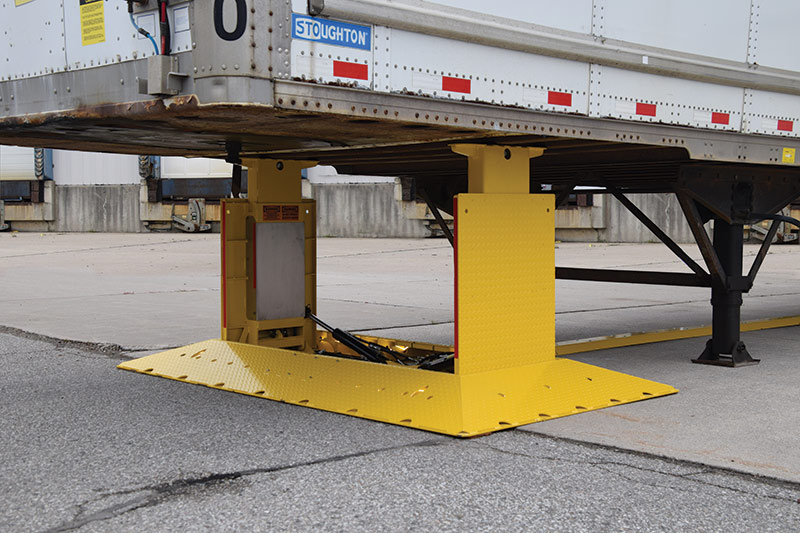
A ground-mounted trailer stand raises and retracts with the push of button.
Get news, papers, media and research delivered. Sign up for our free newsletters.
Stay up-to-date with news and resources you need to do your job. Research industry trends, compare companies and get weekly market intelligence with Robotics 24/7.
A ground-mounted trailer stand raises and retracts with the push of button.
The most essential part of lift truck safety is a rigorous safety check process by operators at the start of shift, while technologies such as telematics, fleet software and sensor-based operator assist alerts offer other ways of making fleets safer. But what about the risks tied to the facility—more specifically—activity at docks?
Docks can be a dangerous area for lift truck operations, in that heavy trucks and loads are crossing dock plates to load or unload goods, and when a light at the door says it is OK to proceed, the assumption is the trailer is properly restrained and stable.
While proper use of dock restraints is central to preventing separation incidents, stability can be an issue when trailers are disengaged or “spotted” from the cab for later loading or unloading. In these scenarios, in addition to deploying the trailer’s landing gear, positioning trailer stands near the nose of the trailer provides another level of safety, in case a landing gear ever fails, says Dirk Seis, director of marketing for Ideal Warehouse Innovations.
Correctly placed stands prevent a trailer from tipping sideways or an “upending” accident where the nose of the trailer dips down. Either one can be deadly. “Trailers collapse more often than people think,” says Seis. “The repeated stresses involved with loading and unloading can be like the straw that broke the camel’s back. And if there’s a collapse, someone can be injured, and severely.”
Trailer stands differ from repair jacks, explains Seis. A stand has a broader support point below the nose of the trailer, and they don’t lift the trailer. Stands range from simpler models on wheels that are manually rolled into place and raised to height, as well as “shuntable” models positioned and removed by a yard truck. Earlier this year, Ideal Warehouse Innovations launched a ground-mounted system that rises and retracts into place, from a control placed indoors and integrated with dock controls.
In evaluating stand choice, companies should consider dock and shipment volume, and the time and ergonomic risks involved in positioning stands manually, says Seis. Safety is a concern, too. Companies after a “no boots on the ground” approach to positioning stands drove the development of shuntable stands, says Seis. The ground-mounted system keeps boots off the ground, and it’s the fastest approach.
“The actual time it takes for workers to place and remove trailer stands is a factor,” says Seis. “For higher volume operations, say there are 80 positions, and they may have multiple DCs across the country, that adds up to a lot of time. There’s a productivity gain to be made in automating that.”
Even a stand needing manual positioning can have ergonomic features, says Seis, such as easy-to-reach levers and a self-lifting action to remove the physical strain of elevating the stand. “In trying to make an operation safer by doing one thing—ensuring trailer safety with stands—you want to minimize the level of strains and risks involved in placing those stands,” says Seis.
Connected dock controls with sensors, digital alerting and software for monitoring dock trends also help with safety.
“The leading smart connected dock equipment is capable of not only sending immediate safety-related alerts, but also of collecting information and helping facility managers interpret and analyze that data,” says Tim Kubly, business development manager at Rite-Hite Digital Solutions. “These insights can ultimately inform a company on how best to make process improvements that positively affect safety for the long-term.”
Smart equipment can detect and alert for specific safety dangers, while generating data to improve cycle times or spot issues with cold chain management. In short, smart docks have many benefits, with safety being one of them, explains Kubly.
“On the inside of a loading dock, motion-activated sensors help prevent pedestrian-forklift accidents by shining a blue light onto the leveler when activity is detected inside the trailer—warning workers nearby that a forklift could be backing out at any moment,” Kubly says.
“As part of a smart dock control system, these sensors can also be interlocked with vehicle restraint controls to prevent premature disengagement of the trailer while motion is detected inside, as well as to audibly alert any unsuspecting worker if they enter a trailer that has been disengaged and is thus unsafe. From a food safety perspective, a smart connected freezer door will send an immediate alert if the door was left open or did not close properly (causing the product inside to melt or spoil) as well as record that data for future review,” he adds.

Roberto Michel, senior editor for Modern, has covered manufacturing and supply chain management trends since 1996, mainly as a former staff editor and former contributor at Manufacturing Business Technology. He has been a contributor to Modern since 2004. He has worked on numerous show dailies, including at ProMat, the North American Material Handling Logistics show, and National Manufacturing Week. You can reach him at: [email protected].
Enjoyed this article? Add Robotics 24/7 as a preferred source in Google Search.

Edge computing gives AI agents the processing power to turn instructions into…

Daimon-TWM world model debuts for the public

Platform helps robots adapt to complex tasks

Look beyond the headlines for the latest in humanoid robots