By
Josh Bond
March 8, 2018
Get news, papers, media and research delivered. Sign up for our free newsletters.
Stay up-to-date with news and resources you need to do your job. Research industry trends, compare companies and get weekly market intelligence with Robotics 24/7.
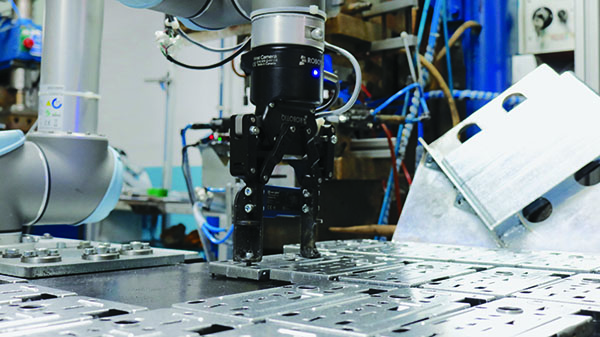
At an Assa Abloy plant in Bucharest, Romania, the skills gap is widening every year. In response, the factory’s management invested in robotics to automate simple tasks and move workers to value-added positions. This generated in-house robotics expertise that set an example for the whole Assa Abloy group.
About 500 people work at the plant, assembling locks that are sent to other Assa Abloy factories worldwide to be transformed into finished products. Of the many processes performed, most are done manually by employees who have been working there for decades.
According to Adrian Iosif, mechanical design engineer at Assa Abloy Romania, the project began with automating the most simple and repetitive processes. The goal was to build a flexible robotic cell that could handle different parts at different stations. For example, welding lock assemblies used to involve an operator who put both parts together manually before inserting them in the welding machine.
The new collaborative robots (Universal Robots) and grippers (Robotiq) use plug-and-play components suited to high-mix/low-volume production. The solution also uses a robot-mounted camera able to locate parts in a wide field of view.
“When the first robot arrived, the reaction of the people was not very good,” Iosif says. “They said the robot would not be able to produce at the same rate. And, they were right at first.”
By trial and error, Iosif and his team were able to reach a 20-second cycle time, resulting in a 20% productivity gain while freeing human hands from a highly repetitive task.
This new process still requires a human presence for now, but makes life a lot easier for operator Moise Nicolae. “At the beginning, I had some technical challenges with the robot,” he says. “But after a bit of time, it became really easy. It’s a big difference for me because my task is easier.”
The facility’s automation department now includes 10 people, only a year after its creation. The team consists of a manager, four engineers, three students who work part-time, and two technicians who help build cells. Each operator will eventually be in charge of two collaborative cells.
“Any time there is a new lock to assemble, you can teach the robot a new part,” Iosif says. “You can teach it as many as you want. Choose one and that’s it; you change the production.”

Josh Bond was Senior Editor for Modern through July 2020, and was formerly Modern’s lift truck columnist and associate editor. He has a degree in Journalism from Keene State College and has studied business management at Franklin Pierce University.
Enjoyed this article? Add Robotics 24/7 as a preferred source in Google Search.
Edge computing gives AI agents the processing power to turn instructions into…
Daimon-TWM world model debuts for the public
Platform helps robots adapt to complex tasks

Look beyond the headlines for the latest in humanoid robots