By
Eugene Demaitre
October 28, 2021
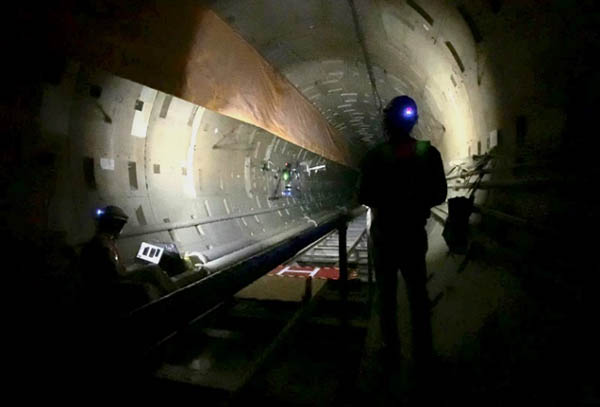
Near Earth Autonomy
Kajima employee using the Topaz system.
Get news, papers, media and research delivered. Sign up for our free newsletters.
Stay up-to-date with news and resources you need to do your job. Research industry trends, compare companies and get weekly market intelligence with Robotics 24/7.
Near Earth Autonomy
Kajima employee using the Topaz system.
Manual inspections of tunnels and construction sites can be time-consuming, difficult, and hazardous. Autonomous drones can help, but they typically require GPS to navigate. Kajima Corp., one of the world's largest construction companies, today said it has partnered with Near Earth Autonomy Inc. to develop targeted systems to inspect such GPS-denied environments.
“We are pleased that many of the autonomy capabilities that we developed for aerial transport also have valuable inspection applications," said Dr. Sanjiv Singh, CEO of Near Earth Autonomy. "Autonomous inspections enable the safe identification and rapid correction of issues. Kajima’s innovative leadership, industry insights, and scale make them ideal partners. We are delighted to collaborate with Kajima to scale the transformative benefits of GPS-denied drone inspections across their construction operations.”
Near Earth Autonomy said its technology allows aircraft to take off, fly, and land safely, with or without GPS. The Pittsburgh-based company claimed that it "bridges the gap between aerospace and robotics" with systems that can improve the efficiency, performance, and safety of aircraft ranging from small drones to full-size helicopters. It is currently developing aerial mobility and inspection systems for commercial and defense partners.
Coincidentally, last week, Near Earth announced that Guy Kimchi, co-founder of Amazon Prime Air, the drone delivery service of Amazon.com Inc., has joined its board of directors.
Manual tunnel inspections are time-consuming for site employees because of the long distances between construction sections and the irregular environments that require continuous climbing and ducking to get through, noted Near Earth Autonomy. Manually performing inspection tasks can also be dangerous because tunnel and underground sites are generally dark and narrow.
Autonomous drones can accelerate the progress of inspection tasks and eliminate the risk of human injury, the company added. The requirement for GPS has slowed the adoption of drones for indoor and underground environments where satellite signals cannot reach.
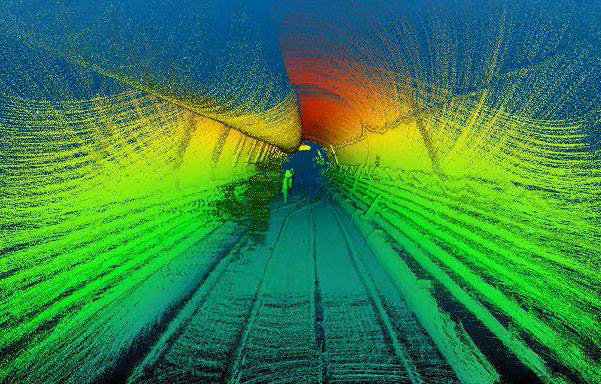
Near Earth said its Topaz flight system (Topaz fs) is a complete autonomy and mapping drone tool that enables inspection in complex, confined environments without the need for GPS.
What are the distances involved in these GPS-denied environments?
"We have tested our system in tunnels 4 km [2.4 mi.] long," said Alex Foessel, senior director of market strategy at Near Earth. "Depending on the flight time and speed of inspection, it can go about 1 to 1.5 km [0.6 to 0.9 mi.]. We're working on four applications related to tunnel mapping. Some would require more data density, so the drone would fly slower and have less range."
How does this technology compare with that used in the recent DARPA Subterranean (SubT) Challenge?
"The technologies are comparable -- they're using SLAM, fusing data from laser scanners and cameras," Foessel told Robotics 24/7. "On the one hand, the SubT prototypes included different sensing configurations. For example, they had more cameras and orthogonal rotating scanners."
"We have one rotating laser scanner and one camera," he explained. "Ours is meant to be operational in a broader set of environments. It's a more stable configuration used day in and day out for a number of inspection applications."
Kajima Corp. engages in construction, real estate development, architectural design, civil engineering, and engineering businesses. It was founded by Iwakichi Kajima in 1840, and Hiromasa Amano, leads the company today as president and representative director. Tokyo-based Kajima oversees construction and development projects worldwide.
In 2019, Kajima conducted proof-of-concept flight tests using Topaz fs and successfully demonstrated its usefulness in multiple GPS-denied construction sites across Japan.
"Through one of our distributors in Japan, Kajima tested Near Earth's technology in its construction projects, which led to inspection and mapping applications," said Foessel. "We recently engaged in more formal, long-term relationships."
Since November 2020, Kajima has used the Topaz fs to enhance safety and productivity through autonomous underground inspections. Applications have included checking for abnormalities in wall surfaces and detecting water and gas leaks at tunnel construction sites in multiple countries.
Kajima said it plans to expand the use of Near Earth’s Topaz fs for inspection operations across GPS-denied and dark construction environments.
"Kajima has identified specific initial tunnel-measurement and inspection applications,” Foessel said. “Next year, we'll be testing system configurations tailored to those selected applications, followed by productization efforts and aiming to commercial offerings in 2023.”
Near Earth Autonomy has automated drone inspections in GPS-denied environments.

Eugene Demaitre was editorial director of Robotics 24/7. Prior to joining Peerless Media, he was a senior editor at Robotics Business Review and The Robot Report. Demaitre has also worked for BNA (now part of Bloomberg), Computerworld, and TechTarget. He has participated in numerous robotics-related webinars, podcasts, and events worldwide.
Enjoyed this article? Add Robotics 24/7 as a preferred source in Google Search.
Edge computing gives AI agents the processing power to turn instructions into…
Daimon-TWM world model debuts for the public
Platform helps robots adapt to complex tasks

Look beyond the headlines for the latest in humanoid robots