By
Roberto Michel
September 5, 2024
Get news, papers, media and research delivered. Sign up for our free newsletters.
Stay up-to-date with news and resources you need to do your job. Research industry trends, compare companies and get weekly market intelligence with Robotics 24/7.

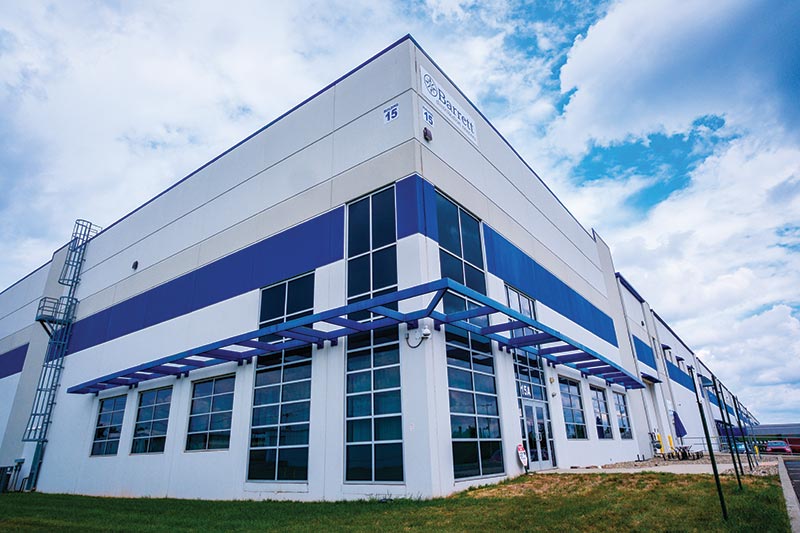
Barrett Distribution Centers’ Hillsborough, N.J., warehouse is a multi-client facility, but roughly half its space is used for Stadium Goods, which offers unique and collectible sports footwear, sold on consignment.
Inventory for Stadium Goods is received at a few dock doors (1) located near a dedicated authentication area of the building (2). These goods typically arrive floor loaded on box trucks and are manually unloaded and brought into the adjacent authentication area.
Within this area, a team of Stadium Goods employees inspects and verifies each pair of shoes or other collectible items. As part of this receiving process, a serial number is assigned to each verified item, and a serialized label is applied to the box or carton. Barrett’s warehouse management system (WMS) uses this number to track each item and generate a license plate number (LPN) bar code.
The verified cartons are inducted into a modified auto bagger system (3) located within the authentication area. The system bags each box in a protective, Stadium Goods-branded polybag, and a print-and-apply mechanism within the system places the LPN label on the outside of the bag.
Near the authentication area, there is a staging point to load the bagged cases onto carts on orderpickers. The orderpicker operators pick up the items and put them away into storage within the 34 aisles of very narrow aisle (VNA) storage (4) dedicated to Stadium Goods. This racking is selective, with the bagged cases stored with the LPN label facing the aisle. The facility also has pallet storage (5), a floor storage and processing area for seasonal products (6), as well as other storage for other clients and inventory types (7).

Since near-perfect LPN accuracy is essential for smooth fulfillment of the unique cases held for Stadium Goods, LPN monitoring and inventory counting is a high priority in the VNA racking. A drone system with AI-enabled software is regularly used to scan the racking to ensure each case is in the correct position. The order-picking process uses a batch pick methodology, driven by Barrett’s WMS. The picking is done by operators on the orderpickers, picking the bagged cases to the pick cart on these operator-up trucks.
Once a set of picks is complete, the operators drop off the goods at a staging point next to the operation’s automated, right-sized packaging system (8). Once inducted, the system creates a right-sized, corrugated shipping carton around each bagged case, weighs the carton, and applies the shipping label. During peak seasons, 12 manual pack-out stations (9) handle additional volume.
A short stretch of roller conveyor is used to move bagged cases into and out of the manual pack out stations, while a short stretch of powered conveyor connects outbound shipping cartons from the automated packaging system with the manual pack out area. The power conveyor brings the completed orders to an outbound sorting point. This is a manual sort point with a bin scan process to ensure the cartons are directed to the correct shipping dock.
There are 29 docks in total, with a few, located right near the pack-out area for Stadium Goods, used for parcel carrier pickups (10). Less-than truckload shipping for other clients is done at the docks located toward the middle of the row of dock doors, (11) while various other dock doors are used to ship goods on pallets or in containers for other clients.
The drone system also is used to scan LPNs on palletized goods held for other clients. Overall, the drone system and its software carry a two-fold benefit: much less labor time versus manual scanning and cycle counting, and friction-free order fulfillment since it ensures goods are in the correct position for order picking, which uses scan verification steps directed by the WMS.

Roberto Michel, senior editor for Modern, has covered manufacturing and supply chain management trends since 1996, mainly as a former staff editor and former contributor at Manufacturing Business Technology. He has been a contributor to Modern since 2004. He has worked on numerous show dailies, including at ProMat, the North American Material Handling Logistics show, and National Manufacturing Week. You can reach him at: [email protected].
Enjoyed this article? Add Robotics 24/7 as a preferred source in Google Search.
Edge computing gives AI agents the processing power to turn instructions into…
Daimon-TWM world model debuts for the public
Platform helps robots adapt to complex tasks
Look beyond the headlines for the latest in humanoid robots