By
Roberto Michel
October 3, 2024
SHIP8
Get news, papers, media and research delivered. Sign up for our free newsletters.
Stay up-to-date with news and resources you need to do your job. Research industry trends, compare companies and get weekly market intelligence with Robotics 24/7.
SHIP8
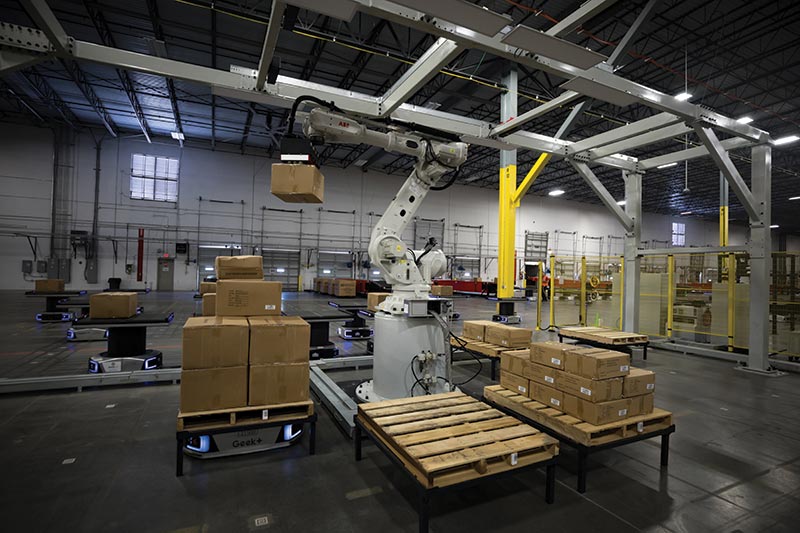
The systems at third-party logistics (3PL) provider SHIP8 INC include autonomous mobile robots (AMRs) and smart industrial robotic arms that automate pick and place tasks.
Most goods arrive as floor-loaded cartons in shipping containers. The inbound cartons are unloaded at one of 13 dock doors (1) outfitted with telescoping conveyors. Associates pick to these conveyors, and automatically move the cartons to mobile sortation AMRs, which then scoot through scan tunnel positions located on a ground-level mobile robot staging, data collection, and travel area (2) adjacent to the dock doors.
Once inbound cartons are scanned at the tunnels, they are directed to one of four industrial robot (3) work areas. Each articulating robotic arm is capable of picking and placing cartons, using vision/AI technology. Depending on fulfillment needs around the mix of inbound cartons versus outbound orders for full cartons, these robotic cells can be assigned to either build up pallets, or to pick full cartons for outbound orders onto a mobile sortation AMR.
For inbound flows where the robots build a pallet, the next step is that a larger format AMR will come along and move the pallet load to an automated strapping machine (4) to unitize it for storage.
The AMRs then bring the strapped and secured pallet loads a large four-way robotic shuttle system that occupies much of the center (5) of the automated facility. This robotic shuttle system has 27,000 storage locations, on four levels. The ground level is an open area used for staging of loads and travel by the mobile robots bringing goods into and out the shuttle, which is a type of automated storage and retrieval system (AS/RS) whose robots can move vertically or horizontally within the storage infrastructure.
The AMRs drop inbound pallet loads at transfer cart locations near the shuttle’s four vertical lifts (6). On the ground level underneath the shuttle, loads are staged for movement for upcoming picking and fulfillment workflows. Some of the loads coming out of the shuttle and allocated replenish an AMR-based shelf-to-person system for each picking, though some pallet loads retrieved from the shuttle will be moved by an AMR to one of the four robotic arms, for autonomous picking of full outbound cartons onto a mobile sorting robot.

The mobile sorting robots then move those particular cartons through print-and-apply stations located on the ground-level mobile robot processing area, and out to the correct dock for outbound loading and carrier pickup.
The ground level of the shuttle system also is where some cartons are split open and placed onto mobile rack/shelving units for the nearby shelf-to-person robotic system (7). A larger format AMR slides underneath these shelf units to transport them to one of four light-enabled picker workstations for the system, which also have flat screens and scan devices to guide and verify picking steps and accuracy.
The associates at the workstations, with hardly any walking needed, place the items picked from the racks to an adjacent row of mobile, light-enabled put walls (8). Once a mobile put wall is loaded up with a complete order or set of orders, the picker pushes a button on the wall unit, and an AMR arrives and moves the put wall a row of manual pack out stations (9). There are 19 of these stations, though during non-peak times, they are not all in use.
When packing for an order is complete at a pack out station, a mobile sortation robot comes along to pick up the finished order and bring it through an automated print-and-apply station located on the AMR processing area, and from there, to the correct shipping dock for loading and carrier pickup. At the docks, the telescoping conveyors are used to load outbound goods and parcels.
The workflows and the fulfillment processes are orchestrated with integration between SHIP8’s warehouse management system and the software for the robotic systems.

Roberto Michel, senior editor for Modern, has covered manufacturing and supply chain management trends since 1996, mainly as a former staff editor and former contributor at Manufacturing Business Technology. He has been a contributor to Modern since 2004. He has worked on numerous show dailies, including at ProMat, the North American Material Handling Logistics show, and National Manufacturing Week. You can reach him at: [email protected].
News ABB Automation Caljan Cognex Conveyors Geek+ Robotics Warehouse Management Systems
GENISOM AI makes ICRA debut at conference in Vienna
World's first omni-modal evaluation including tactile sensing for…
Ultrasonic sensing enhances robotics perception
North America’s largest automation and robotics event takes place June 22-25