By
Brian Albright
August 24, 2017
Get news, papers, media and research delivered. Sign up for our free newsletters.
Stay up-to-date with news and resources you need to do your job. Research industry trends, compare companies and get weekly market intelligence with Robotics 24/7.

As more companies explore the possibility of using metal additive manufacturing (AM) equipment to create both prototypes and production parts, the challenges of quality control and consistency with AM machines is becoming more apparent. The same part printed on the same machine at different times does not always meet the same specification.
Sizes may be slightly off, or pores or cracks may be present.
That lack of consistency is an ongoing problem, and one that the National Institute of Standards and Technology (NIST) hopes to address through a project conducted through the NIST Engineering Laboratory (EL) and Physical Measurement Laboratory (PML). The two labs are collaborating to build the Additive Manufacturing Metrology Testbed (AMMT), which is a custom-built 3D printer that will be used to help gain more understanding of how AM processes work.
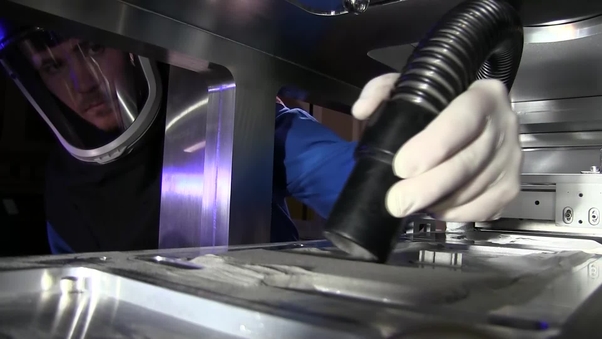
“In the additive manufacturing realm, there was already a push in industry to start incorporating sensors and monitoring systems on their machines,” said NIST’s Brandon Lane, a member of the Engineering Laboratory (EL). “So we wanted to be able to have that capability, and we also wanted a platform where we could test completely new ideas [for sensors.]”
The new testbed is the size of a small car, according to NIST. It is currently configured to print in stainless steel, cobalt chrome and nickel alloy. It is also an open platform, so researchers can have complete control over the system.
“Commercial systems are a little bit ‘black box,’” Lane said. “You can command a certain laser power and velocity, but you really don’t have control over every single microsecond of the process. With our system, we can control the speed and power of the laser at 100 kilohertz – that’s every 10 microseconds.”
The Engineering Laboratory will be responsible for running the tests; PML will supply sensors to measure the AM processes.
The testbed will measure the temperature of the melt pool by measuring brightness of light reflected off the pool during printing. Eventually NIST hopes to create a temperature map of the surface of the printed object over a wide range of light wavelengths.
The researchers are using a camera with a custom-designed achromatic lens to measure the melt pool’s brightness over a range of light wavelengths.
“But at the higher and higher temperatures, it’s the bluer light – the shorter-wavelength visible light – that matters,” said Steve Grantham of the PML. NIST will create additional diagnostics to measure those wavelengths.
Source: NIST

Brian Albright is the editorial director of Digital Engineering and a contributor to Robotics 24/7.
Enjoyed this article? Add Robotics 24/7 as a preferred source in Google Search.

Edge computing gives AI agents the processing power to turn instructions into…
Daimon-TWM world model debuts for the public
Platform helps robots adapt to complex tasks

Look beyond the headlines for the latest in humanoid robots