Nvidia
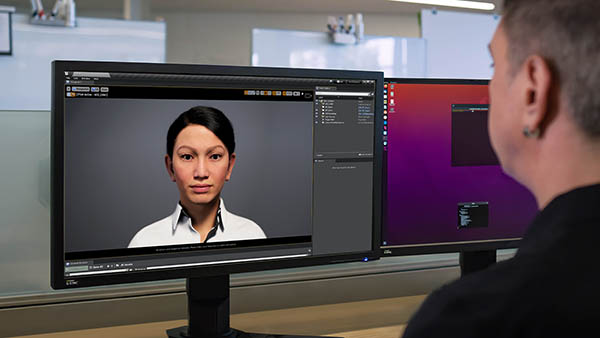
An avatar being designed for the metaverse.
Get news, papers, media and research delivered. Sign up for our free newsletters.
Stay up-to-date with news and resources you need to do your job. Research industry trends, compare companies and get weekly market intelligence with Robotics 24/7.

Nvidia
An avatar being designed for the metaverse.
NVIDIA today announced a new range of developer frameworks, tools, apps, and plugins for NVIDIA Omniverse, the platform for building and connecting metaverse worlds based on Universal Scene Description (USD).
The Santa Clara, Calif.-based company said the expansion of Omniverse includes several AI-powered tools and features that deliver artists, developers, and engineers the power to build virtual worlds and content easier than ever, and better connect to today’s leading 3D applications including PTC Creo, SideFX Houdini, Unity, and solutions from the Siemens Xcelerator platform.
Omniverse, a multi-GPU scalable computing platform for building virtual worlds, is already in use by some 700 leading companies globally to enhance architectural and product design, simplify visual effects workflows, and build digital twins of factories, cities and the planet, according to the company.
“The metaverse is a multitrillion-dollar opportunity that organizations know they can’t ignore, but many struggle to see a clear path forward for how to engage with it,” said Rev Lebaredian, vice president of Omniverse and simulation technology at NVIDIA. “NVIDIA Omniverse closes the gap between the physical and virtual worlds, and these new tools, technologies and collaborations make it possible to leap into the 3D internet today.”
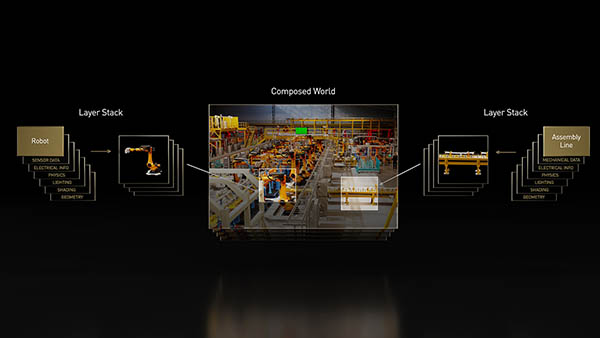
In addition to launching the NVIDIA Omniverse Avatar Cloud Engine — a suite of cloud-native AI models and services for building and deploying lifelike virtual assistants and digital humans — the company unveiled the following platform updates:
Additionally, NVIDIA Modulus, a physics machine-learning framework, is newly available as an Omniverse Extension. Delivering near-real-time performance, Modulus-trained Physics ML models are 4,000x and even 100,000x faster depending on the application, while providing accuracy closer to high-fidelity simulations. The company said. Modulus is one of the cornerstones of scientific digital twins, including NVIDIA’s Earth-2.
As part of a collaborative effort with its partners in the industrial, design, simulation and CAD software ecosystems, NVIDIA also unveiled 11 new Omniverse Connectors, which are USD-based plugins, further opening Omniverse workflows to companies in the industrial and scientific communities. These bring the total number of Connectors to the Omniverse USD ecosystem to 112.
Newly available in beta are Connectors for PTC Creo, Visual Components and SideFX Houdini. NVIDIA announced the ongoing development of Connectors for Blender, Autodesk Alias and Autodesk Civil 3D, Siemens JT, SimScale, Open Geospatial Consortium, and Unity, which will further unlock metaverse workflows for manufacturing, engineering and design companies.
NVIDIA also released major updates to the core simulation technologies that represent materials, physics, and light in metaverse worlds.
Learn more about NVIDIA Omniverse and watch the SIGGRAPH special address.
More on NVIDIA's Omniverse
GENISOM AI makes ICRA debut at conference in Vienna
World's first omni-modal evaluation including tactile sensing for…
North America’s largest robotics and automation event winds down

Automate’s largest day ever draws huge crowds to McCormick Place