Gartner: AI among top supply chain technology trends for 2026

AI-driven, hyperconnected technologies reshaping supply chains and accelerating business transformation

Gartner

By Robotics 24/7 Staff    July 3, 2026         

Gartner: AI among top supply chain technology trends for 2026

Gartner

Gartner identified its top supply chain technology trends of 2026, led by artificial intelligence.

Email Sign Up

Get news, papers, media and research delivered. Sign up for our free newsletters.

Stay up-to-date with news and resources you need to do your job. Research industry trends, compare companies and get weekly market intelligence with Robotics 24/7.
Robotics 24/7 newsletter
Gartner: AI among top supply chain technology trends for 2026

Gartner

Gartner identified its top supply chain technology trends of 2026, led by artificial intelligence.

Agentic AI and physical AI are among the top supply chain technology trends for 2026, according to new research from Gartner.

The report said that advances in AI technologies are enabling chief supply chain officers (CSCOs) to drive business value, strengthen resilience and reimagine operating models, as Gartner’s top technology trends for 2026 illustrate.

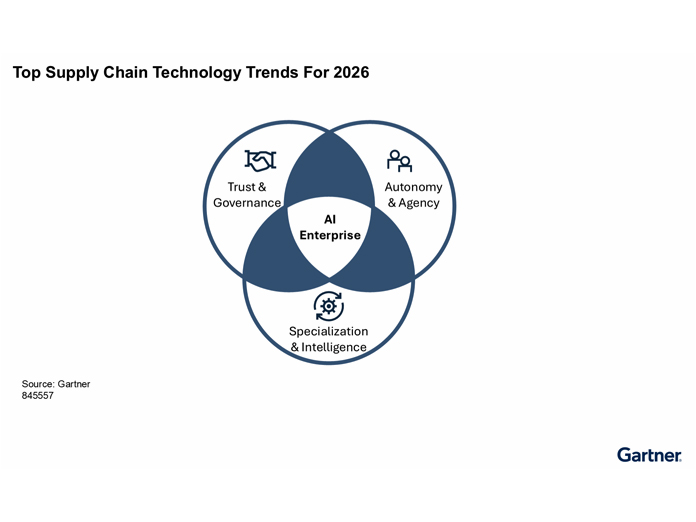
These trends are shaped by three overarching themes: autonomy and agency, specialization and intelligence, and trust and governance. Gartner said that these themes reflect a shift toward intelligent, self-directed and accountable systems that operate seamlessly across digital and physical environments.

Autonomy and agency

Gartner identified the following subtopics related to autonomy and agency:

  • Polyfunctional robots
    • Advances in AI, machine learning and robotics engineering are enabling robots to take on multiple tasks beyond their original design. These flexible systems offer a new workforce model, particularly in environments facing labor shortages, though widespread adoption will evolve.
  • Physical AI
    • Bringing AI into physical operations, this technology combines AI models with IoT sensors, robotics and automation systems to enable real-time sensing, analysis and execution across supply chain environments. It enhances operational efficiency, safety and adaptability across manufacturing, warehousing and transportation.
  • Agentic AI
    • A class of AI systems is emerging that introduces a virtual workforce of agents that move beyond insights to execution, capable of planning, acting and adapting to achieve goals in complex environments. As adoption expands, organizations must establish guardrails to ensure explainability, accountability and responsible use.
  • Collaborative management systems (CMS)
    • Extending the capabilities of individual AI agents, these systems enable multiple agents to work together across workflows and environments, each specializing in a specific task or domain. By coordinating these agents, organizations can automate complex, multistep processes and improve scalability and adaptability, while requiring strong governance to manage emerging risks.

“This year’s trends highlight the growing role of AI as the foundation for more autonomous, intelligent and adaptive supply chains,” said Christian Titze, VP analyst and chief of research in Gartner’s Supply Chain practice. “As organizations move toward hyperconnected, AI-driven environments, leaders must focus not only on deploying advanced technologies, but also on ensuring they work together to deliver measurable value and long-term resilience.”

Specialization and intelligence

Gartner identified the following subtopics related to specialization and intelligence:

  • Intelligent simulation
    • Enhancing traditional modeling approaches, intelligent simulation integrates AI, machine learning and advanced analytics into simulation models to improve predictive capabilities and decision making. It enables more dynamic planning across logistics, transportation and warehouse operations, supporting a shift toward proactive and adaptive supply chain management.
  • Domain-specific language models
    • Designed for targeted business needs, these models are trained or fine-tuned for specialized supply chain use cases, delivering greater accuracy, reliability and compliance than general-purpose AI models. They enable improved performance in areas such as knowledge management, compliance, workflow automation and decision support.

“These trends represent more than incremental improvements. They are catalysts for transforming supply chains,” Titze said. “Organizations that proactively evaluate and integrate these technologies in line with their business objectives will be better positioned to navigate disruption, scale innovation and maintain competitive advantage.”

Trust and governance

Gartner also provided the following subtopics related to trust and governance:
  • Product provenance
    • Growing demand for transparency and regulatory compliance is driving the need to trace and verify the origin and journey of products across the supply chain. Technologies such as AI, blockchain and knowledge graphs are advancing the ability to scale provenance across complex supply networks.
  • Decision governance
    • As AI adoption scales, organizations are implementing frameworks and guardrails to govern AI-enabled decision making, ensuring transparency, accountability and compliance. This approach is essential to building trust and enabling high-quality, auditable decisions across complex supply chain processes.


Latest in Compliance

Latest in Artificial Intelligence

Article Topics

Artificial Intelligence   Deep Learning   Machine Vision   Machine Learning   Components   Sensors   Cameras   Lidar   Software   Simulation   IoT   News   Press Release   Compliance   Gartner   Labor Shortage   Research   Research and Markets   Safety  

All topics

Editors' Picks

Daimon Robotics, Galbot launch RobOmni to see how tactile sensing improves robot manipulation

World's first omni-modal evaluation including tactile sensing for…

Automate 2026: Forklifts, physical AI, vision systems and more from day three in Chicago

North America’s largest robotics and automation event winds down

Automate 2026: Industrial robots, humanoids, software systems and more from day two in Chicago

Automate’s largest day ever draws huge crowds to McCormick Place