Robbyant
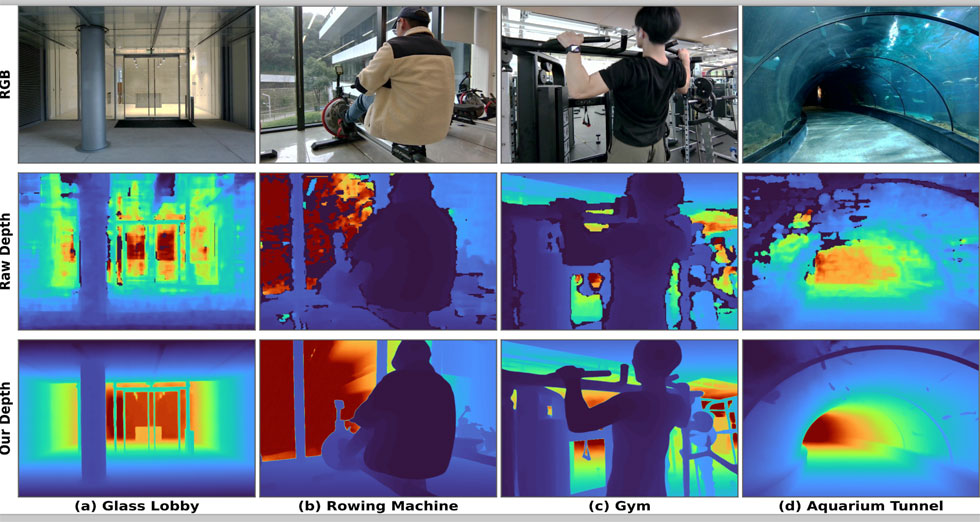
Using chip-level raw depth data from Orbbec's cameras, LingBot-Depth saw improved depth map completeness and edge sharpness in scenes with transparent and reflective surfaces.
Get news, papers, media and research delivered. Sign up for our free newsletters.
Stay up-to-date with news and resources you need to do your job. Research industry trends, compare companies and get weekly market intelligence with Robotics 24/7.
Robbyant
Using chip-level raw depth data from Orbbec's cameras, LingBot-Depth saw improved depth map completeness and edge sharpness in scenes with transparent and reflective surfaces.
Orbbec, a provider of robotics and AI vision, announced a strategic partnership with Robbyant, an embodied AI company within Ant Group, to advance spatial intelligence for robotics through the launch of LingBot-Depth, which the companies describe as a high-precision open-source spatial perception model.
Orbbec said that it provided critical depth-sensing hardware and technical support throughout LingBot-Depth’s development and testing phases. The model was jointly optimized on Orbbec’s platforms, with resulting performance validated and certified by Orbbec’s Depth Vision Laboratory.
The companies said that this collaboration demonstrates the power of coupling high-fidelity sensing hardware with advanced perception algorithms to enable robots to operate reliably in visually complex real-world environments.
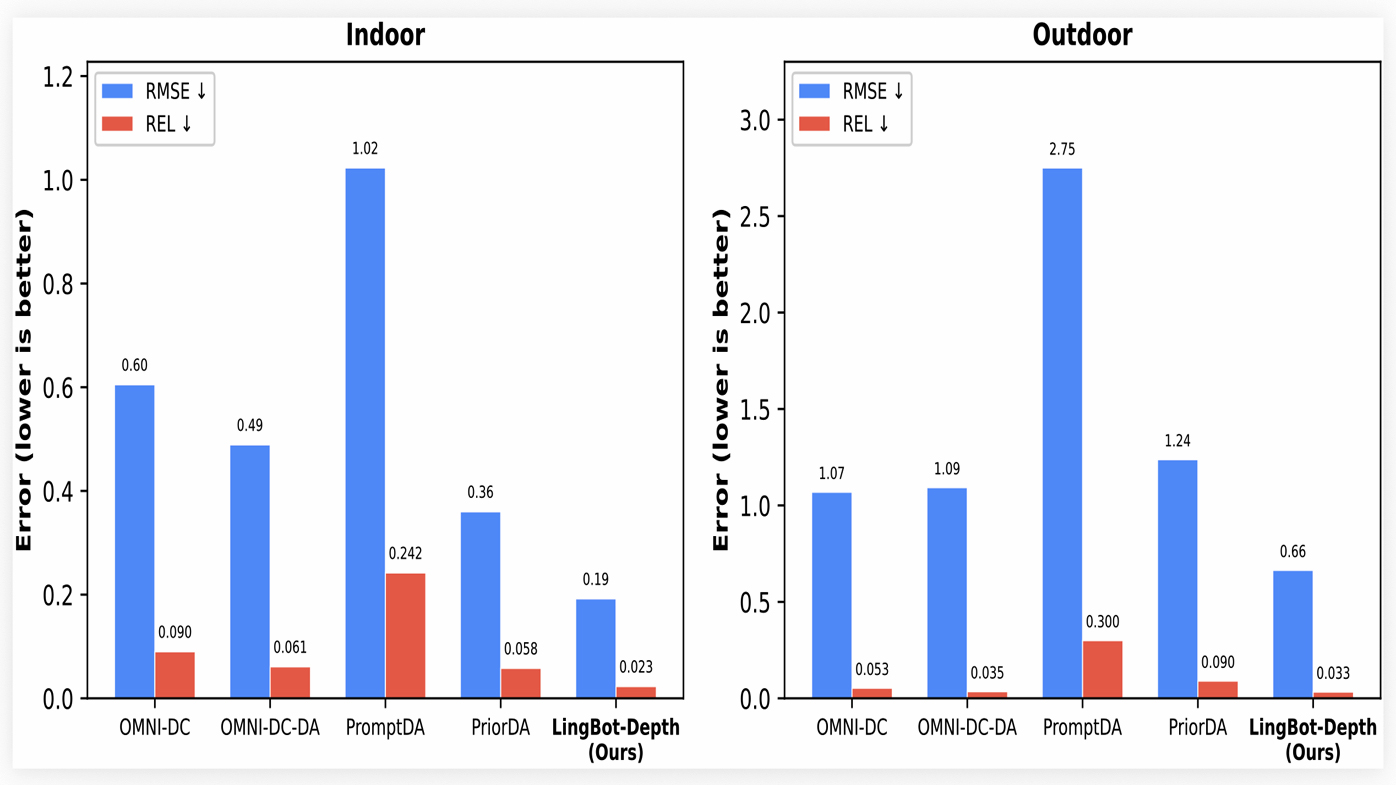
Orbbec said that in benchmark evaluations on NYUv2 and ETH3D, LingBot-Depth achieves state-of-the-art depth estimation accuracy across diverse and challenging scenarios, outperforming leading models such as PromptDA and PriorDA.
Co-optimized with Orbbec’s Gemini 330 stereo depth camera, the companies said that LingBot-Depth achieves a relative error (REL) reduction of over 70% in indoor scenes and reduces RMSE by approximately 47% on the challenging sparse Structure-from-Motion (SfM) task.
“Reliable 3D vision is critical to the advancement of embodied AI,” said Shen Yujun, CTO of Robbyant. “By open-sourcing LingBot-Depth and collaborating with hardware pioneers like Orbbec, we aim to lower the barrier to advanced spatial perception and accelerate the adoption of embodied intelligence across homes, factories, warehouses and beyond.”
The two companies have signed a strategic agreement to develop next-generation depth cameras based on the LingBot-Depth model. Through continued technical collaboration and ecosystem development, Orbbec and Robbyant aim to provide robust technological support for real-world robot deployment.
Using chip-level depth data directly from Gemini 330 cameras, LingBot-Depth intelligently reconstructs missing depth information, significantly improving robots’ perception robustness and task success rates in complex optical environments. The Gemini 330 was used throughout data collection, training, and validation, with LingBot-Depth optimized using high-quality depth data output directly by Orbbec’s depth processing engine.
“Robbyant’s work in spatial intelligence models and algorithms complements Orbbec’s expertise in 3D vision chips and robotic vision systems,” said Len Zhong, head of product management of Orbbec. “In this collaboration, the chip-level depth data provided by the Gemini 330 delivers a stable, high-fidelity, and physically grounded data foundation for the LingBot-Depth model. This is an exemplary case of close coupling between a robot’s sensing hardware and its perception intelligence.”
To learn more about this partnership, click here.
GENISOM AI makes ICRA debut at conference in Vienna
World's first omni-modal evaluation including tactile sensing for…
North America’s largest robotics and automation event winds down

Automate’s largest day ever draws huge crowds to McCormick Place