By
Donald Halsing
May 28, 2025
Unitree Robotics
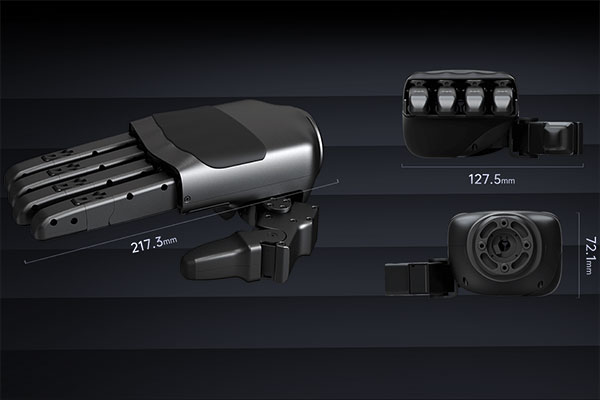
Unitree’s Dex5-1 humanoid robot hand is capable of touch sensing, proprioception, and can grasp up to eight pounds, with design features to help it grip and grasp objects.
Get news, papers, media and research delivered. Sign up for our free newsletters.
Stay up-to-date with news and resources you need to do your job. Research industry trends, compare companies and get weekly market intelligence with Robotics 24/7.
Unitree Robotics
Unitree’s Dex5-1 humanoid robot hand is capable of touch sensing, proprioception, and can grasp up to eight pounds, with design features to help it grip and grasp objects.
Chinese humanoid and quadruped robot developer Unitree recently released its Dex5-1 dexterous robotic hand.
The company said its hand has novel advanced capabilities and is poised to open up new possibilities for what tasks robotic hands can achieve as end-of-arm tooling (EOAT).
Unitree also recently released a video of its G1 humanoid robots participating in a humanoid robot combat tournament.
The Dex5-1 features 20 degrees of freedom (DoF), of which 16 are active and four are passive. The thumb has four active DoF, while each finger has three active and one passive DoF
All joints support smooth backdrivability for direct force control, along with +/- 1 millimeter fingertip repeat position accuracy. Unitree said this hand model eliminates "stiff hands," making operations smoother and more convenient for reinforcement learning (RL) training.
Each hand is capable of +/- 22 degree four-finger lateral swing. Unitree said this ability can improve grip reliability and adapt more effectively to curved surfaces when gripping and grasping objects.
The rotation axis of each finger joint is close to the surface, reducing the gap between segments. Unitree said its “micro-gap” design enables a smoother and more fluid grasp, preventing joint corners from getting stuck on objects.
All five fingers can be replaced independently.
The Dex5-1P model adds 94 force sensors to the Dex5-1 base model. These include 10 in the palm, six in each fingertip, six along each finger, and six in the root of the four fingers except the thumb.
Touch sensors in the hand can perceive between 0.35 and 88.18 ounces (10 to 2500 grams). Pressure and temperature are measured.
Unitree said the sensors support secondary development of tactile AI algorithms for dexterous hands.
The hand also features a high-power density hollow-cup motor and drive, high-precision encoder, and low damping small clearance reducer.
Power is delivered through 12 self-developed micro force-controlled composite transmission joints that enable robots to achieve tactile proprioception (knowing where their limbs are in 3D space without looking) and four micro force-controlled joint gear transmissions.
The working voltage for the hand ranges from 24 to 60 volts, and it interfaces over USB 2.0.
It delivers perceptual and control feedback including joint mode, position, velocity, torque, temperature, stiffness and damping coefficients, along with voltage, current, and inertial measurements from the imu.
The Dex5-1 measures 8.56 inches from wrist to fingertips, 5.02 inches across its palm, and it 2.84 inches thick (217.3 x 127.5 x 72.1 millimeters). It weighs 35.3 ounces (1000 grams).
With the palm facing down, the hand can grasp up to 7.7 pounds (3.5 kilograms). With the palm sideways, the hand can grasp up to 8.8 pounds (4.5 kilograms). Its minimum grip diameter is 0.39 inches (10 millimeters).
The hand can tolerate up to 44 pounds (20 kilograms) of force and fingertips offer a strength of 10 Newtons. It can operate between -4 and 140 degrees Fahrenheit (-20 to 60 degrees Celsius).

Donald Halsing is Associate editor of Robotics247.com. As an editor and journalist with a Bachelor of Arts in English from Framingham State University, he has a strong background in developing engaging and impactful stories for print and digital media. In addition to serving as Editor-in-Chief of Framingham State’s award-winning independent student newspaper, “The Gatepost,” Don spent over four years in operations at Mattress Firm, with his primary responsibilities including inventory control and inventory management. Don is currently pursuing his Master of Arts at FSU and is a professional photographer for Ashley Wall Photography
Enjoyed this article? Add Robotics 24/7 as a preferred source in Google Search.
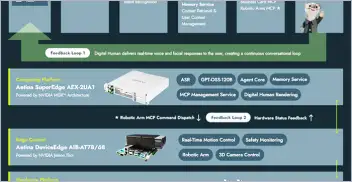
Edge computing gives AI agents the processing power to turn instructions into…
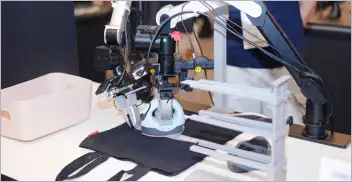
Daimon-TWM world model debuts for the public
Platform helps robots adapt to complex tasks
Look beyond the headlines for the latest in humanoid robots