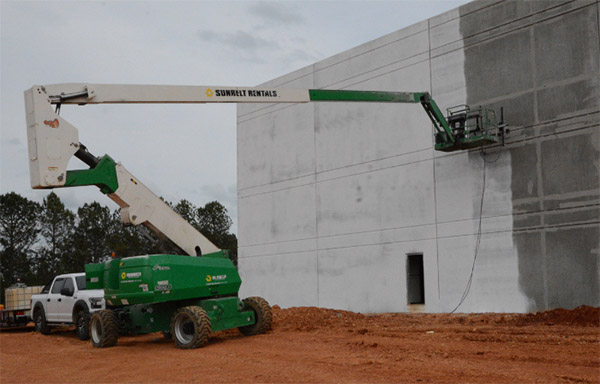
PaintJet
PaintJet uses robots and AI to improve exterior painting productivity.
Get news, papers, media and research delivered. Sign up for our free newsletters.
Stay up-to-date with news and resources you need to do your job. Research industry trends, compare companies and get weekly market intelligence with Robotics 24/7.

PaintJet
PaintJet uses robots and AI to improve exterior painting productivity.
From semiconductor fabs to electric vehicle plants, the U.S. construction space has rarely been this active. But opportunity brings challenges. And the construction workforce is being stretched thin.
This is creating a need for technology to help support construction companies and their employees, as well as developers and the communities that are struggling to keep pace with population growth and building demand.
As noted in my recent piece on industrial automation for Robotics 24/7, at Heartland Ventures, we see major technological gains coming regardless of the near-term economic outlook.
In recent history, construction advancements tend to come in the form of collaboration, project management, and financial management.
That’s all well and good, but if you talk to any contractor right now, the core challenge they’ll identify is the lack of people. As construction companies look to provide value to their stakeholders, this issue is now more pressing than the difficulties associated with design, planning, and management functions.
This is not about replacing human workers. It’s about helping the existing pool of skilled construction professionals. At Heartland Ventures, we have these conversations on a daily basis.
“The Central Indiana construction market is active with everything from battery plants to advanced laboratories producing life-changing new medicines to arenas, multi-family, animal health, industrial, and higher education facilities,” said Kevin Hunt, president and chief operating officer of Shiel Sexton, a major Midwest contractor. “This ever-expanding construction growth has exceeded the availability of the labor needed to manufacture and install the building components.”
Market leaders like Shiel Sexton have been pioneers in building for the future. And today, ambitious tech founders are jumping in to help address their labor needs. Examples of such include:
To be sure, construction brings its own set of challenges when it comes to the adoption of robotics. Safety regulations require a thoughtful approach before putting a machine on a construction site. In addition, the cost-benefit equation has to work; dependable robotics are not cheap, so the scale has to be there to justify the investment.
But it’s clear construction is now primed to embrace automation on a scale not seen before. Straights Research expects the market for construction robots to more than triple by 2030. And it is through these innovations that construction will be able to achieve greater output with less input, propelling the economy and humanity forward.
There are few ways to contribute more to society than by literally building communities. Our friends in construction have always been in the game for this reason -- and in this sense, they have always constructed our future. It’s only natural that these same frontier-pushing firms adopt the future’s technology as well.

Conor McGuinness is a partner at Heartland Ventures overseeing the firm’s Platform function. He leads engagement with LPs and Midwest industry leaders to ensure Heartland’s portfolio aligns with their strategic and financial needs.
Altrad Services Benelux said a 60-m-high scaffold was assembled two weeks faster thanks to KEWAZO's LIFTBOT.
Enjoyed this article? Add Robotics 24/7 as a preferred source in Google Search.
Edge computing gives AI agents the processing power to turn instructions into…
Daimon-TWM world model debuts for the public
Platform helps robots adapt to complex tasks
Look beyond the headlines for the latest in humanoid robots