Artificial intelligence. In popular culture, AI brings to mind images of the dystopian reality of the matrix or the docile-turned-destructive humanoids of I, Robot. But in today’s reality, AI is gaining traction for less sinister reasons.
The real-world application of AI is, predictably, more practical. Businesses can think of AI as a great enabler, capable of automating processes that have long been targets for automation but presented too much complexity for contemporary technology.
For example, past technology could successfully automate repetitive, predictable processes in manufacturing but struggled to be effective with the variety of workflows and items found in e-commerce distribution centers.
By contrast, AI can provide visual perception to identify and classify individual items without explicit programming. AI can be used to tackle problems of path planning, dexterity and grasp by learning based on previous pick attempts or by supervised learning. This combination enables robotics to handle highly variable work, such as singulating various parcels for downstream automation or picking items for individual e-commerce orders.
Fill out the information below to download this resource
Learn how machine learning will unlock new, more complex tasks for automation.
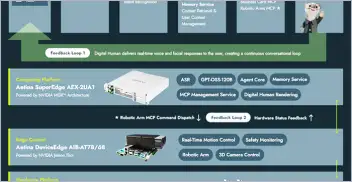
Edge computing gives AI agents the processing power to turn instructions into…
Daimon-TWM world model debuts for the public
Platform helps robots adapt to complex tasks
Look beyond the headlines for the latest in humanoid robots