By
DE Editors
October 10, 2019
Get news, papers, media and research delivered. Sign up for our free newsletters.
Stay up-to-date with news and resources you need to do your job. Research industry trends, compare companies and get weekly market intelligence with Robotics 24/7.
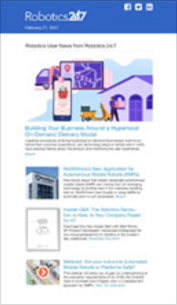
NVision Inc., in cooperation with the Nasher Sculpture Center in Dallas, is making it possible for those with vision impairment to interactively engage with some of the known works by modern sculptors. NVision, a developer of 3D non-contact optical scanning/measurement solutions for more than 29 years, recently scanned several sculptures by Auguste Rodin (perhaps best-known for his sculpture, The Thinker) and Julio González for the Nasher. The scanning data was used to 3D-print to-scale replicas of the sculptures for a tactile educational experience for the blind and visually impaired.
“Who has not been tempted to touch an artwork by a master like Rodin? These scans make that wish possible for everyone to experience,” says Lynda Wilbur, manager of Tour Programs at the Nasher. “It is particularly meaningful when visually enjoying the lines, textures and emotive qualities of a work is not possible due to blindness. These scans of works by significant artists of the 20th century allow our public a rare, hands-on experience.”
Located in the heart of the Dallas Arts District, the Nasher is home to a fine art collection of modern and contemporary sculptures , the Raymond and Patsy Nasher Collection, featuring more than 300 masterpieces by Calder, de Kooning, Matisse, Picasso, Rodin, Serra and more. In keeping with its goal of fostering the study and appreciation of modern and contemporary sculpture, the Nasher selected three sculptures to be scanned and printed for a joint workshop with the Dallas Lighthouse for the Blind, an organization dedicated to improving the quality of life for those who are blind or visually impaired.
The three works—Auguste Rodin’s Hanako and Head of Balzac, and Julio González’s Mask: Reclining Head—were selected for several reasons: all are in the public domain so copyright issues are not applicable, the heads are well-suited for a portraiture study, and the sculptures are not overly articulated, which would make it difficult to scan and print them successfully.
The Nasher chose NVision (Southlake, TX) to do the scanning after noting the positive reviews it received from previous clients as well as its extensive experience, including work done on behalf of other museums. NVision has a long-term commitment to helping the arts; previous projects include scanning—for preservation and later reproduction—the works of sculptor Somers Randolph and Balloon Flower, a sculpture by Jeff Koons, currently located in a small park in front of World Trade Center 7 in New York City.
NVision technicians performed the scanning in the Nasher’s Conservation and Art Storage facilities using the company’s HandHeld laser scanner to collect data on the sculptures’ unique geometries; their complex shapes, contours, and surface details. Given the delicate nature of the sculptures, the Nasher had professional handlers move the artworks to and from the scanning table.
The HandHeld scanner is a portable scanning device capable of capturing 3D geometry from objects of almost any size or shape. The scanner is attached to a mechanical arm that moves about the object, freeing the user to capture data rapidly with resolution and accuracy. As a part is inspected, the scanner generates a point cloud consisting of millions points each with x,y,z coordinates and i,j,k vectors. Integrated software that comes with the scanner is used to convert the point cloud to an STL polygon and an optional tripod provides complete portability in the field. Intuitive software allows real-time rendering, full model editing, polygon reduction and data output to all standard 3D packages.
After NVision completed the three scans, company President Steve Kersen offered to scan a fourth work at no additional cost.
“NVision was already giving us a special rate for three works, so scanning an additional fourth piece was quite generous,” says Anna Smith, curator of Education at the center. As its fourth work to be scanned, the Nasher chose Raymond Duchamp-Villon’s Baudelaire (1911), a plaster bust of 19th century French poet Charles Baudelaire. The scanning process for all four sculptures was done in 2-1/2 hours.
After converting the sculptures’ point clouds to a raw STL file, NVision imported the file into specialized modeling software and then processed the data to an IGES/STEP model, from which CAD models were created. The models were then 3D printed in time for the workshop session.
“The people from NVision were positive and communicated well with us throughout the process,” says Wilbur. “It was extraordinary to learn about the scanning technology. The printed sculptures turned out amazing.”
Kersen believes that 3D non-contact scanning offers opportunities for preserving and replicating priceless sculptures without compromising or degrading the original works. “As our work with the Nasher has shown, the result is often greater visibility for the artist’s work through more extensive displays,” he says.
Additional uses for the replicas are already in the works. The education department plans to use them in workshops that focus on portraiture and with the general public when the original works are on view.
“New ways of using these resources are still being discovered, but we have enjoyed seeing the impact they have made with the vision-impaired members of our community,” says Wilbur.
Sources: Press materials received from the company and additional information gleaned from the company’s website.

DE's editors contribute news and new product announcements to Digital Engineering 24/7 and the Robotics 24/7 sites. Press releases may be sent to them via [email protected].
Enjoyed this article? Add Robotics 24/7 as a preferred source in Google Search.
Edge computing gives AI agents the processing power to turn instructions into…
Daimon-TWM world model debuts for the public
Platform helps robots adapt to complex tasks
Look beyond the headlines for the latest in humanoid robots