AMD
AMD made several announcements at Advancing AI 2026 in San Francisco, which the company said places it at the forefront of physical AI, providing the real-time compute leadership that is powering the next wave of robotics, industrial automation and autonomous systems.
Get news, papers, media and research delivered. Sign up for our free newsletters.
Stay up-to-date with news and resources you need to do your job. Research industry trends, compare companies and get weekly market intelligence with Robotics 24/7.
AMD
AMD made several announcements at Advancing AI 2026 in San Francisco, which the company said places it at the forefront of physical AI, providing the real-time compute leadership that is powering the next wave of robotics, industrial automation and autonomous systems.
At Advancing AI, Advanced Micro Devices’ (AMD) annual flagship event in San Francisco, the high-performance and AI computing technology provider made a slew of announcements.
Specifically, related to further advancing the power of physical AI, the company announced:
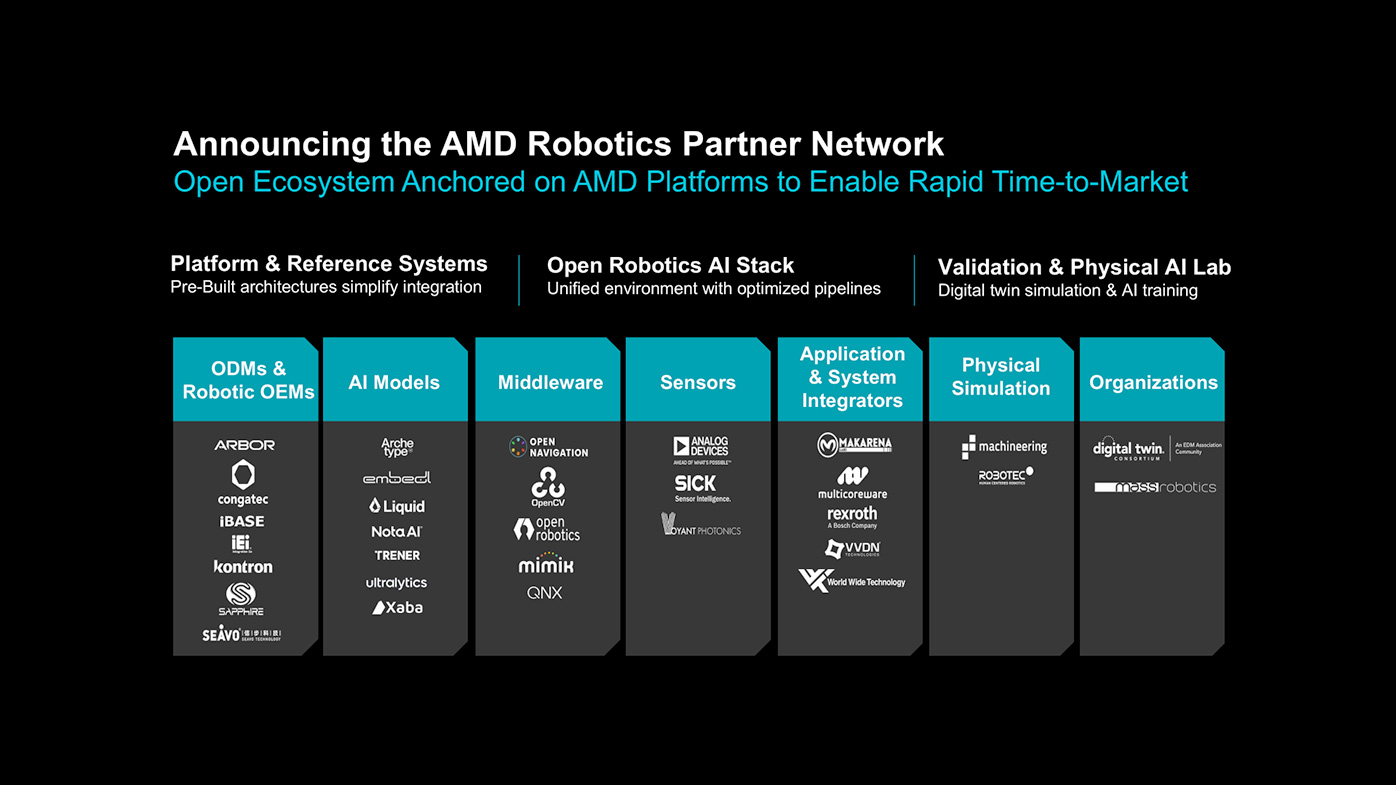
The company said that the AMD Robotics Partner Network brings together a broad ecosystem of validated hardware and software partners to accelerate the development and deployment of robotics and physical AI systems powered by AMD platforms. AMD said that the program connects original design manufacturers (ODMs), independent software vendors (ISVs), simulation providers, sensor and perception companies, safety and benchmarking partners, and system integrators through common AMD hardware and a software foundation built on open standards.
“No single company will build the future of physical AI. Building robots requires bringing together AI models, middleware, sensors, simulation tools, system integrators and production hardware,” said Amey Deosthali, senior director of industrial, robotics and healthcare, Embedded, AMD. “Too often, those pieces come from disconnected vendors with little validation between them. With the AMD Robotics Partner Network, we are extending the AMD open ecosystem approach into robotics to help reduce integration efforts, shorten development cycles and allow roboticists to move from reference platform to production systems with greater flexibility, portability and confidence.”
AMD said that the partner network brings together ODMs and AI model partners to provide reference platforms and systems for rapid integration, while middleware, sensor, robotics technologies and integration partners deliver optimized robotics software and pipelines.
As part of the trio of announcements at AAI 2026, AMD announced the AMD Ryzen AI Embedded X100 Series processors, which it said deliver leadership performance for the demands of physical AI.
The company said that the new processors are designed to accelerate perception, reasoning and real-time control workloads, integrating up to 16 high-performance AMD “Zen 5” CPU cores, a discrete-class integrated GPU and a power-efficient NPU on a single embedded SoC.
AMD said that The Ryzen AI Embedded X100 Series is optimized for physical AI applications such as robotics, industrial automation, healthcare, aerospace and defense, and other intelligent real-time embedded systems.
“The Ryzen AI Embedded X100 Series marks an exciting new chapter for physical AI, unlocking opportunities across a broad range of intelligent, real-time embedded applications,” said Kirk Saban, corporate vice president of product, software and solutions, AMD Embedded. “By delivering leadership CPU, GPU and NPU performance, combined with embedded-specific features, an open software ecosystem and industrial-grade reliability, AMD Ryzen AI Embedded X100 Series simplifies development and helps customers bring increasingly capable next-generation autonomous systems to market faster.”
The company said that the new Ryzen AI Embedded X100 Series processors are expected in the fourth quarter of 2026.
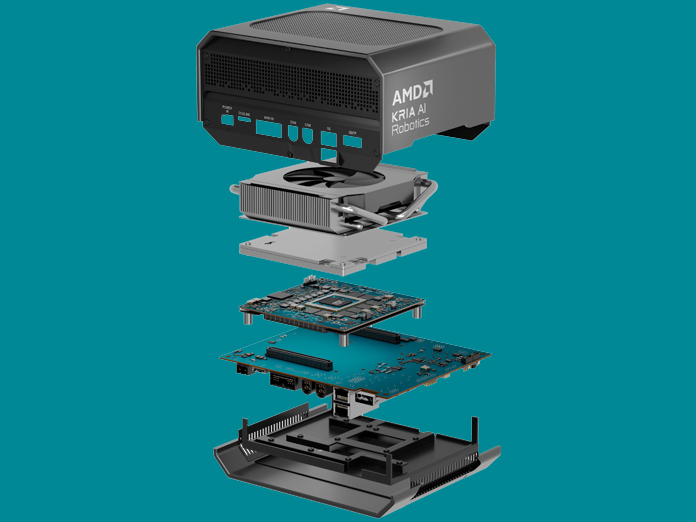
Also at the San Francisco event, AMD introduced AMD Kria AI Solutions, which it said is designed to help developers and customers prototype, build and rapidly deploy next-generation autonomous robotics and physical AI systems.
The company said that the portfolio includes AMD Kria AI system-on-modules (SOMs) and robotics carrier card - powered by AMD Ryzen AI Embedded X100 Series processors - and the AMD Kria AI Robotics Developer Platform.
AMD said that the platform is the first open, turnkey integrated offering for autonomous robotics, combining heterogeneous CPU, GPU, NPU and FPGA compute. The company said that it extends AMD robotics capabilities from the robot body to the robot brain, bringing AI perception, reasoning and agentic decision-making and control together on a single platform optimized for stringent power, thermal and latency requirements.
“For decades, AMD adaptive computing technologies have powered the sensing, safety and real-time control systems at the heart of industrial and surgical robots,” said Salil Raje, senior vice president and general manager, AMD Embedded. “Today, we're extending that leadership from the robot body to the robot brain with the AMD Kria AI SOM and Robotics Developer Platform and we’re enabling customers to build more intelligent physical AI systems, bringing AI perception, reasoning, agentic decision-making and control together on the first open, turnkey integrated platform for autonomous robotics. Built on open standards and an open software ecosystem, the platform gives customers the flexibility to choose the models, frameworks and technologies that best fit their applications while reducing the complexity of moving from development to production.”
AMD said that the Kria AI SOMs, powered by the Ryzen AI Embedded X100 Series processors, are expected to be available from ODM partners starting in the fourth quarter of 2026. The Kria AI Robotics Developer Platform is sampling with early access customers and is expected to be generally available in the fourth quarter of 2026.
Enjoyed this article? Add Robotics 24/7 as a preferred source in Google Search.
Edge computing gives AI agents the processing power to turn instructions into…
Daimon-TWM world model debuts for the public
Platform helps robots adapt to complex tasks

Look beyond the headlines for the latest in humanoid robots