Amazon
Amazon launched the Physical AI Toolchain on AWS, an open-source stack that helps manufacturers build machines that perceive, reason and act in the real world.
Get news, papers, media and research delivered. Sign up for our free newsletters.
Stay up-to-date with news and resources you need to do your job. Research industry trends, compare companies and get weekly market intelligence with Robotics 24/7.

Amazon
Amazon launched the Physical AI Toolchain on AWS, an open-source stack that helps manufacturers build machines that perceive, reason and act in the real world.
Amazon announced the launch of the Physical AI Toolchain on AWS, an open-source platform that brings together architecture guidance, deployment automation and ready-to-use code.
Integrated with the NVIDIA Physical AI stack, Amazon said that it covers the complete physical AI development lifecycle.
Amazon said that the next wave of AI is moving beyond the screen and into the physical world, onto factory floors, into warehouses and on roads. Because physical AI is one of the fastest-growing frontiers in technology, Amazon said that the companies building it need infrastructure that can keep up.
Unlike traditional AI, which processes data and generates text on screens, Amazon said that physical AI enables machines to perceive, understand and act in the real world. Where conventional machines follow fixed instructions and repeat the same task regardless of what's happening around them, Amazon said that physically intelligent machines sense their environment, reason using cloud-trained AI models, and adapt in real time. Operational data flows back to continuously retrain and improve those models, so the machines get smarter with every cycle.
But physical AI is not a single problem with a single solution. The use cases range from machines that work alongside people on production lines to humanoid robots and systems that inspect, move and manage materials on their own. No two require the same combination of data, models, or hardware.
"Physical AI is going to touch every industry that moves, builds, or makes things, and our customers are moving fast to capture that opportunity,” said Uwem Ukpong, vice president, AWS Industries. “We built the Physical AI Toolchain on AWS because customers told us that too much of their engineering effort was going to infrastructure instead of innovation. We want to flip that."
Amazon said that these applications span nearly every industry where machines interact with the physical world, and the momentum is building. According to the recent Global Startup Trends Report on physical AI, one in seven startups globally is now building physical AI, with 72% of builders saying cloud computing is essential to their systems. Amazon said that this activity is part of a broader wave of physical AI development happening across industries, and a growing number of companies are building on AWS.
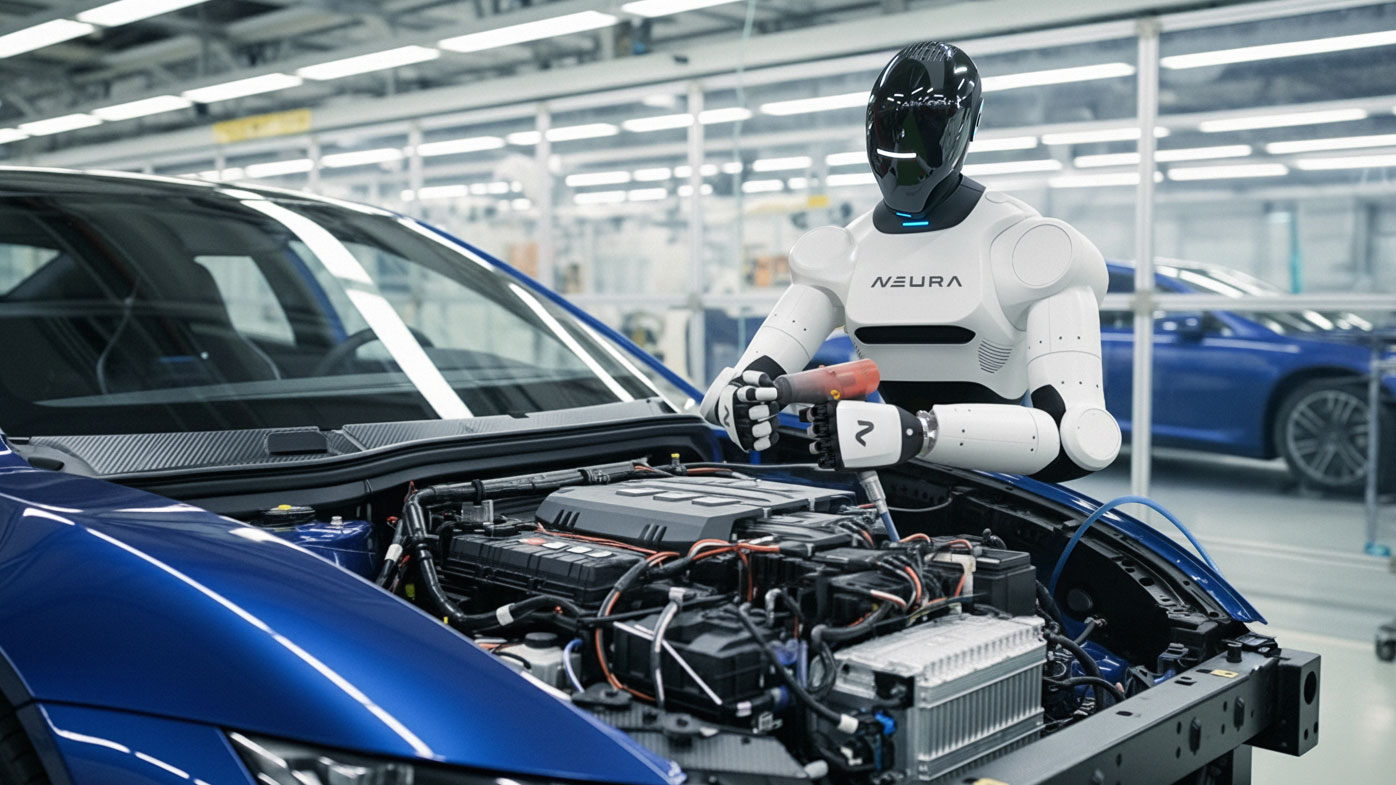
Amazon said that NEURA Robotics is developing cognitive humanoid robots that can see, hear and learn from experience, to bring millions of intelligent robots to market by 2030.
RLWRLD is tackling one of the hardest problems in physical AI - dexterous manipulation - building an 8.1-billion-parameter foundation model that gives robotic hands the ability to grasp, rotate, and handle objects with human-like precision across factory and service environments.
Config has built a data pipeline capturing more than 200,000 hours of robot action data. The company uses generative AI to multiply that data into the diverse training scenarios machines need to operate reliably in unpredictable real-world conditions.
“In Physical AI, speed is everything: how fast you can fine-tune models, deploy them into the real world and scale from individual systems to large fleets,” said David Reger, founder and CEO of NEURA Robotics. “The Physical AI Toolchain on AWS helps us accelerate exactly that cycle. By combining NEURA’s Physical AI stack with AWS’s experience in large-scale infrastructure and deployment, we can move much faster from learning to real-world deployment and ultimately scale Physical AI globally.”
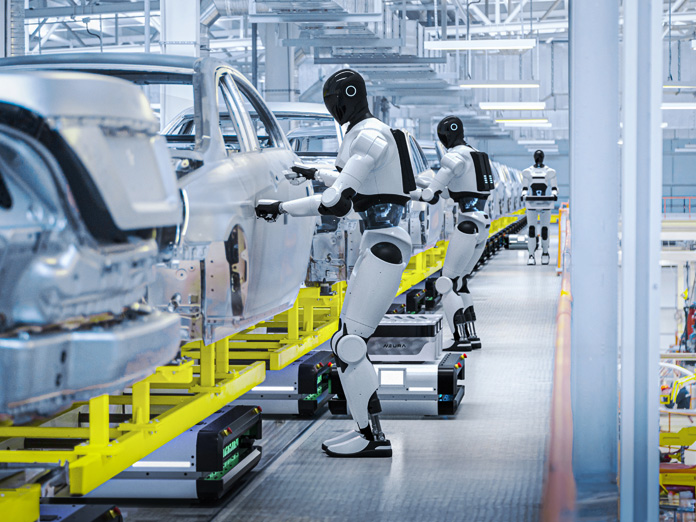
Amazon said that industrial equipment manufacturers can use physical AI to build collaborative robot arms that adapt to new assembly tasks without reprogramming. Companies developing autonomous robots can train them to handle new parts and tasks with increasing precision. Automakers can accelerate development of in-vehicle and in-plant robotics capabilities. And smart factory operators can deploy systems that monitor, predict, and optimize production in real time.
By deploying physical AI within their own operations, using intelligent machines and autonomous systems, Amazon said that manufacturers can increase throughput, reduce downtime, and improve quality on their factory floors. On top of that, Amazon added that each machine generates operational data that improves the models powering the entire fleet, so the hundredth deployment is dramatically smarter than the first. Some companies can embed that same intelligence into the products they sell, turning fixed-capability hardware into machines that get smarter over time.
Amazon said that the toolchain spans five core pillars of physical AI development. Each feeds the next, creating a continuous improvement cycle that accelerates model quality with every iteration:
Powering these capabilities is a combination of AWS services and NVIDIA's physical AI software ecosystem, including:
Amazon said that customers can adopt the full end-to-end stack to manage the entire development cycle from a single control plane, or select only the components they need, such as standalone simulation, training or deployment tools that integrate into their existing workflows. The company added that fleet management capabilities allow them to provision, secure, and update thousands of machines over the air as they scale to production.
“Building physical AI requires a seamless integration of three computing platforms - training, simulation and deployment,” said Amit Goel, Head of Robotics Developer Ecosystem and Edge AI Product at NVIDIA. “The open-source Physical AI Toolchain on AWS brings together AWS services with NVIDIA’s physical AI models, tools, and libraries to provide a scalable, end-to-end workflow that helps developers accelerate the creation, training, validation, and deployment of intelligent robotics applications.”
Amazon said that it has built one of the world's most advanced robotics operations, deploying over one million robots across its operations network. The company said that those robots handle millions of packages daily, working alongside hundreds of thousands of employees to deliver for customers. Earlier this summer, Amazon Robotics unveiled its next-generation autonomous Proteus robot, capable of operating anywhere items need to be moved across sites.
The company said that this experience has given Amazon deep insight into what it takes to build machines that operate autonomously in real-world environments. Amazon said that the Physical AI Toolchain on AWS is built with expert guidance inspired by those learnings, providing architecture guidance, reference code and deployment automation that help manufacturers launch their own physical AI capabilities in weeks rather than the years it would take starting from scratch. Each deployment can be easily tailored to the customer's specific hardware, operational environment, and use case.
Amazon said that the Physical AI Toolchain on AWS provides the proven foundation, and customers bring the domain expertise and hardware that make their products unique.
Artificial Intelligence Deep Learning Machine Vision Machine Learning Industrial Automation Collaborative Robots Robot Arm Software Cloud and Edge Fleet Management Simulation News Press Release Amazon Robotics Assembly Cobots Deployment Humanoid Inspection NEURA Robotics NVIDIA Physical AI Test
Enjoyed this article? Add Robotics 24/7 as a preferred source in Google Search.
Edge computing gives AI agents the processing power to turn instructions into…
Daimon-TWM world model debuts for the public
Platform helps robots adapt to complex tasks
Look beyond the headlines for the latest in humanoid robots