Antioch
Antioch raised $8.5M that the company said it will use to bring “software-speed” to physical autonomy development.
Get news, papers, media and research delivered. Sign up for our free newsletters.
Stay up-to-date with news and resources you need to do your job. Research industry trends, compare companies and get weekly market intelligence with Robotics 24/7.
Antioch
Antioch raised $8.5M that the company said it will use to bring “software-speed” to physical autonomy development.
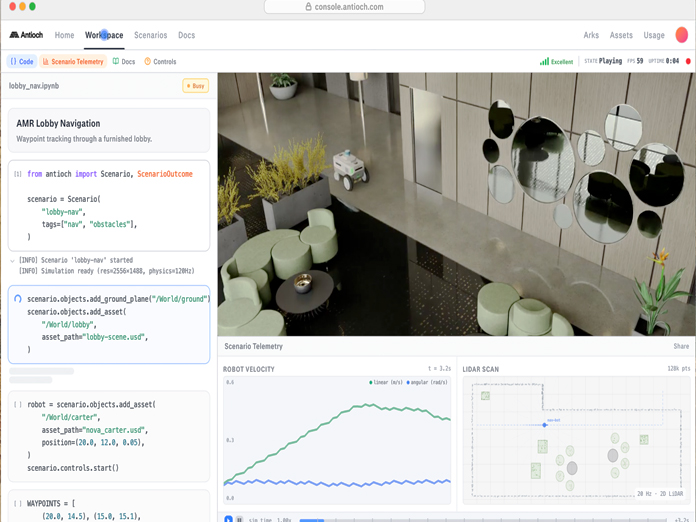
Cloud simulation platform for robotics and autonomy Antioch announced that it has raised $8.5 million to move development and evaluation of autonomous systems out of the physical world and into simulation.
The company said that the funding round was led by A* and Category Ventures, with other investors including MaC Venture Capital, Abstract, Box Group, Icehouse Ventures, and angel investors including Shyam Sankar (CTO, Palantir) and Adrian Macneil (CEO, Foxglove).
Antioch was founded in May 2025. Three of Antioch's five co-founders, Harry Mellsop, Alex Langshur and Michael Calvey, previously founded Transpose, a security and intelligence platform acquired by Chainalysis in 2023. Transpose grew to serve major US intelligence agencies, law enforcement and financial institutions.
The founding team also includes Colton Swingle, previously at Google DeepMind, and Collin Schlager, previously at Meta Reality Labs. The company is headquartered in New York.
"Robotics teams are spending weeks staging warehouses and investing millions into test facilities to validate their systems," Mellsop said. "Meanwhile, companies like Tesla, Waymo and Anduril spend hundreds of millions a year on simulation infrastructure to minimize exactly that. We believe every autonomy team should have access to that level of tooling."
The company said that it eliminates the need for real hardware and physical testing in the development and evaluation process of autonomous systems. Antioch added that validating a robot's behavior in the real world today typically means renting physical space, manually staging environments and resetting hardware between every run. The company said that it's expensive, slow and covers only a fraction of the scenarios a system will face in production.
Antioch said that its pitch is that the simulation ecosystem has matured to the point where this is now possible. Physics and rendering engines from companies like NVIDIA provide increasingly powerful simulation primitives, and generative techniques like world models from World Labs and others are making it cheaper to synthesize realistic environments at scale.
But, Antioch said that the landscape is moving fast, with new tools, models and providers emerging constantly. For most robotics companies, just staying current is a full-time job, even before composing these disparate tools into a usable workflow.
Antioch said that it positions itself as the platform layer that connects autonomy teams to this wave of innovation, while shielding them from churn and fragmentation.
"Over the last 40 years, America's manufacturing advantage has been systematically eroded by offshoring," Langshur said. "The only economically viable path to reindustrialization runs through robotics and automation, and scalable testing is the rate-limiting step."
To learn more about Antioch’s platform and its seed funding round, click here.
GENISOM AI makes ICRA debut at conference in Vienna
World's first omni-modal evaluation including tactile sensing for…

Ultrasonic sensing enhances robotics perception
Cybernetix Ventures’ event kicks off Robotics Tech Week 2026 slate of events