ChatGPT
The varying degrees of warehouse automation in the grocery segment has generated two versions of the dark store.
Get news, papers, media and research delivered. Sign up for our free newsletters.
Stay up-to-date with news and resources you need to do your job. Research industry trends, compare companies and get weekly market intelligence with Robotics 24/7.

ChatGPT
The varying degrees of warehouse automation in the grocery segment has generated two versions of the dark store.
The dark store is the fastest-growing footprint in fulfilment, and most of the industry is still arguing about how big it will get. I believe that is the wrong question. The market size is not in doubt; what it costs to automate the box is. And on that question, I believe that the evidence has just turned decisive.
In November 2025, the most committed grocery automation program in the United States wrote off $2.6 billion. In the same window, one of the largest dark-store networks on Earth is proving it can scale profitably with almost no fixed automation at all. Two markets, opposite bets, and a lesson each is about to teach the other.
This is the analysis the forecasts skip, and it is the one buyers and technology providers actually need.
The term dark store now covers two different businesses that happen to share a name. In the West, it grew out of grocery, a mechanized room bolted onto a supermarket to serve online orders.
In India and in much of Asia, it grew out of quick commerce, a sparse room of shelves and human pickers built to move a small basket to a doorstep in ten minutes. These two lineages made opposite wagers on automation, and the distance between those wagers is the entire story. One spent heavy capital to remove labor. The other spent flexible labor to avoid capital. Both are now arriving at the same question from opposite directions, and only one of them has already paid to learn the answer.
The Western grocery model was sold on arithmetic that looked unanswerable. A human picks roughly 150 units an hour; automation promised several times that, and on paper a four-fold pick rate reads as a labor saving near 75%. That number justified the capital, and it did not survive contact with an operating floor.
What the business case left out was everything around the pick.
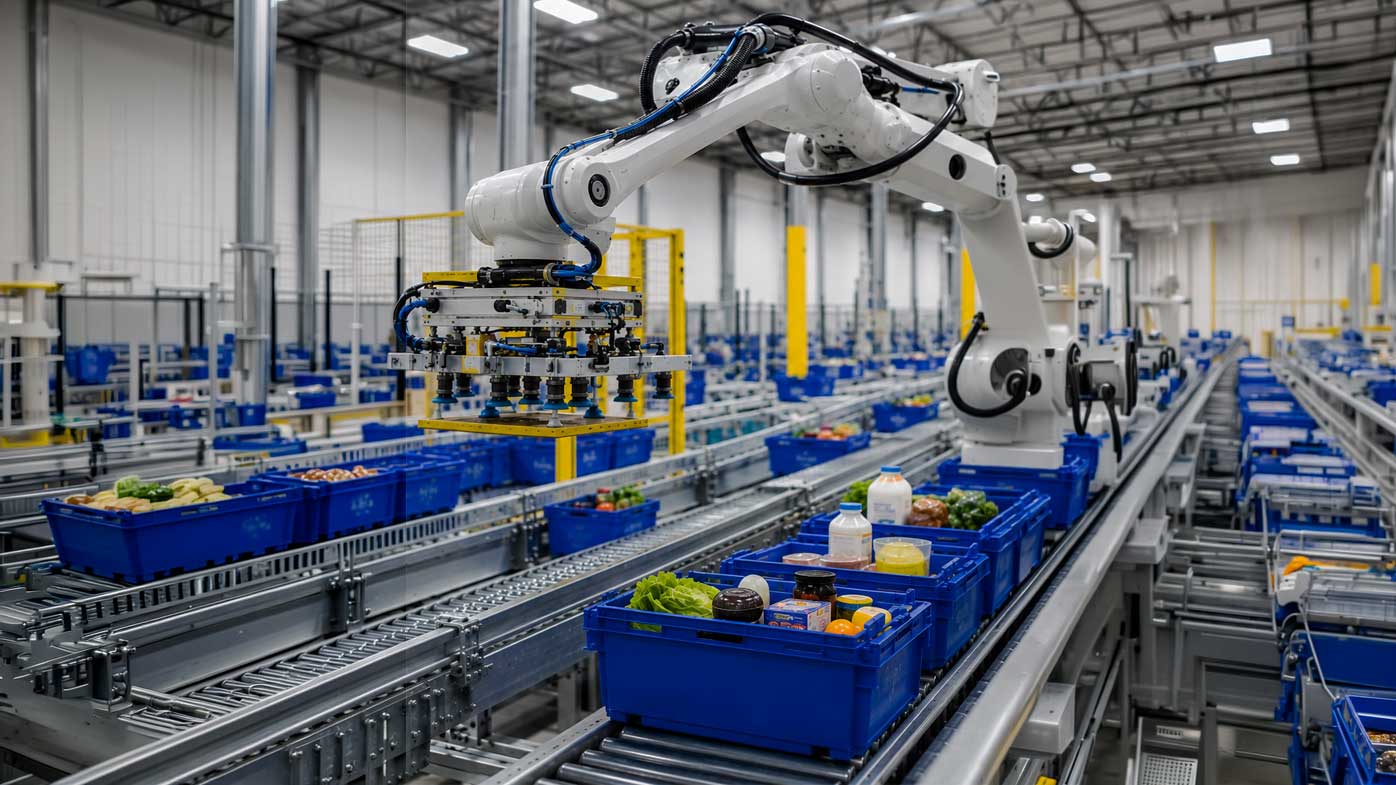
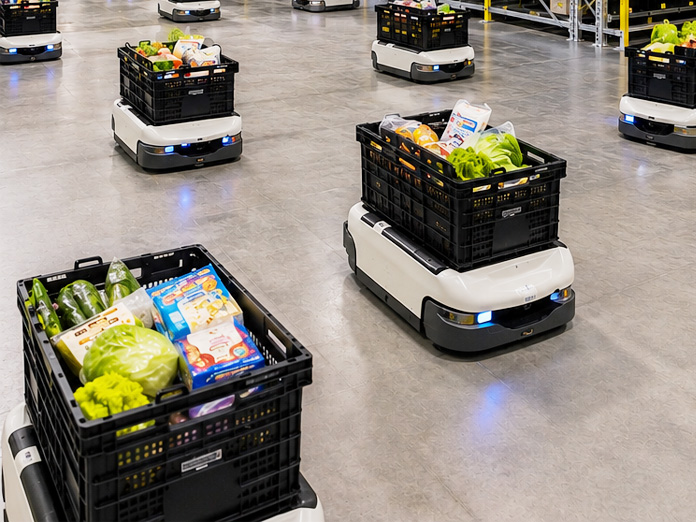
Replenishing the automated grid proved slow and labor-heavy. Consolidation, the step where machine-picked items meet the goods still gathered by hand, became the bottleneck that dragged real throughput below what the equipment could theoretically hit. Peak-hour surges, exactly when the delivery promise is tightest, were exactly when the system was most likely to stall.
Then, the most committed operator in the market stopped pretending. A grocer that had partnered in 2018 to build as many as 20 automated fulfilment centers spent early 2025 studying the network site by site and, in November, acted on it: three automated centers closed, a planned facility cancelled, roughly 350 million dollars paid to its automation partner in compensation, and a $2.6 billion impairment booked in a single quarter.
I don’t believe that this was a verdict saying that the technology was worthless. Instead, it resulted in the more damaging finding that the cost per order stayed too high after the automation worked. The machine did its job, and the economics still would not close. The same grocer posted five straight quarters of double-digit e-commerce growth while making these cuts. Demand was never the problem. The fixed cost of serving it through heavy automation was.
India ran the same experiment in reverse. Its quick-commerce operators built one of the largest dark-store networks on earth with almost no fixed automation, crossing six thousand dark stores by the end of 2025 in a market worth nearly $11.5 billion and still growing above 75% year on year.
Where the grocer spent capital to remove labor, the quick-commerce operator spent labor to avoid capital, betting that cheap, flexible, close-at-hand picking would beat any fixed system in a footprint this small and this volatile. In a market where the same ten-minute model bankrupted well-funded European players, the bet has held. Only just, and only for the leaders.
That bet is now meeting its limit, and the reason is the single most important fact in this category: the economics are decided per store, not per network.
Recent teardown analysis from QKS Group found roughly 3,600 of the top 3,800 big-city stores profitable while smaller-city stores are bleeding cash. On a hundred-Rupee order, delivery can take 40-50 and store operations another 20-25, leaving a thin sliver for product cost and margin combined. When most of every order is spent before the product is even counted, the only routes to profit are a bigger basket or a cheaper pick, and the second of those is an automation question. The strain is already visible in the metric that matters most: independent tracking this year showed on-time delivery at one major player sliding from 84 to 76% in eight weeks. Speed is the moat, and the moat is eroding under the very density the model depends on.
Both dark store histories converge on one physical fact. Warehouse automation was built to optimize scale, measuring throughput in absolute terms and amortizing capital over a forgiving horizon. The dark store removes those assumptions.
In a few thousand square feet serving small baskets at high frequency against a delivery clock, the binding constraint is not absolute throughput but throughput density, and the capital question is not how much a system moves but how much of it can move again when the site does.
This is why the industry's favorite distinction, between a fleet of mobile robots and a fixed storage-and-retrieval grid, quietly stops being useful here.
In a large building, the two run as separate subsystems a buyer can shop between. The dark store is not big enough to run them apart. They either collapse into a single coordinated mechanism or they do not fit.
When the physical boundary between movement and storage dissolves, so does the evaluation boundary, and coordination stops being the layer that ties the architecture together. It becomes the architecture. It is also precisely what broke the first history, because replenishment and consolidation are coordination failures, not hardware ones. The large building hides weak orchestration behind spare capacity. The dark store is built to punish it.
Conventional automation economics assume a stable site: the building stands, the volumes hold and a multi-year payback is safe. The dark store violates that at the root, and both histories prove it from opposite directions.
The Western grocer closed automated centers that could not hit their demand-density thresholds; the Asian operator already runs a network where a large share of stores never reaches profitability and must be relocated or shut. In neither world does the site reliably outlive the equipment.
The automation that wins here will be judged less on peak throughput than on redeployability: how much of the investment survives a site move, and how fast a configuration stands up and comes down. The providers who understand this are not selling the ability to move more boxes.
They are selling the ability to be wrong about a location without being ruined by it.
For the operator weighing automation in a small-format network, the discipline is to read the first history as a warning about sequence. Heavy automation was committed before per-order economics could carry it. The counter-move is to prove a site profitable on flexible labor first, then introduce automation only where density is high enough and stable enough to survive a payback shorter than the site's own life expectancy.
The order of evaluation is the whole game:
A dark store judged on big-box criteria will over-invest in the wrong virtues and discover the mismatch only after the fit-out is paid for.
For the technology provider, the dark store is not a market to be served with a shrunk-down edition of an existing product. It is the most honest test environment in this field. The room is too small to hide behind mechanical horsepower, too fast to hide behind average-case performance and too volatile to hide behind a payback spreadsheet.
Whatever a system genuinely does well, the dark store makes visible; whatever it merely claims, the dark store finds out. The sharpest positioning available right now is not a faster robot. It is a credible answer to redeployability and coordination density, because that is the ground on which the next decade of these deals will actually be won.
For everyone else reading the category, my view is that the takeaway is a lens, not a number. The dark store is not one emerging market with a large forecast attached. It is two convergent experiments in the same physics, one that automated too early and paid for it, one that has not automated yet and is about to decide how.
The interesting question was never how big it becomes. It is which history teaches the other first, and whether the systems on offer are built for the small, fast, disposable box the dark store actually is, rather than the large, stable one the industry keeps pretending to design for.
The operators who see it that way are already building for it. The language we use to judge them has not caught up. That gap is exactly where advantage is hiding.
About the author: Kumar Anand is an Associate Director & Principal Industry Analyst at QKS Group. With extensive experience in logistics, procurement, inventory management, sustainability and digital transformation, Kumar collaborates with leading organizations to enhance operational efficiency and resilience across their supply chains. As Principal Industry Analyst, Kumar leads research projects focused on supply chain management, specializing in the integration of emerging technologies such as AMRs, navigating technologies, and multi-enterprise supply chain business networks. Kumar holds an MBA in Operations and Supply Chain, with a career that spans impactful roles in supply chain consulting and market research.
Artificial Intelligence Machine Learning Autonomy Mobile Robots Industrial Automation Collaborative Robots Robot Arm Software Data Management Fleet Management News Other Research Asia Ecommerce Europe Fulfillment Grocery Grocery Industry India Investment Research and Markets Stock Replenishment
Enjoyed this article? Add Robotics 24/7 as a preferred source in Google Search.

Colette Kress, current EVP and CFO of NVIDIA named interim CEO

China's Office of the Working Mechanism for Foreign Investment Security…

President Trump orders a review of robotics imports over national security…
Platform helps robots adapt to complex tasks